Thursday, May 11, 2006

Regime, Judges, and Public: Take Five

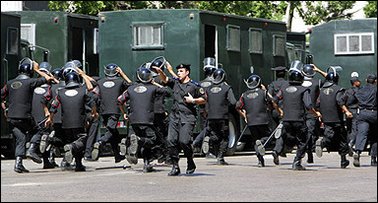
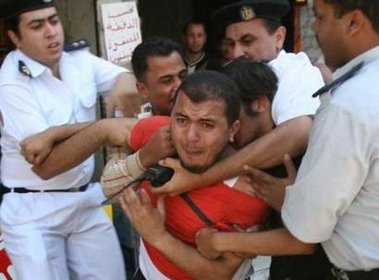
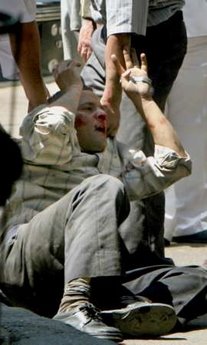
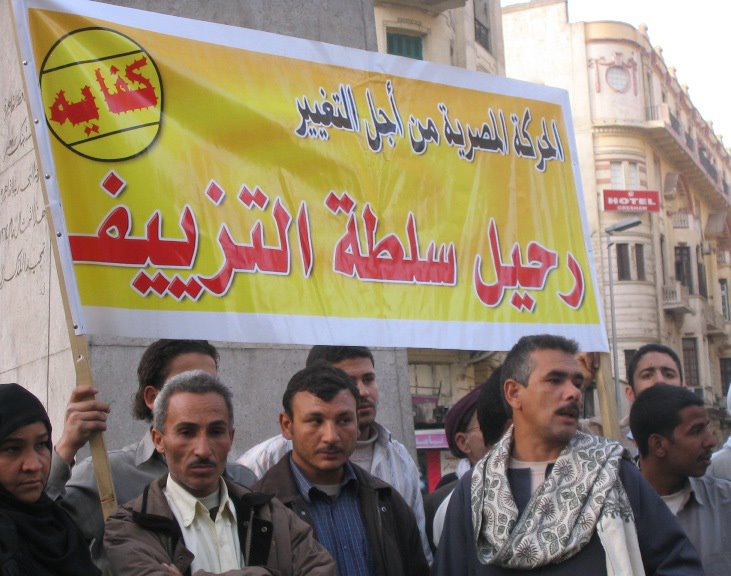
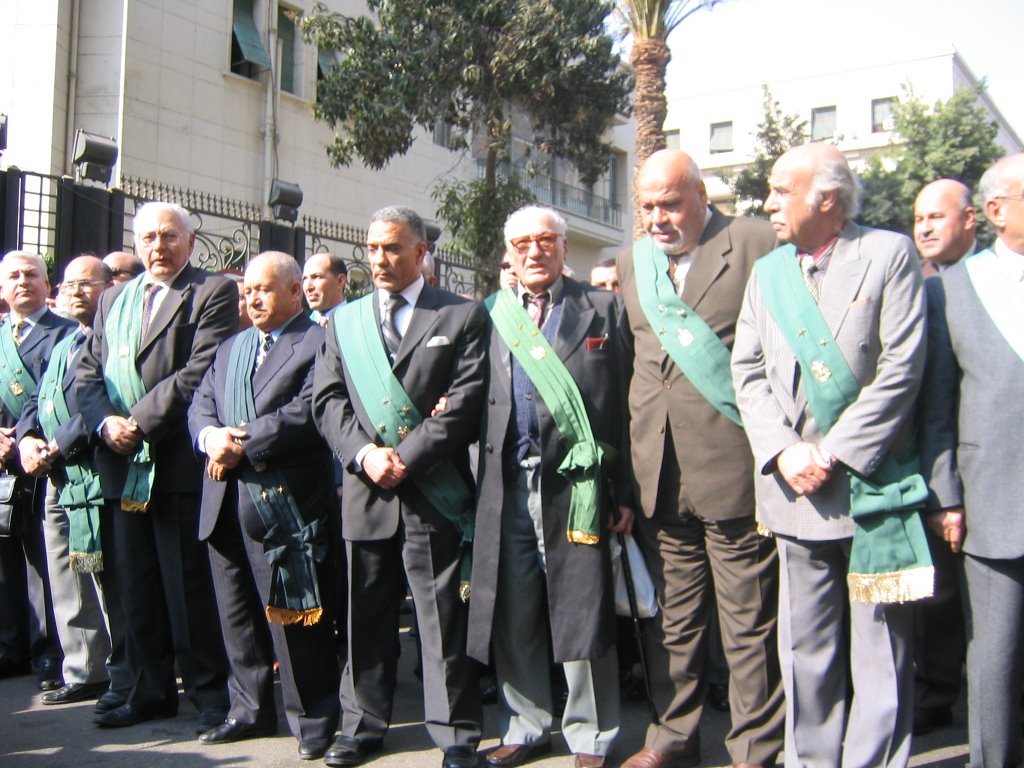
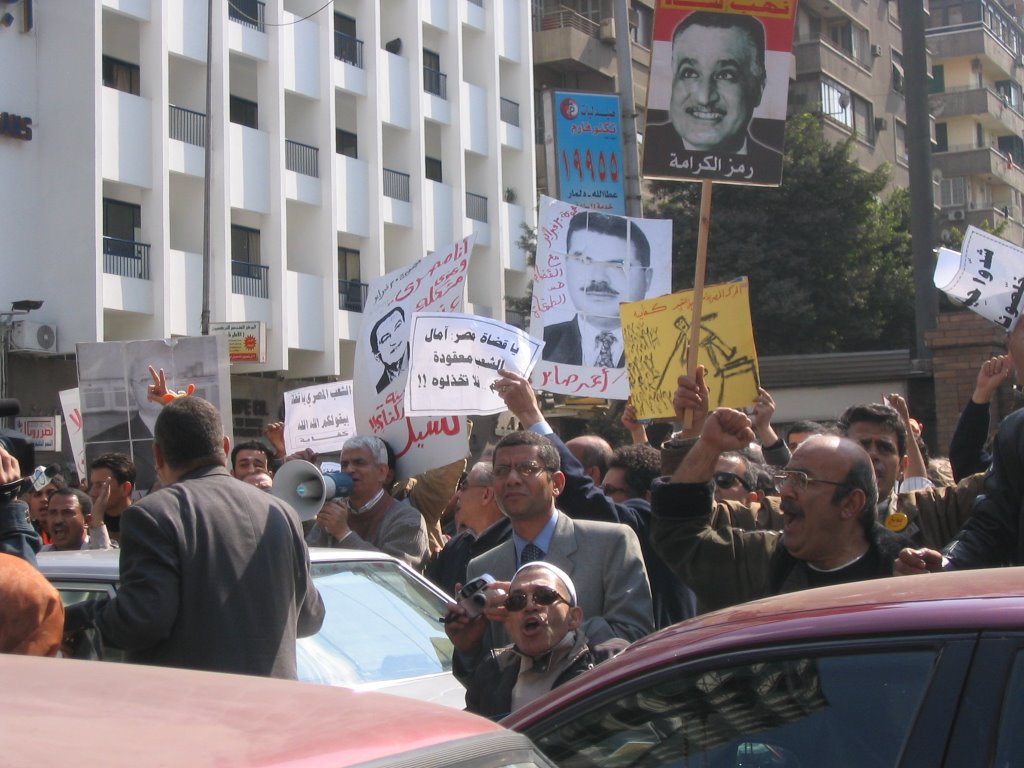
“The streets of downtown looked as if a foreign country had declared war on Egypt,” quipped a judge. Indeed, Thursday 11 May was even more brutal than Thursday, 27 April, as security forces deployed maximum and indiscriminate force to sunder the growing bonds between judges and public.

While the head of state was busy surveying Pharaonic artefacts in Berlin, security forces in Cairo were busy quashing peaceful demonstrators showing their support for judges.


Journalists were not exempt from police brutality; al-Jazeera’s camera and sound crew and Associated Press reporter Nadia Abou El-Magd were roughed up by both uniformed and plainclothes police agents.


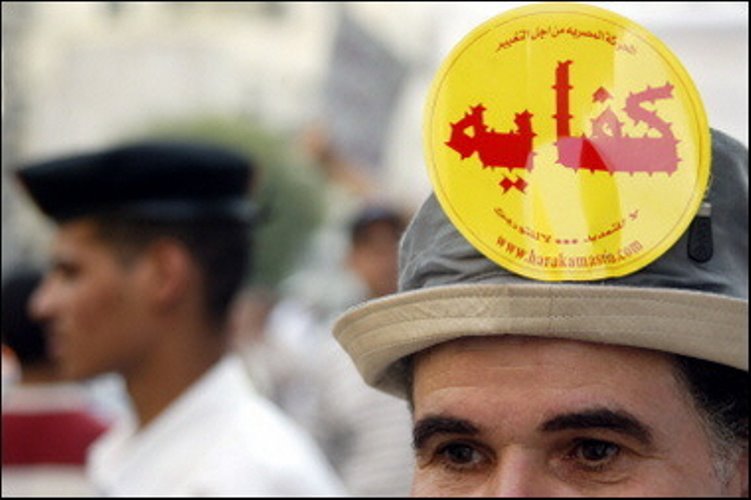
And as per usual in the last few years, police officers did not exempt women from their violence. Kifaya has this harrowing account of what happened to al-Destour journalist Abir al-‘Askari, no stranger to police terror. She was one of the many women assaulted on referendum day, 25 May 2005.

Lives were lost yesterday. On its way to reinforce the already overwhelming security presence in downtown Cairo, a truck carrying CSF recruits overturned on 6 October bridge at Abbasiyya, killing 8-10 conscripts (reports vary) and injuring 20.

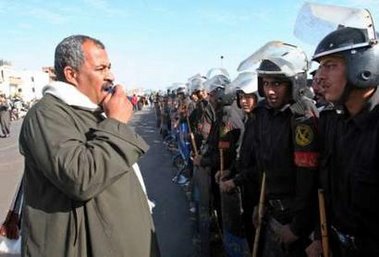
Unlike 27 April, security forces occupied the inside of the High Court building and obstructed even workaday judges from reaching their courtrooms to adjudicate among ordinary litigants. On the orders of disciplinary tribunal head and Cassation Court president Fathi Khalifa, none but the two accused judges and seven members of their defence team were allowed entry into the courthouse. As Cassation Court justice and head of the defence committee Hossam al-Ghiryani went inside to negotiate with Khalifa, about 400 judges attending with accused judges Mekky and Bastawisi waited outside, rigorously separated from members of the public by elaborate phalanxes of CSF recruits.

Khalifa refused to budge and the judges refused to comply. The hearing was adjourned yet again to 18 May. Judges returned to their Club for further deliberation, which culminated in a resolution to continue the weeks-long sit-in that has so perturbed the Mubarak regime. Two proposals were also floated: boycotting the hearing on 18 May until Fathi Khalifa recuses himself from the disciplinary board, and a more compromise proposal to attend but only under the condition that security forces evacuate from the courthouse.

What is happening in Egypt today has caught the men of the regime off guard. They never anticipated the resolve of judges to follow through on their mission of ensuring clean elections. They never anticipated the persistence and depth of popular support for the judges. And they never imagined that indiscriminate and brute force would only reinforce the resolve of both judges and activist segments of the public. Most of all, they never thought that election-time mobilisation would continue well after elections were over.

Sometimes, it is the simple but fatal mistake of miscalculation that is the undoing of the high and mighty.


*Photos from AP, Reuters, AFP.

Wednesday, May 10, 2006

مدد

Yet another significant day dawns, as judges Mahmoud Mekky and Hisham al-Bastawisy prepare to reappear before the disciplinary board entrusted with reviewing their “competence” to hold their judicial posts. They may very well be dismissed, censured, or the hearing adjourned yet again.

There’s also the slight possibility that the ministerial order referring them to the board will be voided, in exchange for judges disbanding their weeks-long sit-in at the Judges Club. A farrago of government emissaries to the Club and to disciplinary board president Fathi Khalifa have been attempting to broker just such a deal, but it appears that all negotiations have reached an impasse.

Meanwhile, in what may very well be a first, sitting Egyptians judges have penned an opinion piece in a major foreign newspaper. Mekky and Bastawisi wrote this article in the British Guardian outlining their views, thus considerably widening the audience for this remarkable drama. Particularly notable are the two judges’ firm avowals of self-reliance in their battle for autonomy. As is to be expected, powerful third parties are now intensely interested in what used to be the marginal and rarefied affair of Egyptian judicial independence, viz. American and European governments. I read Mekky and Bastawisi’s concluding statement as a clear signal that they will have no truck with attempts to appropriate their struggle by those who have their own agendas: “In Egypt we don’t have any confidence in US policy because it is a contradictory policy that pays lip service to democracy while supporting dictatorships. We have confidence in the Egyptian people. We welcome support from any quarter, but we won’t rely on it. We will depend on ourselves in our campaign for reform and change.”

Organised elements of the Egyptian public continue to declare their solidarity with judges. There are now some 100 activists of all political persuasions being detained for their unceasing support of the judges, among them three women activists (Nada al-Qassas, Asma’ Ali, Rasha ‘Azab), feisty bloggers-demonstrators Alaa Abdel Fattah, Malek Mustafa, and Muhammad al-Sharqawi, veteran demonstrator Kamal Khalil, journalists Ibrahim al-Sahari and Saher Gad, and some 50 members of the Muslim Brothers.

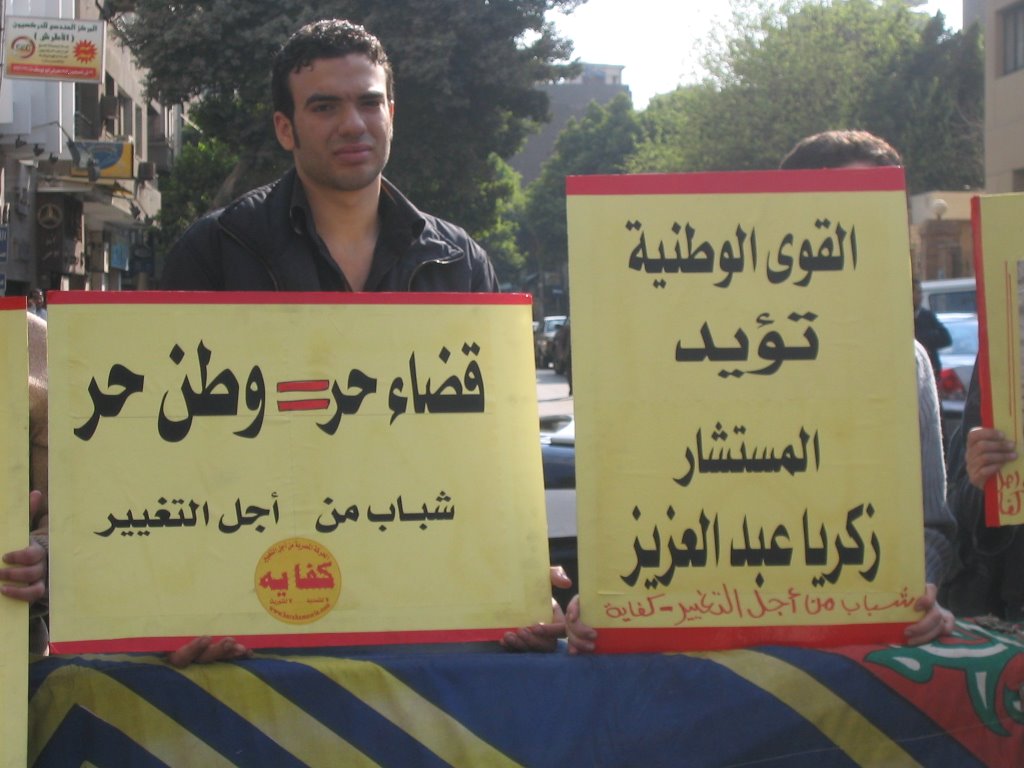
A medley of “Egyptian National Forces” have signed a short statement calling for the release of all detainees and reaffirming solidarity with judges. The signatories are Kifaya, the Nasserist Party, the Communist Party, Freedom Now, the Muslim Brothers, the 9 March movement for university’s independence, Writers and Artists for Change, The Street is Ours, Journalists for Change, the Egyptian Socialist Party, the Tagammu’ Party, the Socialist People’s Party, the Labour Party, the Ghad Party, the Karama Party, Youth for Change, the Revolutionary Socialists Organisation, the Pharmacists’ and Physicians Syndicates.

The date and time: 11 May, 10 am

The place: High Court building

The slogan: Yes to judicial independence, no to tyranny and to the state of emergency, long live the Egyptian national movement.

*AP Photo, April 27, 2006.

Monday, May 01, 2006

Mubarak: Fin du Régime?

Forecasts of a fin de siècle fill the air, alternately breathless and reasoned. They point to the swiftly cascading natural and man-made disasters, terrorist bombings, political movement (hirak siyasi), recurring sectarian conflict, and economic malaise, all mingling in a portentous brew. Murmurs abound that Mubarak’s regime is in its final throes, that delaying local elections, swiftly renewing emergency law, and repeatedly cracking down on protest are signs of the beginning of the end. Predictably, current events are compared to the combustible final years of Anwar al-Sadat’s tenure, when the tussle between an increasingly irrational president and an angry, organised society ended so abruptly, violently, and dramatically.

There is an equally compelling though less ambient view that such predictions are facile and rather foolish. How can anyone really predict anything as complex as regime change? And even if change occurs, there’s no way to determine precisely why it happened, leaving the field wide open for every disingenuous two-bit pundit to retrospectively pronounce that he/she guessed it all along. Above all, there’s no inevitable connection between one or a few social crises and a fin du régime. Regimes have imploded in the absence of major crises or societal discontent, and regimes have survived despite multiplying crises and intense discontent. Hosni Mubarak’s regime has been dogged by crises and intensifying street protest since at least 2000, yet it totters on.


Déja Vù

I remember the same feeling of an untenable status quo on the verge of explosion. It was in spring 2003. As the American invasion of Iraq was imminent, the government speedily secured the renewal of emergency law. Massive anti-war protests then shook the country, and biting anti-Mubarak slogans electrified the streets. Security forces viciously beat protestors and threatened the women among them with rape; two opposition parliamentarians were savagely attacked by hired thugs; Hosni Mubarak’s obscenely huge visage was torn off the NDP headquarters, and Gamal Mubarak “led” a hastily organised government anti-war protest in Cairo stadium, flanked by the bankrupt and sycophantic Adel Imam and the erstwhile powerbroker Kamal al-Shazli (those were the good old days, Kimo. How cruel are the times).

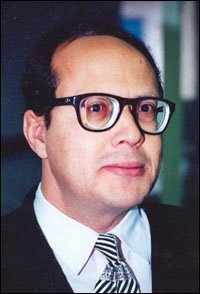
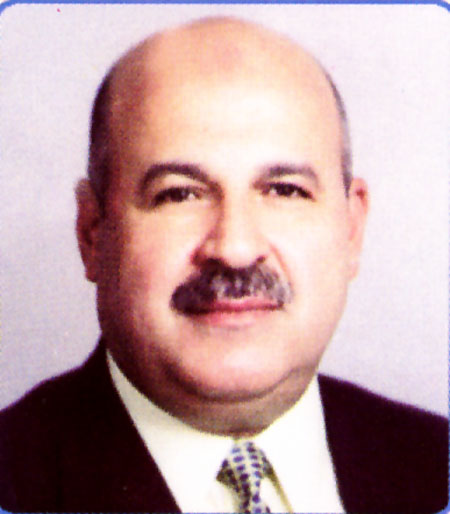
Back then, Abdel Halim Qandil (right) and Abdellah al-Sennawi took turns savaging the regime, and with considerable rhetorical force, too. It was difficult to resist their weekly forecasts of impending doom, of a spent regime devoid of any ounce of legitimacy, stupidly hastening its own ignominious demise. When several presidential emissaries failed to tame the intrepid duo, Qandil was plucked from his Cairo street in the dead of night and stuffed into a speeding car by four massive individuals in suits. They savagely beat him, demanded that he stop writing about “the big people,” stripped him of all his clothes, and left him to die on a deserted highway on that frigid November night. Of course, this only widened his popularity and fortified his resolve, earning him the respect he deserves. As for Sennawi, he continues to tirelessly deliver weekly auguries of regime downfall, apparently untroubled by plenty of evidence to the contrary.


Old but Sturdy?


If Mubarak and his retinue survived the upheavals of 2003, which were arguably the gravest challenge to their rule, then why shouldn’t they be able to muddle through the current difficulties? The regime is still intact, internal fissures exist but are manageable, and there have been no spectacular defections of any key pro-regime figures or blocs. The ministers are all siphoning off our public funds and tying up traffic as usual, governors are slavishly doing their jobs as glorified security personnel, and NDP independents are kept in line and are only really troublesome during elections.

The ballyhooed “reformists” surrounding Gamal Mubarak are busy walking their delicate tightrope of just the right amount of loyalty coupled with a healthy helping of, shall we say….flexibility. The hubbub manufactured by the unctuous Osama Ghazali Harb a few months back was an amusing but essentially harmless little sideshow. Much as he clambered to claw his way into the inner circle, Harb was never more than a pathetic, marginal hanger-on, perpetually pleading and grovelling at the gates, only to be unceremoniously rebuffed every time. So he finally grew tired and embarked on his latest project of reinvention. Mr Harb is apparently contemplating founding a “liberal” political party with other “respectable” social personages.


As the truly great Stefan Rosti (centre) used to say, “diabolical!” (gahannami!).

If the commanding heights of repressive rule are holding together, so seem to be the nuts and bolts. The enforcers of repression continue to follow orders and to smash dissidents. Everyone from governors to security directors at the top to police chiefs, officers, and simple recruits at the bottom are doing their bit (if not more) to run the coercion machine. If anything, it seems as if the new Cairo security chief, Ismail al-Shaer, is even more ruthless than his predecessor Nabil al-Ezabi, who’s moved on to greener pastures. For his efforts in policing the numerous contentious episodes of 2005, Ezabi has been rewarded with a big, fat governorship (mabrouk ya siyadat al-liwa).

For the regime to end, state security personnel must splinter and some then join the reform movement, even if secretly à la Ukraine. At the very least, a critical mass must shirk their duties and withhold their cooperation. Everyone was excited by the 1986 CSF mutiny precisely because it seemed as if the agents of repression were turning on their masters, at a time when other social forces (particularly labour) were also rebelling. But the formidable capacities of the Egyptian state effectively contained that brief upsurge, and draconian new control mechanisms were instated to prevent any second acts. If the sinews of state control remain intact and loyal to the regime, it’s difficult to imagine how the latter can be dislodged.

Much has been made of the security forces’ crushing of protestors over the past few days, and at least one person has written that the culture of police brutality and impunity is itself a portent of impending chaos. However, aside from the one incident of the police beating of judge Mahmoud Hamza on 24 April, recent police brutality is nothing new. Has some invisible threshold been crossed?

What of the most inscrutable institution in Egyptian politics? There’s a lot of talk about what the military will and won’t do in X, Y, or Z event, but frankly, I don’t know how anyone can credibly claim to know anything about the potential behaviour of this institution. I don’t care how many “Western diplomats” are anonymously quoted in foreign news accounts pontificating on this matter. Nor how many informal conversations were had with “top-ranking generals” while strolling on the beach at Marina (or is it Ain al-Sukhna?). Or any of the other laughable gossip and tall tales that enliven the cocktail party functions of the foreign and local blathering classes. Some Nasserists seem to think that the valiant military will step in at just the right moment to prevent a handover of power to Gamal or to save Egypt from other nightmarish prospects. I beg to differ. If this logic holds, the military would have stepped in a long long time ago, mesh keda walla eih?

The most intriguing thesis I’ve heard (and wish I could claim credit for) is that the military no longer acts as a coherent, corporate entity. Since the Abu Ghazala affair, Hosni Mubarak has ironically presided over the comprehensive depoliticisation of the Egyptian military. Although he does not explicitly make this argument, the most astute and respected scholar of Egyptian organisations had this suggestive yet still crucial information to share on current military practices, facts that have gone strangely undiscussed. Anyone who claims that the military can still act as the final arbiter and guardian of the republic must contend with both severe lack of information and internal organisational practices that suggest quite the opposite.


The End Draws Nigh?


If there are very good reasons to doubt forecasts of imminent regime demise, there are equally good reasons not to uncritically accept assertions of regime “stability.” After all, no serious observer can dismiss the significant, perhaps seismic shifts over the past few years in how the regime interacts with its domestic and international interlocutors. A regime that was able to effectively quell a militant Islamist insurgency from 1992-1997 now seems unable to manage peaceful voters, peaceful judges, and peaceful street demonstrations.

A regime that convinced the country and the world that it was waging a brutal but necessary campaign to rid Egypt of terrorism now cannot muster a single convincing explanation for any of its increasingly irrational and often hysterical actions. In September 1999, Hosni Mubarak began his fourth term with only the faintest murmurs of elite opposition, confined to closed rooms and abstruse constitutional conversations at that.

In September 2005, Hosni Mubarak was being pilloried and humiliated in public and private just as he was putting himself up for "election" (AP Photo, September 10, 2005).

The signs of decay are numerous and multiplying all around us, but in my opinion, two in particular stand out as indices of a potential cataclysmic upheaval. First is the extent to which Hosni Mubarak and especially his family have become the target of popular hatred, biting ridicule, or mild distaste (depending on who you talk to). There is no disaster, policy decision, or daily inconvenience that is not popularly believed to originate at the doorstep of the presidential residence. Whether it’s the series of tunnels and overpasses near Heliopolis and Madinat Nasr, or the fancy, air-conditioned “capital cabs” complete with digitised meters, or the crackdown on opposition candidates and voters during elections, or the crackdown against alleged homosexuals, or the decision of the Minister of Justice to refer two senior judges to a disciplinary board, it is truly remarkable how swiftly such actions are attributed to Gamal, Alaa, and Suzanne Mubarak, by both patrician and plebeian alike.

It matters little whether these and other decisions are actually the work of the ruling family. What matters is the near-unanimous public perception, the incessant jokes, the rich rumours, and the flourishing samizdat. If Suzanne Mubarak is continuously presented to us as the First Lady of Virtue and Beneficence and her son is foisted upon us as the Visionary Young Moderniser with a Heart of Gold, is it any wonder that Egyptians believe the president’s family runs the country? Add to this additional tangible facts such as the yawning succession vacuum, the marriage between business and power (of which the ruling family is a neat exemplar), and the never-missed opportunities to exploit and insult Egyptians.

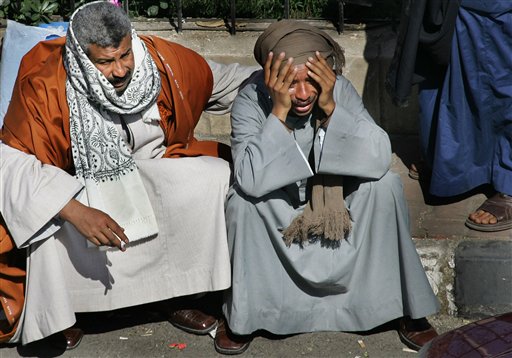
I cannot contain my outrage at this last trait. When the ferry sank and the Dahab bombings happened, the state-owned media made sure to highlight that Gamal bey’s “Policies Secretariat” observed a moment of silence for the ferry victims, and Suzanne Mubarak oh-so-graciously cancelled her trip to a “businesswomen’s conference” in Turkey so she could visit the Dahab injured. Does this not reveal an extraordinary level of indifference to the loss of human life and to the grief of family members? (Family members of ferry victims, Cairo, March 13, 2006).

If the ruling family is increasingly viewed as the problem, an unlikely sector is increasingly viewed as the solution. The second sign of regime decay is the Mubarak regime’s unexpectedly drawn-out and now extremely public confrontation with judges. This could have remained a contained and rather marginal intra-state affair, were it not for the highly unusual and intensifying public support of judges as the only trustworthy, inspiring, and capable force in public life. Every major pundit has written about the judges’ saga over the past two weeks. Nearly every major social group has visited the Judges Club to express solidarity for the ongoing sit-in. And as we know, the extremely brave and committed young activists who have staged their parallel sit-in supporting the judges were attacked three times by security forces and finally forcibly removed one day before Bastawisy and Mekky’s hearing.

That day was a turning point of sorts. The outpouring of public support for judges on 27 April took everyone by surprise, most of all the judges themselves. It surpassed the solidarity demonstrations of 13 May, 14 August, and 2 September 2005, and it surpassed the turnout on 17 March 2006. As a judge and member of Bastawisi and Mekky’s defence team reflected, “One amazing thing is that on our way from the Club to the courthouse and back, security failed completely and we were hugged by the masses, they knew us by name, they were singing for us, one of them kissed my hand! It was a huge day in the history of our country, I know that our days will be dearly remembered as part of our great history for years to come, thank God I was part of it no matter how small, and thank God I was on the right side.”

An intriguing proposal was floated on that day, first by Nasserist parliamentarian Hamdeen Sabahy in the library of the Cassation Court, as throngs of judges, journalists, and lawyers waited for the disciplinary board’s verdict (adjournment until 11 May). He said that if the two judges are dismissed, Egypt will have gained two candidates for president. The electrifying suggestion was met with enthusiastic applause and of course percolated to high places. The authorities are reportedly now scrambling to contain the whole matter before 11 May.

The Judges’ Club resolution after its 27 April emergency general assembly is a powerfully worded document. Its last paragraph in particular has a momentous ring to it, at least for me: “Egypt’s judges, and they represent one branch of state power, realise that the nation is the source of all powers, and that achieving security and stability has it source in the prosperity of the nation and the consent to its rulers, and that the rulers’ esteem is in responding to the desires of citizens, not in haughtiness and intransigence. There is no way of achieving security and stability in the country merely through the repression of force and the control of power. Rather, the people’s hope in justice must be preserved, as well as preserving their dignity and honour, and reviving their hope in reform, and establishing a true democratic life through fair elections and real transfer of power, and lifting all exceptional laws including ending the state of emergency, and unleashing freedom of expression, and the freedom to form parties, unions, and associations, without any restrictions, so that Egypt can regain its place among nations.”


Aporia


There are firm grounds for confidence in regime stolidity, and equally robust signs of impending implosion. Comparing current events to the twilight of Sadat’s rule or Hosni Mubarak to Romania’s Ceauşescu is good for dramatic effect, I suppose, but I wonder how those comparisons are made, and to what extent they are simply parroting a currently very trendy idea. I am also confounded by those who think that nothing has changed, who dismiss popular ferment as so much frippery that doesn’t dent the “real” sources of power, who assert that only external pressure matters.

I think only an oracle (if there are such things) can know which “path” will be trod at this “crossroads” that so many people keep announcing. If Egyptian politics have indeed arrived at a crossroads, then I’d like to savour the extraordinary uncertainties and hence possibilities that characterise such points. Unless you’re Teiresias, loud assertions about the likelihood of this or that “scenario” are rather dubious, mesh keda?

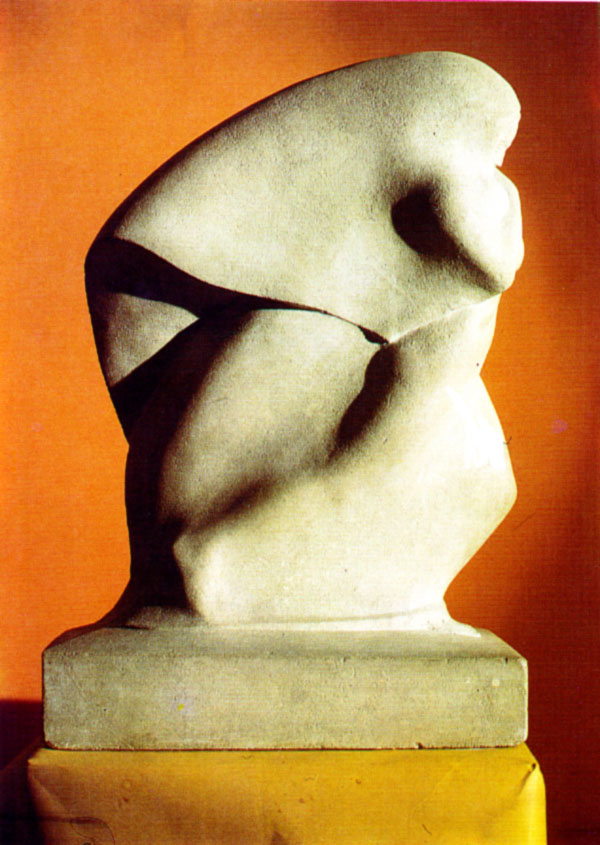
*Mahmoud Mokhtar, “Keeper of Secrets” (Katematul Asrar)

Wednesday, April 26, 2006

On the Eve of the Hearing

The incredible Wael Abbas has captured on video security forces' disbanding of the peaceful vigil in support of judges maintained by Kifaya, al-Ghad, Freedom Now, and allied civil society groups. Amid screams, sobs, and cries of "Down with Hosni Mubarak," "Down with Habib al-Adli," riot police cornered protestors as plainclothed agents removed them one by one. In a final, eerie scene, police peeled off the huge Egyptian flag that demonstrators had strung up to frame their vigil.


Among those arrested today are Kamal Khalil, journalists Ibrahim al-Sahari and Saher Gad, and blogger Malek Mostafa. These and more are in addition to the 12 protestors arrested early Monday morning and currently held in police custody for 15 days on the following charges: assembly, assaulting public functionaries, disseminating allegations that disturb public order, amd obstructing a street without permission. These are the actual charges.

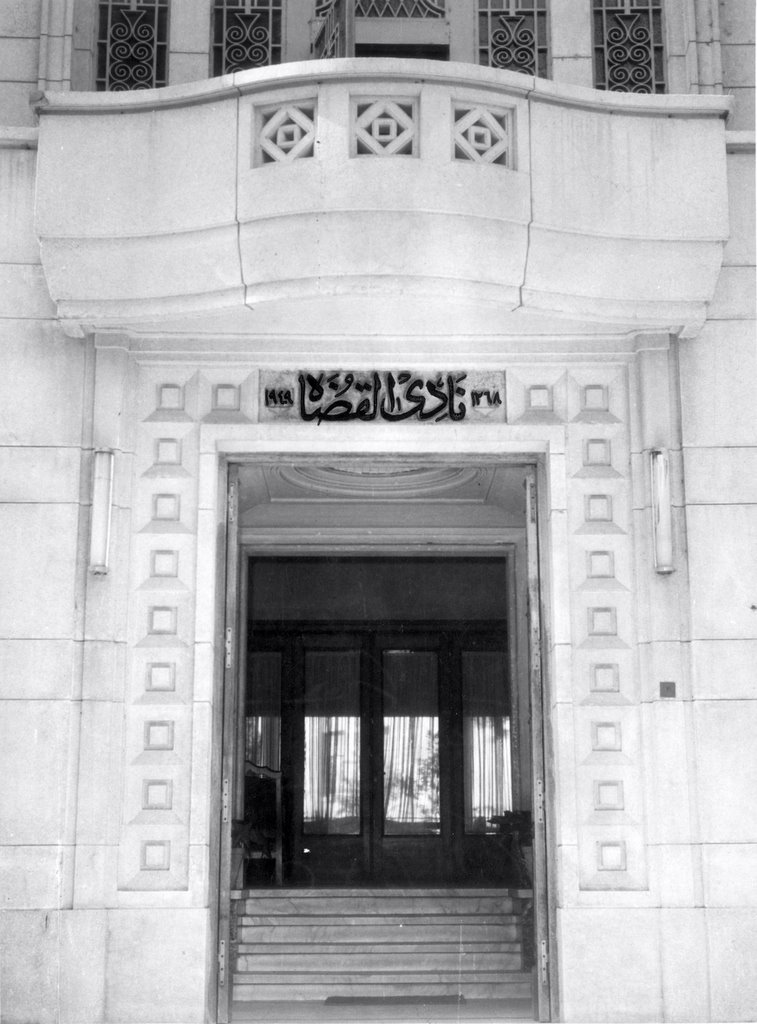
Power was abruptly cut off and then eventually restored to Nadi al-Quda today, where judges are energetically planning for today's decisive events. A defense committee comprising 24 judges and headed by justice Hossam al-Ghiryani is preparing its legal arguments for the disciplinary hearing of justices Bastawisy and Mekky, due to begin at 10 in the morning. Afterwards, the Judges Club will convene an extra-ordinary general assembly.

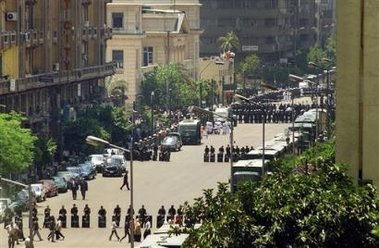
The square of downtown bordered by Abdel Khaleq Tharwat, 26th July, Ramsis, and Champollion streets, home to the Bar Association, Press Syndicate, Judges' Club, and the High Court complex, is now clogged with the trucks and personnel of the Central Security Forces. “Freedom Square,” as it’s fittingly dubbed, looks to be under siege, in an attempt by security forces to obstruct the medley of civil society protests planned for today, and importantly, to dampen turnout at the general assembly. Outrage is at an all-time high after the unprecedented beating of a judge by State Security and police agents on Monday. Judge Mahmoud Abdel Latif Hamza, president of the North Cairo Primary Court, was savagely cursed and beaten while taking photos on his mobile phone of security forces' first disbanding of civil society groups' vigil. The raid made sure to pilfer the huge signs with reformist judges' photos.

The powers-that-be are intensely perturbed by the outpouring of popular support for the judges. For the past week, the Club has welcomed an unceasing flow of supportive delegations from all over the country. Coptic dignitaries, university professors, members of parliament, the press syndicate board, and countless other citizens have walked through the Club's elegant, wrought-iron gates to express their solidarity and admiration. A young judge, overcome by emotion, tells of the endless platters of delicious, home-cooked, and artfully arranged food (and fresh-squeezed juice and desserts!), carefully packed and delivered to the Club, courtesy of dozens of anonymous Egyptian women. “I’ve grown plump,” he chuckles.

Mystery surrounds the outcome of an eleventh-hour negotiation manoeuvre by the regime. Presidential emissary Adli Hussein, a former judge and now governor of Qalyoubiyya, was dispatched to meet with the Club’s board on Sunday evening, reportedly to arrive at a truce of sorts. Yet only innuendo and rumour remain in the wake of his visit. On Monday, Hosni Mubarak was forced to publicly address the crisis with judges. In an interview with al-Gomhoriyya, he said that this was “a dispute among judges, specifically between the Judges Club and the Supreme Judicial Council, neither the government nor the state has anything at all to do with it.”


And so begins another chapter in the tale of the president, the judges, and the public.

*Hosam Gharbeia, "Hearing" (2001)


Thursday, April 20, 2006

Tribulations of Self-Determination

After an emergency meeting Tuesday night, the Judges Club board resolved to immediately begin a continuous sit-in at the Club until 27 April, when two frontline figures in the judicial independence movement will appear before a disciplinary board that will determine their “competence” (salahiyya) to retain their judicial posts. By the wee hours of Wednesday morning, judges were milling about in the beehive that is the Club, starting the sit-in, while the Club’s committed clerical staff organised themselves in shifts to man the phones, serve tea, and otherwise ensure the smooth running of the institution.

This latest, most flagrant harassment of pro-independence judges is only the most dramatic in a bundle of reprisals this week that demonstrate as never before just what is at stake in this gripping politico-judicial saga. We know that judges have long chafed under the arbitrary and corrosive control of the executive, but developments this week reveal just what that means in very concrete terms.


Facts


On Sunday, the Justice Minister summoned the two senior judges to appear before a disciplinary board (magles ta’dib), a very grave procedure that surpasses a warning (tanbih) and leads to one of two possible outcomes: censure or dismissal. The specific charge against the two judges is slandering another judge by falsely accusing him of complicity in rigging elections. Be it noted: this is the first time in Egyptian judicial history that judges of this rank have been disciplined. Even the notorious August 1969 “massacre of the judiciary” steered clear of this procedure, instead retiring or transferring 189 judges to non-judicial posts under the rubric of “judicial reorganisation.”

The two justices in question are high-ranking members of the Cassation Court, and as such count among the crème de la crème of the Egyptian judiciary. Alexandrian Mahmoud Mekky and Cairene Hisham al-Bastawisy have also long been active in the judicial independence movement. They are not elected members of the Judges Club board but serve on the 21-member committee entrusted by the Club to produce an assessment report on the autumn 2005 parliamentary elections. Both are highly effective spokesmen for the cause, with a penchant for precision and clarity of expression and an unwavering commitment to judicial collective action for a new law, and full supervision over elections.

Let’s remember that this very dramatic escalation comes at the end of a long train of harassments that began in 2004 with the warnings issued to Hossam al-Ghiryani and Mahmoud Mekky’s older brother Ahmed, followed by the November 2005 order by the Supreme Judicial Council to refer 10 judges to interrogation for their outspokenness about election abuses, to the February-March 2006 orders of the SJC to strip seven judges of their immunity as a prelude to interrogation by the State Security prosecution.
Bastawisy in particular has been tagged in each and every one of these procedures. It’s pointless to speculate on precise reasons why, given the extraordinary amount of misinformation, rumour, and conflicting reports flying about, but one thing is clear: Bastawisy is a very capable, articulate, and bold judge who made a strategic decision in 2005 to take the judges’ case to the public and link it to the cause of clean elections. For years, he has worked avidly for a regional Arab Judges Union, and schooled scores of young judges in the doctrines of judicial independence and separation of powers before his stint as lecturer at the National Centre for Judicial Studies was terminated. In 2005-06, he has been a model of dogged perseverance, unfazed by truly crushing pressures and the criticisms of some in the profession who believe that his conduct deviates from judicial traditions.

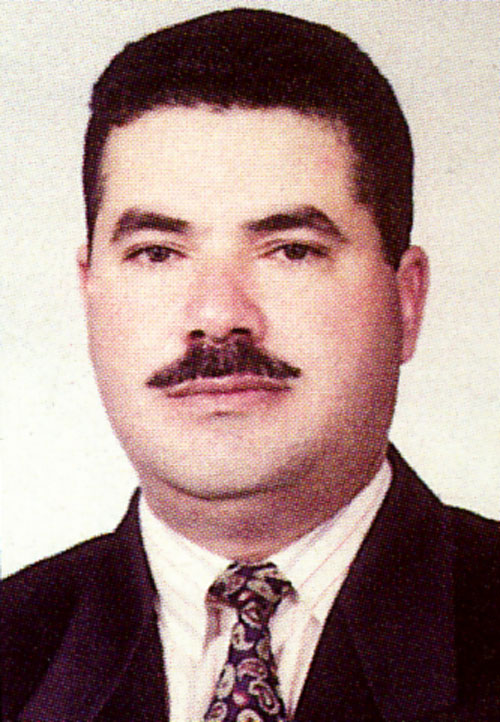
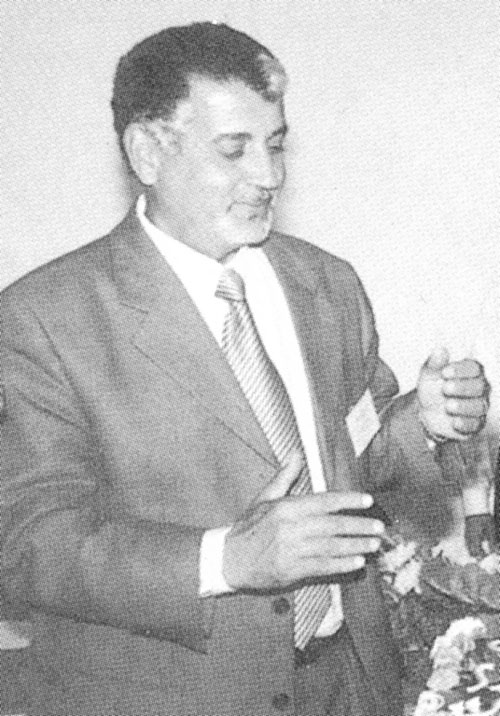
In a distinct but related development, the Supreme Judicial Council has granted its permission for the interrogation of Alexandria Judges Club board member Mahmoud Abou Shousha (b&w photo above). The permission was granted after a complaint filed by one Ezzat Agwa against Abou Shousha for the latter’s allegedly slanderous remarks against Agwa uttered at the December 16, 2005 Judges Club general assembly. Ezzat Agwa of course was the long time incumbent president of the Alexandria Judges Club and close pal of certain government ministers until his ouster in the 2004 Club election and defeat in another election a year later, both of which saw the victory of reformist Mahmoud al-Khodeiry. Agwa’s name is included on the “blacklist” of judges alleged to have colluded in rigging elections, a list put out by the Bar Association board. There’s no word on why Agwa waited four months to file his complaint. All that we know is that at 34, Abou Shousha is one of the youngest members of the judicial independence movement, a natural orator with an engaging, calm demeanour and a razor-sharp mind who inspires other young judges to join the cause.

Finally, distinguished senior Cassation Court justice Hossam al-Ghiryani, no stranger to harassment, has also been fingered. He received a phone call from the technical bureau (al-Maktab al-Fanni) of the Cassation Court summoning him for an interrogation before the president of the Court regarding supposedly dozens of unspecified and anonymous “complaints” against him. Incredible as it may seem, anonymous grievances are currently enough to subject an Egyptian judge to interrogation and potential disciplinary proceedings.


Context


The pattern governing all of the actions this week is clear: the regime is leaning on certain judges to activate seemingly unobjectionable procedural mechanisms to punish prominent reformist judges, who are portrayed as errant deviants undermining the stature and integrity of the judicial profession. Now, there is a real rift between Egyptian judges, particularly visible in the last four years. This rift widened into a yawning chasm after the parliamentary elections, as reports swiftly circulated telling of certain judges colluding to fix results in the critical districts of Damanhour, Madinat Nasr, Quellin, Doqqi, and Kerdasa, to name but a handful. Bastawisi and Mekky rightly assert that they have never accused any of their colleagues; indeed, the Club committee preparing a report on parliamentary elections is still not finished precisely because it is scrupulously compiling reliable data on the vote count at each and every auxiliary polling station in each of the contested districts. However, this investigative work is itself perturbing, and judges whose initials appeared on the Bar Association’s blacklist have had their reputations sullied and wish to silence their colleagues.

It just so happens that the minority of judges who are ruffled by the bold leadership of the Judges Club have strong ties to legal personnel in the executive branch, so they are an exceptionally well-connected minority. Both groups have been colluding to undermine, fracture, demoralise, frighten, and otherwise confuse reformist judges by a variety of mechanisms. The problem is that none of these seem to be denting the resolve or support of the pro-independence coalition. For example, take the manoeuvre to piece together a pro-regime judicial counter-coalition in the form of a presidium of “presidents of appeals courts.” As Zakariyya bey Abdel Aziz said, “I don’t know what that is.”

Indeed, there is no such thing in Egyptian judicial structures, it’s an invented entity designed to mobilise judges against the Club’s leadership as a prelude to eventually unseating them. On 29 March, this entity convened a meeting of about 130 judges; the sole item on the agenda was to “discuss the appearance of several judicial colleagues on satellite television channels.” On 2 April, they issued a statement that rebuked “some judges who wish to impose themselves with loud voices and inappropriate expressions…the judiciary is the judiciary, if you don’t like it, then resign and work in politics as you wish, so that judges don’t become a vehicle for political ends.”

The statement was also keen to lambaste the proposed meeting between the Judges Club board and the American-based organisation Human Rights Watch. As we know, there was an insane panic in the corridors of power about this meeting, leading the government to unleash a pathetic, hopelessly amateurish smear campaign against both the Club and the rights organisation, even as the hapless Ahmed Nazif met with its delegation and received a humiliating dressing-down. Could it be that this mammoth regime armed to the hilt with “New Thought,” “women’s empowerment,” and all those other Western-friendly slogans is mighty scared of some judges? Truly, I feel for Mr Nazif. It must be so difficult waking up every morning knowing what quantities of self-abasement the day holds.

But back to our story. I’ll wager that the manoeuvre to construct a critical mass of judges to discredit the independence movement will fail. Here’s an indication: on 7 April, internal elections of the Mansoura Judges Club returned a victory for the reformist camp. Hussein Qandil won the presidency of the Club, receiving 241 votes, while Mahmoud Siddiq Berham garnered 106. Qandil’s slate also captured three out of the four board seats up for election. Berham heads a circuit of the Cairo Appeals Court and is active in the effort to malign the independence movement and its leaders.


More Facts


There’s no clearer testament to the urgency of a new judiciary law than the summons meted out to Bastawisy and Mekky. Consider: the existing law specifies that the disciplinary board’s verdict be announced in a secret session, and that it cannot be appealed “by any route,” (Article 107). The Judges Club proposed law stipulates that the verdict be announced in an open session, and that it be subject to appeal before a special circuit of the Cassation Court. Judges note the irony that all ordinary litigants are granted the opportunity to appeal court verdicts, while judges are not availed of the same opportunity when it comes to their own affairs.

The existing law says that the disciplinary board is to be composed of seven members: president of the Court of Cassation serving as president, the three most senior presidents of appeals courts, and the three most senior Cassation Court justices (Article 98). First, we know that the actual persons who hold these posts now are simply incapable of ruling fairly on the “competence” of any reformist judge. President of the Cassation Court Fathi Khalifa has been violently and publicly sparring with reformist judges for at least four years, and presidents of appeals courts are now trying to bypass the existing, legitimate judicial representative institution (the Judges Club) by constructing a phony body as a counterweight. The Judges Club draft law proposes a different composition for the disciplinary board that addresses potential conflicts of interest.

But the root cause of the problem remains: Article 111 of the existing judiciary law empowers the Minister of Justice to refer any judge to a disciplinary board. Correcting this glaring violation of separation of powers has not been among judges’ demands, both because this prerogative has not been used before and because there are other, more pressing executive violations of judicial independence that they’ve experienced and seek to fend off. Now, in 2006, the hypothetical has become real. As crises often do, this one is bound to sharpen judges’ demands and add to the list of abuses from which they seek deliverance.


Significance


It’s easy to become entangled in the absorbing details of this never-ending story and forget why it all matters. To me, the real gravity of what we’re witnessing today transcends the battle for a truly independent judiciary, as irrefutably crucial as that is. Independence of the judiciary is not enough to realise democracy, nor is it a synonym for democracy. Democracy hinges on the capacity of citizen groups to form freely and govern themselves, unencumbered by the grasping claws of the state. The Judges Club saga is especially riveting because it concerns a very special group of citizens, those who are at once members of and watchdogs over the state.

But the fundaments of judges’ struggle are the same for other citizen associations currently in the throes of their own projects of autonomy. Witness one unfolding right now before our eyes: Egyptian engineers and their truly epic efforts to take back their union from a decade of enforced hibernation and decay (and surely we all know how superior Egyptian engineers are, don’t we?!). And Egyptian professors acting collectively to wrest their campuses from the stultifying grip of security forces and their vile academic collaborators. And Egyptian journalists finally cognisant of the president’s phony “promise” to abolish imprisonment for press offences. And Egyptian physicians who have been emboldened by judges to hold similar stands outside their union. And let’s not forget Egyptian actors, who in a less publicised but critical election last December threw out their own ossified leaders, including the intolerable presidential sycophant Yusuf Sha’ban, and voted in the honourable Ashraf Zaki as union president and fresh, new members to the board.

I can’t think of a truer observation about this whole drama than one penned years ago by a perceptive scholar, yet ever resonant today: “Egypt’s rulers have harboured an enduring suspicion of organised professionals.”

Tuesday, April 11, 2006

Friday, March 17, 2006

Spring

It was a sight to behold. Egyptian judges hailed from all over the country on Friday for a silent stand in their stately club, continuing their struggle for a new law that ensures judicial independence. Swathed in their plush red and green sashes, they stood silently for a little less than an hour as cameras clicked and whirred all around them and a lovely spring sunshine illuminated the proceedings.

Supportive pro-democracy demonstrators momentarily suspended their chants and slogans out of respect for the judges’ wish for a silent stand. For a spell on Friday afternoon, the otherwise hectic Champollion St. was blanketed by an eerie, momentous silence, punctuated only by the gently rustling leaves on the trees bearing witness. Once again, the dignity and persistence of Egypt’s judges fills me with awe.

The large turnout was in part driven by the collective outrage at the questioning of very prominent and popular pro-reform judges such as Assem Abdel Gabar, Nagi Dirbala, and Yahya Galal (top middle three, left to right) by the Supreme Judicial Council. At the emergency general assembly meeting following the silent vigil, the Club honoured them and the other targeted judges. The hugely popular Dirbala in particular received wildly enthusiastic applause, his story made more dramatic by the fact that his son has been barred from appointment to the parquet (niyaba), almost surely in retaliation for the positions of the father.

Before the silent vigil, Kifaya, al-Ghad, Freedom Now, and allied groups marched in support of the judges, led by the two indefatigable and inimitable Kamals (Khalil and Abu Eita). In what I think is a first in Egyptian history, protestors held aloft huge posters of prominent pro-reform judges such as Zakariyya Abdel Aziz, Mahmoud al-Khodeiry, Hisham al-Bastawisi, Ahmad Saber, and Hossam al-Ghiryani. The posters were designed by the energetic young people who organised the thursday evening Tahrir Square sit-in to support judges and journalists. Demonstrators stopped in front of the Judges Club and a curious and inexplicably moving scene unfolded.

Demonstrators chanted the name of Club president Zakariyya Abdel Aziz (top), who stood silently on the Club steps flanked by his colleagues, in quiet acknowledgement of the protestors' heartfelt salute. A fiery young protestor with a formidable voice addressed Abdel Aziz directly and almost angrily: "Stand firm! The pressures on you are immense, stand firm!"

When the relatively unknown Abdel Aziz was first elected Club president back in 2001, no one could have guessed that five years on, his would become nearly a household name. Certainly no one could have imagined that he and his intrepid colleagues would morph into the most potent symbols of Egyptians' desire for political change, repositories of hope, inspiration, and not a little pride. An ordinary citizen who came to observe the judges' stand said, "I'm here because I want change in this state."

It's a lot to ask of judges working under conditions of considerable duress, but the majority of men on the Egyptian bench show no signs of shirking. As judges ended their vigil and made their way to the general assembly deliberations, our honourable judge Hossam al-Ghiryani flashed the victory sign, to the applause and delight of the demonstrators and passersby who lingered to watch.

March has always been a fertile time in Egyptian annals. As with 2005, this year's spring promises new and unexpected developments. At the conclusion of their assembly, judges resolved to stand again on May 25, but this time inside the High Court building, as they had planned for this friday before "the authorities" closed off the court complex. "No rights without sacrifice!" bellowed a judge at the general assembly. And so the saga continues.

Tuesday, March 07, 2006

In Omnia Paratus

Two more judges have been tapped for interrogation, this time (and for the first time) both very popular, elected members of the Cairo Judges Club board. Nagi Dirbala (right) and Ahmad Saber (left) are among the 14 board members elected by a landslide during the December 16 elections. Singling them out is a direct slap in the face to the popular will of the majority of judges. Saber is the gifted orator who begins every general assembly meeting with a speech that animates and stimulates the crowd. Dirbala is the extremely hardworking, methodical man behind the scenes: keeping the records, organising the proceedings, taking care of business. Both are devoted Club members and key pillars of the pro-independence alliance. The regime’s trawl has now taken in eight pro-reform judges, prompting inevitable whispers of an impending “new massacre of the judiciary.” As the March 17 extraordinary general assembly approaches, only one thing is sure: judges are now prepared for anything.

Correction: initial reports that Saber was reprimanded proved false. To date, seven (and not eight) pro-reform judges have been apprehended: Hisham al-Bastawisy, Mahmoud al-Khodeiry, Ahmed and Mahmoud Mekky, Yahya Galal, Assem Abdel Gabbar, and Nagi Dirbala.

Monday, March 06, 2006

The Plot Thickens

I say, I never thought executive-judicial relations could be so…what’s the word…ah yes, riveting. For the pedant at heart, nothing could be more absorbing than the tussles within Egypt's remarkable judiciary, with all their intricate twists and turns, their historical resonance, the plethora of detail, and the fascinating play of manoeuvre and counter-manoeuvre. Normal people are really quite the poorer for spurning all this wealth of delightful legal arcana. Absolutely delightful, I say.


You see, it appears that our august but positively curmudgeonly Mr Fathi Khalifa has struck again. Yesterday, he referred two more senior judges for interrogation. Alexandrian Cassation Court vice presidents Yahya Galal (top right) and Assem Abdel Gabbar (top left) allegedly made remarks to the media “disparaging” the Supreme Judicial Council and harming the “dignity of the judiciary,” thundered Khalifa (tut tut). It would appear that Mr Khalifa has grown tired of and perhaps a tad threatened by judges’ outspoken remarks about violence against both them and voters during elections, and their activism for a new law to guarantee judicial independence. In Mr Khalifa’s world, you see, judges must remain forever obedient and submissive to their superiors. They must above all exhibit a healthy dose of deference to the president and his appointees. To demand independence, why that is sacrilege, profanation, vile irreverence!

But note well, our indefatigable Fathi bey is not without some measure of guile. This time, perhaps chastened by the outcry at his
earlier outrage, Khalifa has not stripped the judges of their immunity so that they can be interrogated by non-judges. Instead, acting in his capacity as president of the Cassation Court (not president of the Supreme Judicial Council), he has referred them to internal interrogation by another judge as a possible prelude to meting them a warning (tanbih), as per Article 94 of the existing judiciary law. It’s an oh-so-intricate but real legal distinction. How it will be received is another matter, however. Given the extraordinary friction between the Judges Club and the SJC, fine distinctions are likely to be subsumed by the bigger picture.

And that is: the more that pro-government judges illegitimately pull rank, engage in unprovoked, unjustified, and imprudent actions, and slam the door in the face of even the possibility of negotiation, the more power and prestige accrues to the ever-growing pro-independence faction. It is extremely telling that in his most recent fit of rage, Khalifa railed against the emergent links between the Judges Club and wider civil society forces. The Club “has become a conclave for opposition to the government” and the Alexandria silent protest “has no meaning and was a group of friends who don’t represent judges.” He elaborated, “The Judges Club should not be opened to a bunch of lawyers and journalists, and anyone aggrieved by the government, and the Kifaya movement…this is an exploitation of the atmosphere of freedom to harm others, and to libel and slander senior officials reaching all the way to the president.”

Leaving both the bigger picture and the legal arcana aside for a moment, I confess to being consumed by a vexatious question. It seems as if every action Fathi bey has ever embarked on has led to precisely the opposite of what he intended. Judges’ feisty collective action today is in no small measure pushed along by Fathi bey’s modus operandi. I am worried, is he perhaps not consulting the right people? Might I suggest the lucid tracts of Sun Tzu, Machiavelli, even Clausewitz? A better strategy is long overdue. Mish keda walla eh, ya Fathi bey?!


Friday, March 03, 2006

'Tis the Season

Mahmoud Mokhtar (1891-1934), "al-Khamaseen" (c. 1920s).

Tuesday, February 21, 2006

Honour

It was both predictable and unexpected. Last friday's judges’ protest attracted men of the bench from all over the country, the bulk of them young and outraged. Adorned in their red and green judicial sashes, they cut striking and dignified figures, arrayed in silent protest for one hour on the steps and veranda of the magnificent Bolkly villa that serves as headquarters of Alexandria’s Judges Club. It was predictable that the government’s most recent manoeuvre would fuel anger, radicalising the moderate and moving the hesitant. But the actual turnout was unexpected. Before the targeting of the four judges last week, organisers were hoping to draw at most 50. Instead, 400 attended. Well over half of them hailed not from Cairo or Alexandria, but Mansoura, Zaqaziq, and al-Saïd. They delivered eloquent speeches in solidarity with their wronged elders. Buoyed by the blessings of their mentors and their own experiences, these once anonymous young men are the ones the executive must now contend with, today and for years to come.

Though not among the four stripped of their immunity, judges cleaved to one eminent and much-loved senior judge whose ad-libbed comments on Friday drew unanimous plaudits and even tears. Muhammad Hossam al-Din al-Ghiryani (top) commands respect. The solemn protest was his idea, to send a clear signal that judicial action will not fizzle now that elections are over. Instead, it will revert to the original cause for which judges have always agitated: a new law that will effectively preserve their independence. Ghiryani is quite literally central to this battle. Three years ago, a curious confrontation between him and the Supreme Judicial Council rallied judges to action. In fact, it foreshadowed and fuelled current events, where pre-emptive strikes intended to thwart collective action had precisely the opposite effect. For judges, the integrity of elections has always been an important capillary, but autonomy is the jugular. Let’s dissect, shall we?


Straws in the Wind

The story begins with the 2000 elections, when two candidates appealed election results in the East Cairo Zeitoun district before the Cassation Court. On May 12, 2003, the Court circuit headed by Ghiryani ruled for the plaintiffs, arguing that since six out of 49 auxiliary polling stations were not supervised by judges, the declared results were null and void. The ruling was like hundreds of others, but with a key difference: the incumbent in this particular district was none other than Mubarak’s chief of staff, Zakariyya Azmi. Still, the constitution leaves it up to parliament to decide whether to implement such rulings, so the matter was largely moot. Until president of the Court of Cassation Fathi Khalifa intervened. In August, he issued a written comment criticising the ruling, highly anomalous by judicial customs and entirely frowned upon. It is an ingrained principle that sitting judges on the Cassation Court (high appeals court) are not subject to top-down review of their rulings; Khalifa’s comment raised several red flags.

A month later, in September, during parliament’s recess, a presidential decree raised judges’ retirement age from 66 to 68, flying in the face of a consensus among judges that prolonged tenure has corrosive professional and political repercussions. Professionally, a top-heavy judicial structure thwarts the promotion of creative legal talent and ossifies extant ideas. Politically, it risks creating pockets of government loyalists deferential to an executive branch that controls their terms and conditions of service and thus blunts their professional judgement. The plot thickened a month later, when the Supreme Judicial Council headed by Khalifa intervened in a dispute between the Judges’ Club and a retired judge seeking Club membership. The SJC issued a decree declaring that the Club falls within its purview.

Percolating tensions galvanised judges to action. On October 17, 2003, they convened at the Judges Club to deliberate on what they perceived to be growing provocation and intervention by the SJC. Ironically, Khalifa was also in attendance in the entirely honorary capacity of “President of the General Assembly,” pursuant to the Club’s by-laws. The two main orders of business were the raising of the retirement age and the relationship of the Club to the SJC. Judge Ahmed Mekky launched a tirade against the SJC, calling it “an appointed Council that has become of the rulers.” At this point, Khalifa leapt out of his seat and stormed out, tripping and falling as he left the dais. He has not since re-entered the Judges’ Club.

Unfazed, attendees forcefully argued against any oversight of the Club by any organ, including the SJC. Ghiryani delivered a wonderful address on the absolute autonomy of the Club’s general assembly, subject only to the “glass ballot box.” Addressing judges on the SJC, he said, “You are our elders, and command all due respect, but do not create roles for yourselves not granted to you by law. Would that you would properly carry out those duties that are specified for you by the law.” Eleven days later, on October 28, the SJC issued a decree signed by Khalifa asserting that any response to SJC decrees made “in an inappropriate manner” is a violation of the judiciary law and therefore subjects a judge to disciplinary action. But the intra-judicial dispute didn’t end there.


Last Straw


On January 12, 2004, the SJC singled out Ghiryani and Mekky, demanding that they explain in writing “the reasons” for what they said and did. Both retorted with detailed arguments uncovering the procedural violations of Khalifa’s summons. On January 28, the SJC replied to them in writing, “whereas what you have done is unprecedented in the history of the judiciary, and so as not to have it repeated, and pursuant to Article 94 of the law on the judiciary , we warn you not to regress again in the future.”

It was the proverbial straw that broke the camel’s back, the capstone to a long train of abuses. Khalifa’s high handed warning sealed his reputation as a pro-regime judge heading an institution under near-total executive domination bent on silencing independent, reformist judges. But once again, the executive had miscalculated, wagering that the targeting of two prominent judges would silence the rest. Instead, it spawned quite the opposite. Judges surmised that they had to stand up for the honour of their colleagues and take back the SJC.
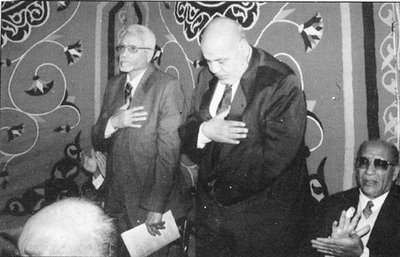
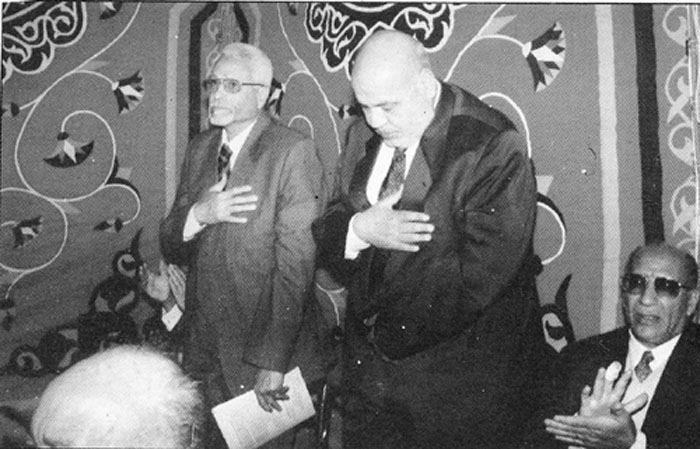
On March 12, 2004, they descended on the Judges Club in droves for the extraordinary general assembly that would start it all. Ghiryani and Mekky were literally silenced by the overflowing solidarity of their peers, receiving sustained applause for several minutes (top). Little-known Alexandrian judge Mahmoud al-Khodeiri (seated) delivered an inspiring address that day that would eventually catapult him to national prominence.

In April 2004, in an astounding upset, Khodeiri won the elections for president of the Alexandria Judges Club by a mere 2 votes (count ‘em!), beating out chronic pro-regime incumbent Ezzat ‘Agwa. Exactly one year later, the Alexandria Judges Club convened the general assembly that sparked judicial action for full electoral supervision, and the first time judges floated the idea of an election boycott. At that meeting, judge Tareq al-Tawil donned his sash and led his fellows in an impromptu vow to remain independent and vigilant against vote fraud. Judge Mahmoud Abu Shusha recounted a moving story about his experience in the 2000 poll. And judge Hossam al-Ghiryani said, “We want a truly independent judiciary that can protect freedoms and human rights, and the first of these rights is the right not to have one’s will falsified through rigged elections.” A few days later, the SJC issued one of its limp statements underlining that judges should maintain their “distance from working in politics.”


Grasping at Straws?


If recent history is anything to go by, the government and the SJC’s latest actions are only bound to unify the ranks of reformist judges and buttress their resolve for a new law. Leaks of yet another, impending increase in judges’ retirement age to 72 has fuelled fresh outrage. And each further provocation deepens suspicions of an all-out assault on the judiciary rather than the harassment of a handful of outspoken judges. The Minister of Justice’s latest decision to get ugly and cut off $10.5 million in annual funding to Judges Clubs all over the country can only reinforce this. It’s a mystery to me what sort of strategy the government and its legal retainers think they’re pursuing, since for at least the past three years each and every one of their ill-considered moves has spawned a damning counter-move. Surely they could manage this delicate process with a bit more finesse? Or some plain old common sense? But goodness, it boggles the mind, this uninterrupted train of miscalculations and blunders, does it not? I quiver with anticipation for the upcoming March 17 general assembly, which is likely to be every bit as stimulating as its predecessor two years ago, and then some.

Wednesday, February 15, 2006

Escalation

In a dangerous escalation, at 4:30 pm yesterday, the Supreme Judicial Council lifted the immunity of four judges leading the movement for a new judiciary law and full judicial supervision of elections: Judge Hisham al-Bastawisy (above far left), Alexandria Judges Club president Mahmoud al-Khodeiri (below right), and the brothers Mahmoud and Ahmed Mekky (above center and below left).

The reason: a judge filed a complaint claiming that the four judges had wrongly accused him of complicity in rigging elections at the polling station he supervised in Mansoura during parliamentary elections. The Supreme Judicial Council lifted their immunity so that the judges can be questioned by the State Security Prosecution (Niyabat Amn al-Dawla al-Uliya).

First, this is the same maneuver used by the government to place professional associations under sequestration. The story is always the same: induce a pro-regime professional to file a phony complaint, thus providing a pretext for the government to swoop in and neutralise challengers. It should be obvious that this is the selfsame tactic also used to destroy suddenly unruly opposition parties (al-Shaab in 2000 and al-Ghad in 2005). Divide et impera.

Second, this is much more serious, since it’s a branch of state power that’s now under attack. The government has not interfered this blatantly to diminish independent judges since August 1969. The immediate cause this time is a sit-in judges are planning at their club in Alexandria this Friday. The action is to protest the Supreme Judicial Council’s utterly secretive and high-handed posture on the draft law on the judiciary. The Council’s president, Fathi Khalifa, has been entirely uncollegial and less than forthcoming about a bill that judges have been fine-tuning and refining for years. Khalifa's behaviour is nothing new.

To make matters worse, news had leaked out that the Council’s draft meets none of the judges’ demands, instead deliberately codifying the executive’s will to power. Case in point: the bill reportedly raises judges’ retirement age from 68 to 72, a blatant violation of judicial majority opinion. At the December 16, 2005 Judges Club general assembly, 3,706 out of 4,732 judges voted against raising the retirement age, which is a transparent maneuver to block the promotion of younger judges and prolong the tenure of their pliant, regime-friendly elders.
The judges’ sit-in will proceed as planned, and now will surely draw more attention and perhaps even the participation of hesitant fence-sitters. The government’s recent unstudied action is likely to be perceived not simply as an elimination of individual reformist judges, but as an assault on the integrity of the judiciary.

All eyes on Bolkly, Alexandria tomorrow, as we wait and watch this dramatic turn of events.

Sunday, February 05, 2006

Ferry Tragedy

It is one of the worst disasters in Egyptian maritime history. At or around midnight on friday, the ferry As-Salam 98, carrying 1,414 passengers from Saudi Arabia to Safaga, sank in the Red Sea after a fire broke out on the car deck. Flooding occurred during the firefighting, causing the vessel to list and then capsize. No distress signals were sent from the ship, and search and rescue operations were launched seven hours after it sank. Reuters and AFP have compiled more details.

So far, 460 survivors have been brought ashore, after many hours of desperately clinging to life in the frigid waters. Around 190 bodies have been found, and 700 are still missing. The stories of the survivors are chilling. "There was a blaze down below," said survivor Nader Galal Abdel Shafi. "The crew said 'Don't worry, we will put it out.' When things got really bad the crew just went off in the lifeboats and left us on board."

The press and rights groups are raising pertinent questions over authorities' handling of the disaster, including the deployment of Central Security Forces at Safaga. Relatives flocked to the port from all over Egypt seeking news of their loved ones, and some clashed with riot police who barred their way to the port area and hospital. "We are not afraid of the security forces," said Dahi Abdallah Ahmed, who came to Safaga to look for his missing cousin Khaled, who had found a job in Saudi Arabia. "We are a people that is used to not having any leadership in hard times. We solve problems our own way," he said.

Other distraught relatives pointed to chaotic management and lack of adequate or timely information about the rescue effort. Tareq Sharafeddin had no news of his wife and four children. “Are they among those rescued by the Saudis, are they in a hospital in Hurghada, in the morgue or dead in the sea? I don’t know.”


Like the spate of other recent transport-related disasters, almost all of the passengers were working people who made their living in Gulf countries (some were pilgrims returning from Makka). Survivors and relatives said many of them were bringing back sometimes years' worth of savings.

Monday, January 30, 2006

Persons of the Year 2005

I will always remember 2005 for its abundant surprises and endless ferment, with not a single dull moment, not even a lull. It’s a year too eventful for the inevitably boring and perfunctory exercise of the year-in-review, yet too rich to let pass without some sort of stock-taking. A year unthinkingly dismissed as a ‘disappointment’ by contrarians, cynics, and busybodies who prattle too much and think precious little.

Cataloguing the many events of the year would be tedious and unimaginative, mish keda? I want to instead emphasise three “persons” who made 2005 rather exceptional. First, the Egyptian Judges Club, Nadi Qudat Misr, a wondrously unlikely space of incessant mobilisation. Second, Kifaya, a wondrously unlikely impulse of political innovation. And finally, the recruits of the Central Security Forces, those fearsomely helmeted and armed human beings omnipresent on Egyptian streets, more than ever in 2005. Judges, activists, and gendarmes. Together and separately, they shaped 2005.


1


The Egyptian Judges Club is a remarkable institution. Founded in 1939 as a collective of judges adamant about a new law for the judiciary (eventually promulgated in 1943), it continues to aggregate and organise judicial opinion, and continues to agitate for a new law guaranteeing the true independence and professionalism of the judicial branch. The Club’s pivotal role in 2005 comes as no surprise to the judges themselves, whose robust collective memory is stacked with proud moments of defiance and resolve: 1951, 1963, 1968-69, 1984, 1990-91, 2004, and 2005.

The Club’s general assemblies in 2005 were, without exaggeration, historic events, and I hope their videotaped proceedings are circulated for a much wider and fuller viewing than the snippets aired on al-Jazeera. But what on earth is a general assembly? It’s the supreme deliberative and law-making body of a particular institution, comprising all its members. Historically, the general assemblies of Egyptian professional guilds have been paradigms of direct democracy, featuring real debates, virulent disagreements, hefty doses of humour, utter chaos, ego wars, adamant majority rule, and vocal protests by the minority. Sometimes, general assemblies have seen inspiring displays of oratory and heroism. Sometimes, they were witness to startling instances of shameless quackery. Always, they were an arena for brinkmanship and the clash of competing interests. Direct democracy.

It’s no surprise then that Egypt’s rulers have always sought to control and infiltrate professional unions’ general assemblies, from King Farouq all the way down to the current embattled ruler and his entourage. The control attempts are that much more fascinating when the general assembly in question is composed of state officials, and all the more delectable when those state officials have a tradition of convening contentious general assemblies that threaten the vital interests of the power-hungry executive.

The Judges Club general assemblies in 2005 were a nightmare for Mubarak and his lieutenants. On April 18 in Alexandria and then May 13, September 2, and December 16 in Cairo, judges not only subjected the regime to measured but devastating criticism in full view of local and international media. They also threatened to complicate a very sensitive procedure that Mubarak and Co. were very nervous about: elections. Now there have always been judicial rumblings every time an election rolls around. But in 2005, the judges took everyone by surprise when they turned rumblings into concrete and effective mobilisation. Most surprised were the Mubaraks and their minions in the Supreme Judicial Council and the Ministry of Justice, who still don’t know what to do with the adamant judges.

The 2005 general assemblies were also occasions for a highly significant yet almost imperceptible process. They politicised, inspired, and perhaps even radicalised younger judicial cadres, led by a charismatic and delightfully plain-speaking contingent from Alexandria. These younger judges clinched the victory of Zakariyya Abdel Aziz as chairman on December 16 and re-elected Mahmoud al-Khodeiry to a second term in Alexandria a week later. As their long serving elders gradually retire from the scene, the younger judges will steer the battle in its next phase, armed with less patience, closer ties to the judicial rank and file, newer ideas for redrawing executive-judicial relations, clearer concepts for more effective action, and most important: less fear. “Do your utmost,” they say to the executive’s legal henchmen and inept fixers. “We are not afraid.”
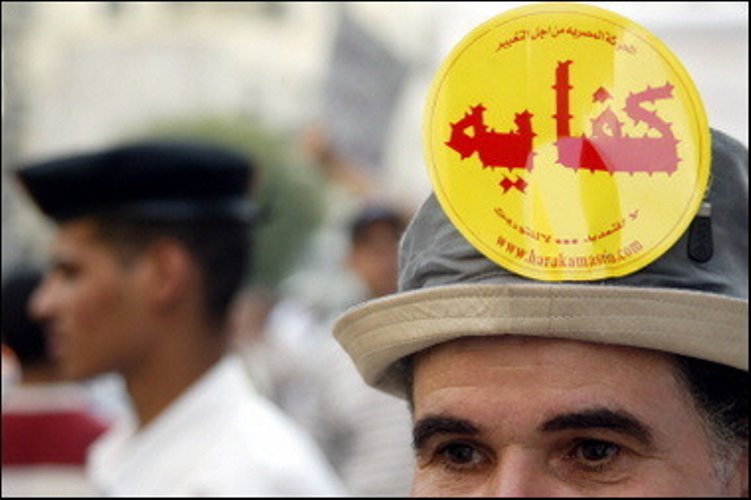
Nadi al-Quda’s struggle for a new judiciary law and full supervision over the electoral process did not begin nor end in 2005. That year was merely a particularly meaty chapter, to be continued over the next several years, and still in its full throes as I write this. But the truly new element introduced in 2005, aside from the relinquishing of fear, is the new affinity between judges and activists that made itself especially clear on May 13 and September 2. When judges signalled at the beginning of the year that they would have no truck with falsifying voters’ will in elections, Kifaya and Muslim Brother activists quickly cleaved to the judges and protested more than once in solidarity with their demands.

Judges in turn relished the public support and cultivated it as a key asset in their negotiations with the executive. And so a new alliance was made, one that al-Ahali journalist Tharwat Shalabi neatly captured in December when he dubbed Nadi al-Quda the new Beit al-Umma. Presumptive veteran journalist Sana’ al-Beesy shamelessly cribbed Shalabi and pilfered the credit for the evocative metaphor, so let’s set the record straight and return the credit to its rightful bearer.


2


There’s no doubt that Kifaya was one of the main architects of heightened public consciousness of and support for judicial independence. But it did much more. A movement-idea that was subjected to incessant criticism from the day it was born, Kifaya muddled right on through, organising the summer Wednesday demonstrations that were finally capped by the “Batil!” protest of September 10, before all the relevant parties turned their attention to the battle of parliamentary elections. If wresting the right to collective street protest was all that Kifaya did, it would have been remarkable enough.

But it did more. Kifaya spurred all sorts of groups to form spin-offs (Youth, Artists, Journalists, Lawyers, and Doctors, all For Change). It jolted the Ikhwan behemoth out of its satisfied complacency as the prime opposition force. It infuriated police chiefs and their superiors and threatened the gerontocracy running the “opposition parties.” It alternately flummoxed and tempted a broad spectrum of international observers, not least the journalists and editors of the American Washington Post, who rather ingeniously found a way to credit George W. Bush for Kifaya’s existence (smashing, no?). Like the Judges Club, Kifaya confounded all its interlocutors while compelling them to radically reorder their plans.

I can’t resist mentioning those who were acutely perturbed by the movement. Gamal Hosni Mubarak and his daddy and their mercenaries first tried to dismiss Kifaya as a handful of foreign agents parachuting in on dear Egypt. Then they dispatched their house intellectuals to dub Kifaya a “TV phenomenon” with no representational clout. But then their British and American political consultants alerted Gamal and daddy that attacking Kifaya was inappropriately gauche and a tad thuggish (oh dear). The handsomely rewarded image-makers thus instructed that it was much sexier for the Gamal Mubarak product (90% foreign-made, the remainder pure local knavery) to appropriate the energy and rhetoric of the movement.

So the dutiful Mubaraks, confident that the aganeb are always right, abruptly shifted gears. They went around waxing lyrical about how the “Cairo Spring” was a marvellous thing, how dearest Egypt would never be ruled in the same bad old ways again, how the NDP had a spanking new plan to transport Egypt to blissful heights of prosperity and freedom. Gamal’s friends pitched in to help, declaring that Kifaya’s mere existence was a sure sign of the uniquely benevolent and open-minded temperament of Egypt’s current rulers. Ahhhh, the chicanery.

Outside the halls of illegitimately acquired political power but keen on remaining on its good side, a whole cottage industry sprung up to pooh-pooh the very idea of Kifaya. “They should stop cursing the president, ‘ayb” they frowned. “They’re a bunch of failures and leftist has-beens who desperately want the limelight,” they smirked. “What is their vision?” they demanded. “Can they do anything else but demonstrate?” they wondered. “They’re so disorganised.” “They’re anti-Mubarak, but what are they for?” “They’ll never be able to run the country!” “Who’s behind them? I don’t trust them.” “It’s a handful of intellectuals, they don’t have any popular support.” “What is this silly term, “Kifaya”? Shouldn’t they come up with a more respectable name?” “And those girls who go to their protests, of course they’re going to be attacked, what do they expect?”

I count myself among those who are deeply inspired by this thing called Kifaya. I respect those who have serious and insightful critiques of the movement, but I have nothing but scorn for those who cloak their hatred and fear as serious critique. As a social movement compared to others in Egyptian history and the history of other countries, Kifaya is a tiny and precarious creature, with its share of blunders and factionalism.

But I still love it. For having the courage and decency to say enough, however feebly. For weathering physical injury and abuse to make a point. For not succumbing to the pernicious myths about Egyptians’ (and Arabs’) masochism. For trying to do something constructive and noble despite the formidable odds. For reminding us of the power and value of a quixotic act. And for laying the groundwork for collective action despite intense political, tactical, and personal disagreements, all in a political environment fraught with risk and danger. Above all, I love it for working to dismantle the fear implanted in the majority of Egyptians by decades of repression, deprivation, and rotten ideas.

Believing in Kifaya may or may not be like believing in the efficacy of hurling an egg at a stone. It does mean believing in an urgent recovery of civil citizenship, what the movement articulated with its two-day conference of 3-4 January. As sectarian conflict flares up with disturbing regularity, huge class inequalities deepen by the day, the very notion of the public weal is completely eroded, the state has ceased to protect and instead attacks citizens, and a generalised malaise engulfs even the most microscopic interpersonal relations, how could it not be patently obvious that regaining our citizenship is a matter of the absolute highest urgency?

Kifaya, the Ikhwan, Ayman Nour, Freedom Now, unaffiliated leftists and Islamists: all in their own ways have chosen the path of resistance and refusal to accept our lot. So have genuine liberals, not phony government hacks and certainly not two-bit entrepreneurs who’ve found in “liberalism” a fancy cover for their achingly embarrassing scribblings (the Tarek Heggi and Mohamed Salmawy crowd). Kifaya gathers all these people under its big, rickety, but protective umbrella. I’ll cleave to it any day, warts and all.


3


Nothing symbolises the state of eroded citizenship more poignantly than the plight of the Amn al-Markazi soldier, what the late masters Atef al-Tayyeb and Ahmed Zaki presciently foretold with their unforgettable character Ahmad Sab’ al-Layl in al-Baree’ (The Innocent One). The year 2005 offered unprecedented opportunities for traffic between the Central Security Forces and activist citizens. I like to think that this was an eye-opening experience for at least some recruits, but I don’t know. What I know is that their swollen ranks and sub-human living conditions are constant reminders of the depths of exploitation and injustice in this country, one of the many tragedies created by Hosni Mubarak’s regime that will take us decades to clean up.

Though composed for an entirely different context to salute an entirely different class of soldier, Nigm and Imam’s
beautiful tune always rings in my ears when I see the CSF recruits, idling together on some residential street, waiting for their next assignment to put down noble protestors or attack unarmed refugees. Like the great Kamal Khalil, I’ll never be able to see the recruits as willing accomplices in state violence, but downtrodden and violated human beings. Their emancipation is inseparable from the struggle for effective representation and real social justice in Egypt.

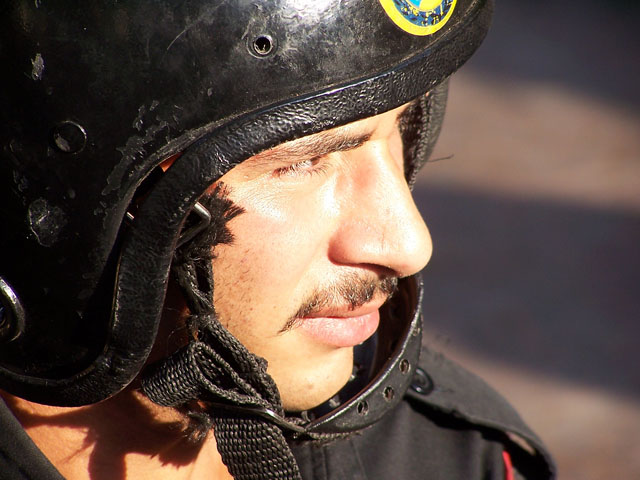
*Alf Shukr to the talented Mouaten Masri for the photograph of the CSF recruit.