Tuesday, November 07, 2006

Social Science in the Public Interest

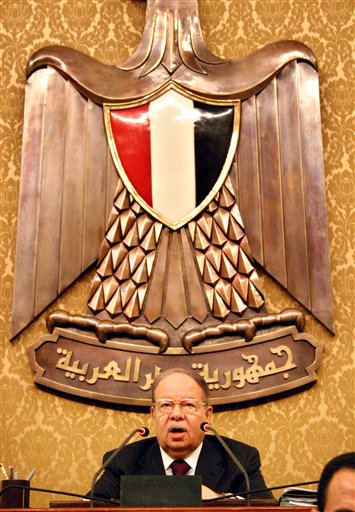
The Marxist intellectual, prolific development economist, and stringent perfectionist Ismail Sabri Abdallah passed away on 6 November, 2006, at the age of 81 (photo courtesy of al-Masry al-Youm). Abdallah harboured many ostensible contradictions. He was a scion of patricians who devoted his life to redistributing economic and political power to the poor. He was a deeply knowledgeable, even zealous follower of Karl Marx’s ideas while being equally brined in the profundities of Arabic thought and history (especially poetry). He fused a deep familiarity with and respect for southern Egyptian folkways with a charming, uncontrived Francophile streak. He spoke and wrote precise and lucid prose in Arabic, French, and English. His adult life oscillated between membership in underground Marxist organisations, long stints in prison, equally long stints as a decision-maker in the highest echelons of government, and collaboration with a wide network of international development organisations.

Ismail Sabri Abdallah was one of a nearly extinct class of public intellectuals who also doubled as public servants, and were highly esteemed in both capacities. Toward the end of his life, he told me, “I’m still a Marxist until this moment because I haven’t found a better method to analyse social events. I’ve been in prison and in power and I still haven’t changed my mind!” Continuously since the 1950s, he worked to apply social science to real-world problems, to use conceptual tools to mobilise broad swathes of the public rather than enlighten only narrow segments of the elite. He was a rare gem in an intellectual field cluttered with irrelevant theorists, sycophantic yes-men, and a stultifying, generalised air of mediocrity.


Abdallah was born in 1925 to a family of rural notables that hailed from Upper Egypt. His cultured, erudite father invested much in his children’s education. Ismail’s sister was one of the first to attend a boarding school established by Nabawiyya Musa, the pioneer advocate of women’s education. Ismail’s early intellectual strivings were nurtured by his father’s extensive library, particularly rich in the classics of Arabic literature. Ismail then enrolled at the Law Faculty and immersed himself in the heady politics of Egyptian communism of the 1940s, when various communist factions alternately competed and cooperated with one another and with other ideological formations to recruit adherents. In a conversation with me toward the end of his life, Abdallah recalled that it was during this formative period that he understood that electoral democracy was meaningless without a bedrock of economic redistribution.

After graduating from law school in 1946, Ismail could not pursue serious study of economics in Egypt since there was no Economics faculty (the Economics and Political Science Faculty would eventually be established in the early 1960s), so he traveled to the University of Paris, where he earned a doctoral degree in economics in 1951 (he wrote his dissertation on the theory of money). But Abdallah’s time in Paris was not confined to the university library. He mingled in French leftist circles, where he met his future wife, Gulpérie Aflaton, a free-spirited Egyptian woman from an aristocratic family, the sister of equally spirited socialist-feminist activist and painter Injy Aflaton.

The couple returned to Cairo and married in 1951, and Abdallah took up a post as a lecturer in Alexandria University. In November 1954, the bright young economist was recruited to become an economic adviser to the president’s office, but less than a year later, in June 1955, he was arrested, charged with membership in an illegal communist organisation, and tortured in a military prison before being released by an irregular tribunal. The abrupt oscillation between elite technocrat and political prisoner would not end there.

After the nationalisation of the Suez Canal in 1956 and the Egyptianisation of banks and foreign businesses, Nasser’s regime created the Economic Institution (al-Mu’asasa al-Iqtisadiyya) in January 1957 as a public holding company to manage all existing public enterprises that were formerly British and French assets. Abdallah was appointed as head of the Institution’s Economic and Financial Division, a post that entailed considerable access to the president. For the Economic Institution was not only a source of unfiltered technical expertise, but an attempt by Nasser to check other state institutions, especially the Ministry of Industry led by the ambitious Aziz Sidqi.
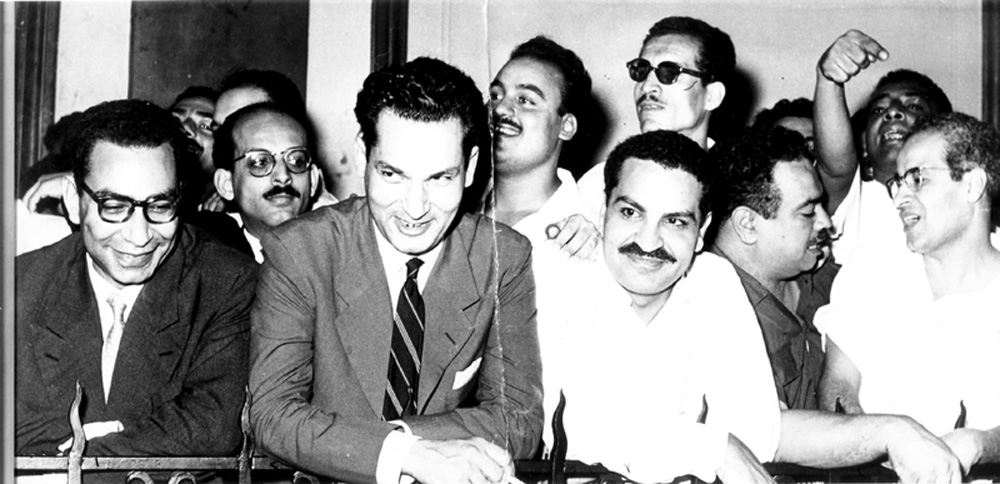
But only two years later, on New Year’s Day 1959, Abdallah was rounded up again along with 200 other socialists and communists, including the recently departed and much-missed Ahmad Nabil al-Hilali. They were tried by military tribunals and sentenced to three- and five-year gaol terms. Abdalla and his colleagues are pictured in the dock on 6 September, 1959.

Abdallah was a key figure in the remarkable world created by Egyptian leftists during their desert prison confinement from 1959-1964. His death is a serious loss for any attempt at reconstructing an oral history of this defining moment in Egyptian political annals. Abdallah recalled fondly and very vividly the rich educational and cultural activities of the prisoners, including lessons in everything from astronomy to mathematics to the staging and production of plays by two theatre troupes. Abdallah taught international politics, Abdel Azim Anis taught mathematics, and Ahmad Youssef al-Guindi taught Russian. But when Abdallah embarked on a translation of Das Kapital (Part One), the prison administration confiscated his papers, he remembered with a raucous laugh. For Gulpérie Aflaton, this period was particularly trying, as both her husband and her sister were imprisoned, an experience that she recounts in her memoir La ballade de geôles (2002).


In yet another startling and abrupt transformation, after their release in 1964, the former prisoners of conscience were appointed to leadership positions in the state’s cultural institutions, essentially managing the Nasserist state’s remarkable patronage of the arts. Abdallah became chief editor of the venerable publishing house Dar al-Ma’arif. At the same time, he was on the editorial team of an entirely new and creative experiment, the leftist monthly review al-Tali’a (the Vanguard). When Gamal Abdel Nasser made a quick appearance at their inaugural editorial meeting, accompanied by Muhammad Hasanein Haykal, Abdallah (seated to Nasser's right) and al-Tali’a editor Lotfi al-Kholi (seated to Haykal's left) expressed surprise that the president would not sit down for a conversation. So Abdel Nasser sat down, and a sophisticated discussion ensued.

Reflecting on the man whose regime both violently harassed and dramatically promoted him, Abdallah’s tone held an unmistakeable hint of admiration, “He’s really a Shakespearean character: when he was powerful, he was not intellectually mature, but when he matured after 1967, he was no longer powerful.”

For about 10-15 years, al-Tali’a was one of a handful of the most important publications in Egypt, featuring pieces by leading public intellectuals such as Adil Hussein, Tariq al-Bishri, Fu’ad Mursi, Abu Seif Youssef, and a legion of unsung political economists. It was very much an effort to employ social science in the public interest, to air provocative findings and chart important trends for the benefit of both policy-makers and the general public. The pages of al-Tali’a are especially intriguing after 1968, when Nasser began to experiment with new policies and political structures, partly in response to sustained societal criticism of his regime after the 1967 war. And throughout the 1970s, I’d say the profile of the journal was heightened even further, as it turned into the leading forum to air candid and credible critiques of public policies, most especially Sadat’s Infitah.

Abdallah’s career as a public servant continued in the Sadat years. He was a member of the committee that drafted the Constitution in summer 1971, and was particularly instrumental in the inclusion of the clause in Article 18 that insists that the state “provide for the independence of universities and scientific research centres.” As the Director General of the Institute of National Planning (1969-1977) and Minister of Planning (1971-1975), Abdallah led a team of economists that sought to articulate a strategic vision for Egypt’s economic development based on a robust industrial policy and a cautious approach to integration in the international economy. But those visions were increasingly at odds with Sadat’s conception of Infitah, and so Abdallah resigned his ministerial portfolio when the new Mamdouh Salem government was installed in April 1975 to root out all obstacles to Infitah, including public officials with socialist commitments.

Naturally, Abdallah was among the 1,536 intellectuals and activists ordered arrested by Sadat on 5 September, 1981. In his collection of essays, Tabareeh Gareeh, journalist Salah Eissa wrote a very moving description of this prison stint, including anecdotes about their lively political discussions, and oral poetry competitions that the prisoners organised to pass the time. As Eissa tells it, Abdallah won every time, so deep and erudite was his stock of memorised extracts from the classical canon.

From the 1980s onward, Abdallah continued to apply the vocation of social science to the cause of social justice, but now outside the halls of government for good. He helped to direct the venerable Egyptian Society for Political Economy, Statistics, and Legislation, and then started the Third World Forum, whose mission statement reads, “Intellectual self-reliance is a cornerstone to assure the success of Third World struggle for development. Its work involves and is addressed to mass organizations, scientists, intellectuals, academicians, technicians and politicians. It promotes problem oriented theoretical and empirical analysis aiming to provide real options for policy makers and organized social groups.” The forum's signature project, Egypt 2020, builds on Abdallah's early work in Images of the Arab Future (1983), an attempt to map out an endogenous, strategic plan for Arab development that the Arab Human Development Report would later echo, though without the emphasis on the development of specific, alternative futures scenarios.

To me, Abdallah’s legacy is manifold and wide-ranging: His commitment to praxis, his fusion of sophisticated modelling techniques with careful attention to the peculiarities of the Egyptian case, his commitment to maintaining autonomy from “The Prince” while training his expertise on the content of public policies, his relentless energy and productivity, his critical stance on prevailing orthodoxies, his accuracy and precision. I know that I and perhaps many others will continue to be inspired by Abdallah’s core political judgements: his faith in popular mobilisation, his insistence that Egyptian policy-makers do have the choice to carve out independent, reasoned policies, his deep suspicion of attempts to romanticise Egypt’s monarchical past as some putative golden age of pluralist politics, and his clear-eyed assessment of how to overcome Egypt’s deeply rooted, undemocratic legacies.

Abdallah’s endearing personal qualities are no less evocative for me: he hated mediocrity and resisted it in his daily life. He was punctual to a fault, dapper but never ostentatious, gregarious but never babbling, truly modest but without a hint of falsity. He was exasperatingly stubborn and dogmatic about rival political factions, most especially the Islamists, the only issue in which his clear thinking gave way to what I think was really political envy more than anything else.

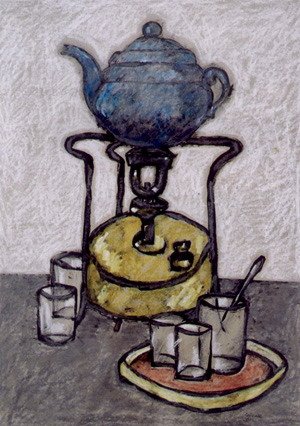
As those who knew him know well, Ismail Sabri Abdallah went to work every day in a nondescript office in begrimed building No. 36 on chaotic Dokki St., the kind of building that reeks of history, where the stairs sag under the accumulated weight of the years, the stairwells are pitch black, and the patterned tiles have taken on a dull, grey hue. His desk was perpendicular to the desk of his lifelong fellow traveller, Ibrahim Saad Eddin; the two looked like two ancient civil servants poring over administrative memoranda. While Abdallah was gregarious, Saad Eddin was the quiet scribe who softly interjected reminders or corrections to the occasional visitor who interrupted their quiet work routine. The tea always came in a chipped teacup and mismatched saucer, the chair was uncomfortable and downright evil, and the conversation was never anything but edifying, stimulating, and challenging.

Adieu, Doktor Ismail Sabri Abdallah.

Monday, October 30, 2006

Sociability

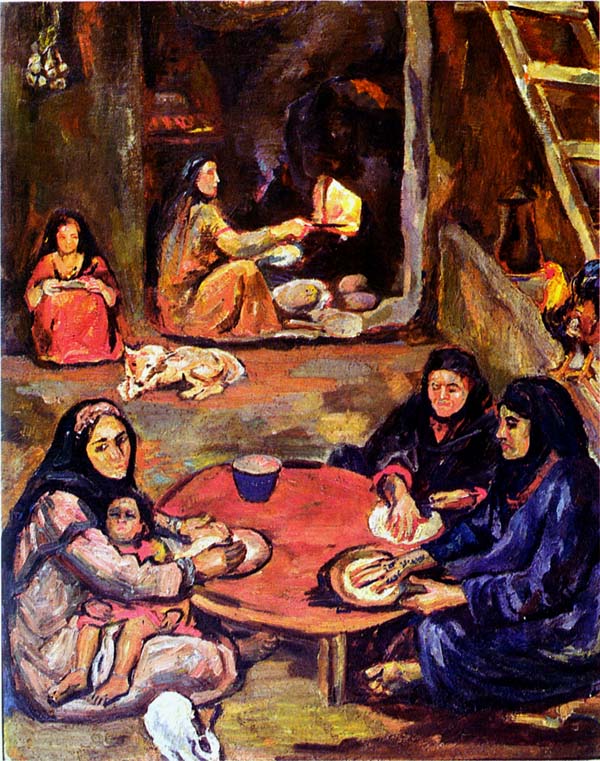
Wabur Gaz (1981), Adel Thabet Attalah (1943-)

Monday, October 16, 2006

Monday, October 09, 2006

The Magnificent Sharafantah

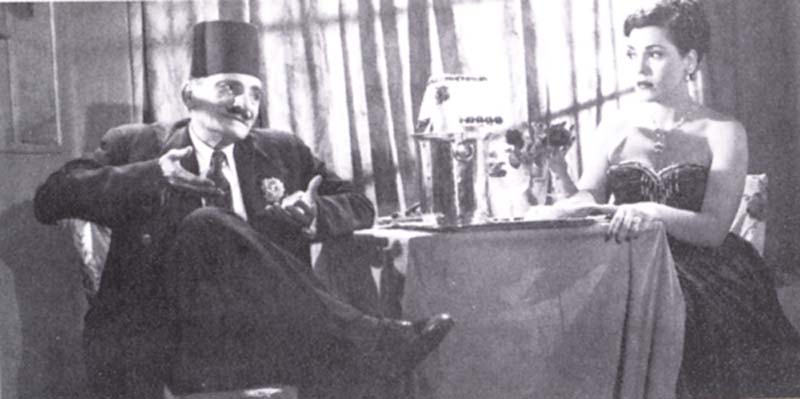
Though he never played a leading role, and he never attained much fame, I will always love Muhammad Kamal al-Masri (1886-1958). In every film I’ve seen him in, he acts his supporting roles with such gusto, skill, and evident fun that it’s impossible not to be taken in by his charm and naturally comedic face. The first time I saw him was in his final film, ‘Afreetat Ismail Yassin (1954), where he played the loony eccentric who dons furniture covers as capes to keep his clothes clean, with little ribbons running down the front of the cape (for style, naturally). I laughed out loud, envying such an absolutely ridiculous and brilliant idea!

The Cairene al-Masri was a born performer. He started acting at an early age, and later joined the theatre troupes of Salama Hegazy and Sayed Darwish. This vaudevillian milieu, so rich in turn of the 20th century Egypt, was nicely portrayed in Habib al-‘Umr (1947), where Masri plays an entertainer with the lively troupe led by Farid l’Atrache. “Sharafantah” is the name of a theater character that al-Masri once played on stage, a name that he would later adopt as his professional moniker.


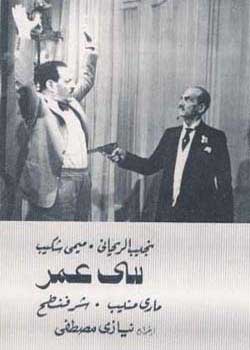
Something about Sharafantah’s malleable face makes me giggle, and it’s not just the curled moustaches. It must be how swiftly the face morphs from serenity to wild anger, as it did in Miss Mama (1949), when a perfectly cordial barbering session ends with the irate Sharafantah threatening the terrified Muhammad Fawzi with a very sharp knife. But predictably, my favourites are the two classics, Salama fi Khayr (1937) and Si Omar (1941). Before this brilliant collaboration with Naguib al-Rihani, the two were actually on very bad terms. But luckily for devotees of Egyptian cinema, reconciliation ensued and spawned an unforgettable comedic duo.

The two films are based on identical gags, where the put-upon simple clerk played by al-Rihani is mistaken for a prominent and monied personage. Sharafantah, of course, plays the suspicious snoop who calls the bluff. As with so many flicks of that era, both films are conservative, crude morality tales about the perils of class mixing, at a time when political ferment and social transformations were unsettling the established order in Egypt.

But as comedies, they work beautifully. I enjoy Salama fi Khayr slightly more than Si Omar, mostly because of how much Salama (al-Rihani) and his uptight schoolteacher neighbour Bayoumi Morgaan (Sharafantah) revel in hating each other. It all starts when Salama, sitting down to a warm meal prepared by his kindly wife (a young Fardous Mohammed), is outraged by a huge chunk of ceiling that falls smack in the middle of his soup, courtesy of the incessant banging in Bayoumi effendi’s upstairs apartment. It’s all downhill from there, as both trade the most—how shall we say?—candid and pungent epithets (“you lowly dog!” “you shameless liar!”) Clearly, it’s much funnier in Arabic.


So during this Ramadan, which in its Egyptian version has come to mean not simply heightened spirituality but also cultural appreciation, I’d like to remember and esteem the great Sharafantah, for all the joy and laughter he brought to so many generations of film-lovers, for all the energy he brought to his roles, and for his positive inimitability.


*Poster of Si Omar found here, photo of Sharafantah from Mustafa Darwish, Dream Makers on the Nile (1998).

Sunday, September 24, 2006

Ramadan

Ramadan is here, with all of its magic and light.

Ramadan kareem, everyone. Try not to eat too much kunafa!

Tuesday, September 12, 2006

A Few of My Favourite Things

Every once in a while, I get a hankering for some of the commodities I grew up with. My memory is crammed with the locally produced goods churned out by our run-down, inefficient state factories of yore, with their no-nonsense packaging and unabashed use of garish primary colours. My retro streak returned recently. For no reason, I recalled Rabso, the all-purpose, can-do detergent in the lemon-yellow box with the flaming red sun surrounded by cheerful soap bubbles.

I feel the need to write an ode to Rabso.

When I was little, I pestered my grandmother to let me help on laundry day, when the bathroom turned into a steaming cauldron of boiling whites and the whole apartment was filled with the soothing smell of fresh-washed clothes. To pacify me, teta let me wash my grandfather’s cotton handkerchiefs in a small tisht. I happily sank both arms up to the elbows in the frothy Rabso suds, fiercely beating the delicate kerchiefs and spilling half the tisht water all over the floor. I also got to hang the kerchiefs, but only on the first clothesline closest to the balcony railing, and with teta firmly holding my hands and securing the wooden clothespins on the limp, chastened kerchiefs.

I didn’t care that Rabso always left tiny but painful blisters on my hands, even when I had rinsed them extra carefully. Helping with the wash was too much fun to pass up. I think it must have been then that I developed a loathing of dusting and sweeping and a love for laundry and all other water-based household chores.

Sadly, the mediocre Rabso and its pathetic “competitor” Omo (what kind of a dumb brand name is that?!) have been overtaken by the new, snazzier Persil, the hated Ariel, and the locally franchised versions of the American Tide and All. Now, “respectable” supermarkets and mini-markets wouldn’t be caught dead stocking Rabso and other such has-beens of the detergent world; they’re too passé for the upwardly mobile, brand-conscious bourgeois homemaker. The expiring public factories that produce Rabso and Omo would never even think to commission one of those chirpy commercials with the bouncy fellahat waxing enthusiastic in their fake rural accents. You have to go to the low-income stores and any of the surviving consumer cooperatives to find Rabso now. And there it’ll be, sitting on the dusty shelves with its eternally yellow box still stubbornly askew, relic of a bygone era of local industrialisation and sensible consumer thrift.


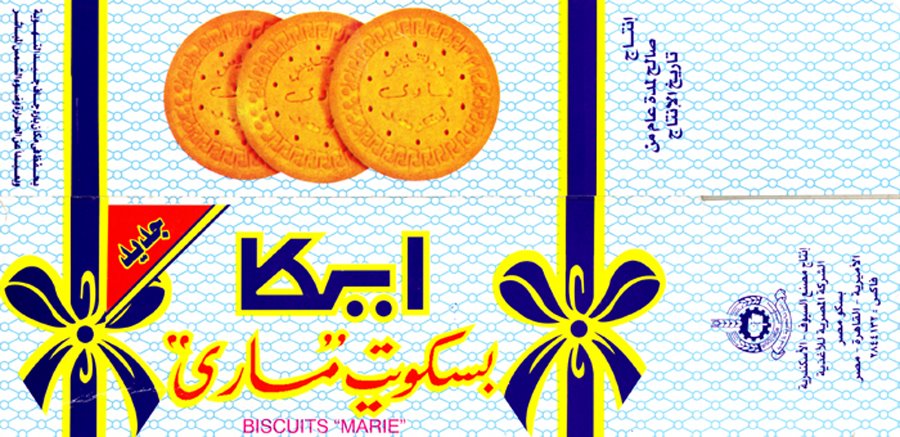
In my biased opinion, Biscuits “Marie” have got to be some of the most delectable cookies ever concocted by man. I grew up on these extremely brittle biscuits with the strong, artificial vanilla flavour and not-quite-crisp texture. Adults of a certain age will remember how the biscuits dissolve immediately the minute they’re dunked in tea. That’s the only way to have them, of course, soaked in black tea, although I recently devoured half a box of dry biscuits on an empty stomach and they were as delightful as ever.

Biscuits “Marie” (no idea why the quote marks) were both a favourite breakfast and a lovely dessert, light and filling at the same time, sublime in their straightforward plainness and absolute spurning of frill, save for the businesslike, faintly Grecian pattern engraved on each biscuit. The only extravagances allowed are the joyful blue-and-yellow ribbons on the package, a bit of whimsy perhaps from the marketing department at Biscomisr?!

Alas, the most excellent Biscuits “Marie” have not escaped the sad fate of Rabso. I’m sad to see them shunted aside on store shelves to make room for the fancy varieties from England, Denmark, and the UAE. In a bid at relevance, Biscomisr has appended an utterly unconvincing “New” to the package. But discerning tasters will know that the cookies have not changed a mote. And thank God for that. In a world of more-is-better and imported-is-best, the Spartan minimalism of my favourite biscuits is a delightful exception.

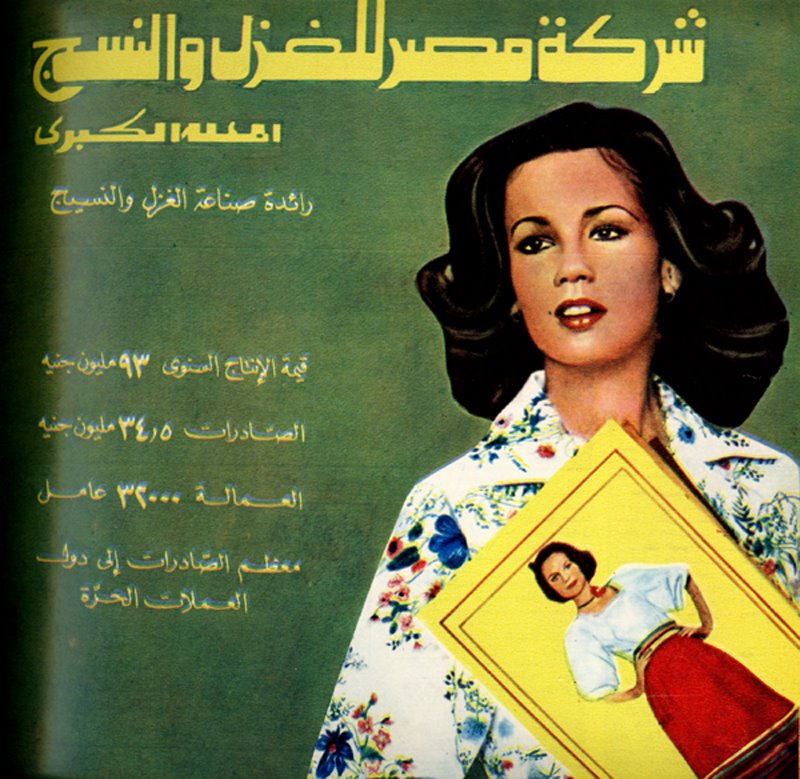
Once upon a time, it was chic to support local industry and buy domestic textiles. Nothing was finer than the threads produced by al-Mahalla al-Kubra’s many public factories. True, their towels and linens come in only limited colours and styles, but so what? I learned to love plain white and stay away from that peachy hue so ubiquitous on sheet sets. And I learned to love the chaotic designs and clashing colours on the Mahalla bath towels: who would have thought that pink and orange are a good combination?!

This advertisement from the 1970s boasts of the Egypt Textile Company’s productivity, £E34.5 million in exports made possible by 32,000 workers. Now, one by one, Mahalla’s textile companies are being privatised. The workers are laid off or given “early retirement” packages. The designs are spurning beautiful simplicity and embroidery for “modern” prints of large, ungainly flowers, or worse, atrocious “Pharaonic” designs all over the covertas. And for some ridiculous reason, a hideous shade of purple is now ubiquitous on the covertas, which aren’t made of 100% cotton anymore but increasingly incorporate polyester threads. To add insult to injury, there are now fake satin sheet sets that come in the most offensive colours. What is the world coming to?

In a grouchy mood, I went to el-Ghuriyya recently to look for some plain, cotton dinner napkins like the ones I bought years ago but are now too frayed. I didn’t even dare look for linen napkins with beautiful embroidered flowers, I know they’ve been extinct for a long time now. But even decent cotton napkins were nearly impossible to find, and I must have poked my head into every storefront on both sides of el-Ghuriyya and endured the bored stares of the shopkeepers. Finally, a curmudgeonly old vendor reluctantly pulled out a packet from a huge black plastic bag buried in the bottom of a cabinet. He grumbled and complained that the factories are being privatised and don’t sell such things anymore. He made it perfectly clear that I was quite an inconvenience, and yelled at me as if privatisation was my idea. But he did ask me what design I wanted, and let me riffle through them to choose. I picked half a dozen, pearl-white napkins with a subtle white-on-white floral design. They are so pretty I’ve decided not to use them, and keep them clean and folded in the china cabinet drawer.

I would now like to confess that I have always loved the stodgy, kitschy Qaha brand, with its cloying jams, syrups, and preserves that come in substandard packaging. I love the brand logo, the rotund orange with the chef’s hat and pea pods for arms. I don’t think I’ve ever seen anything so whimsical. I would buy a Qaha jam any day over any of the concoctions put out by Vitrac, if I can only find them. Metro and other supermarkets have apparently decided that selling Qaha is not chic, as a manager there told me in so many words. They prefer to stock their shelves with the American Smucker’s and various products from Central Europe, since of course anything imported is automatically….more chic.

This ad from the 1970s was Qaha’s attempt to remain relevant when faced with the influx of Infitah-era foreign competitors. Overnight, Qaha company became “the symbol of progress,” boasting boxed juices, frozen vegetables (packaged in polyethylene bags!), and pure honey. I suppose the blond children in the ad were an assurance of just how progressive Qaha is. Still, and despite the desperate advertising, I love Qaha, especially its apricot jam and juice. I’d like to pay tribute to it now, before it disappears for good, if it hasn’t already. Like Safinaz Kazem, I don’t much appreciate nostalgia, but there are always exceptions.

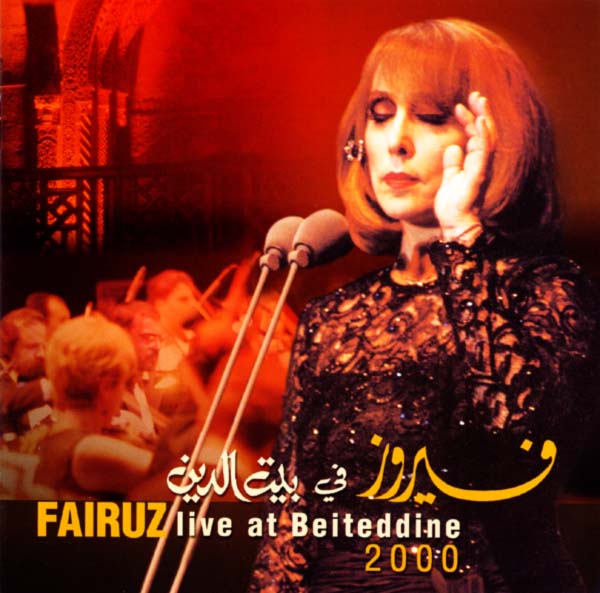
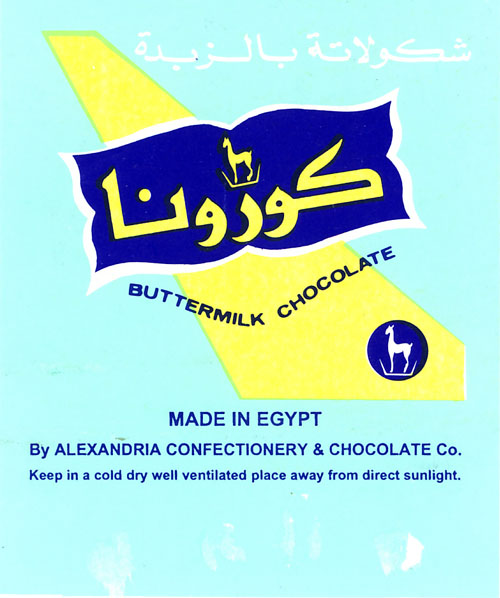
If Korona were to ever compete with other chocolates, there’s no doubt in my mind that it would barely make the bottom of the list. It’s too sweet, the chocolate used is obviously mediocre, and it’s always too soft no matter what the temperature is. It doesn’t melt in your mouth so much as stick there in a heavy lump (am I right?) But to my seven-year-old palate, Korona is the best chocolate in the world. It’s the most exciting treat in the world. Korona reminds me of the excitement and perpetual sense of wonder of my childhood. It reminds me of going to Um Sana’ all by myself and buying it along with bim bim (coca-cola flavour, please). Every time I walk into a baqqal now, my eye zooms in on the neat teal square lying forlornly in the fridge, overtaken by Toblerone and Twix. The grocer devastates me with his offhand remark, “children don’t prefer it now.” Maalesh, maybe one day they’ll rediscover its ordinary charm.

Sunday, August 27, 2006

The Domestic Wages of War

It’s too early to really know whether and how Egyptian politics will be affected by the latest regional armed conflict. Looking for dramatic change makes no sense, but whining that nothing will change is no better either (and more annoying). Every regional cataclysm has had an impact on domestic Egyptian politics. After all, no informed person needs to be reminded that the very character of contemporary Egyptian politics was forged in lockstep with defining regional events, specifically in the year 2000 when Hizballah drove out Israel from southern Lebanon in May and Palestinians embarked on the al-Aqsa Intifada in September.

The oft-heard claim that Egyptians (and all Arabs) first used to protest against Israel, then supposedly switched gears and turned their wrath upon their own governments is a myth. Domestic and regional politics have always been joined at the hip: protest against Israel was never a substitute for or a “distraction” from protest against ruling regimes. Instead, ever since the 1979 Israel-Egypt Peace Treaty and the summer 1982 Israeli invasion of Lebanon, Arab publics and oppositions have been protesting against both Israeli policies and their own governments’ foreign policies and domestic despotism. So although it’s early, I’d like to consider two domestic consequences of Israel’s 2006 war on Gaza and Lebanon: the intensification of criticisms of the president, and renewed debate over what constitutes (and who defines) Egyptian national security.


The President and the Adversarial Press


It’s no longer shocking to ravage Hosni Mubarak in the independent and partisan press. Let’s reflect on this for a moment. In the space of four short years, from Ariel Sharon’s reinvasion of the West Bank to the American invasion of Iraq to the present, the totemic untouchability of the Egyptian president has been shattered into a million little smithereens. It’s not just a matter of biting jokes and humour, because those have been circulating since time immemorial.


It’s a matter of holding the president accountable, as this headline from the 31 May al-Destour suggests. It’s a matter of developing serious critiques of Hosni Mubarak’s domestic and foreign policies, and questioning why the office of the Egyptian president, regardless of who holds it, should entail such stupendous prerogatives.

To give credit where credit is due: it was al-Sha’b newspaper in the mid-1990s that started it all, with its relentless pursuit of former kingpin Yusuf Wali (remember him?) and its none-too-subtle innuendo about the shady business practices of Mubarak’s sons. The 1995-1996 battle over the draconian press law originated in the government’s attempts to silence such muckraking, and Sha’b editor Magdi Hussein served gaol time more than once after being convicted of libel. The government bided its time and then pounced when it saw its opportune moment, shutting down al-Sha’b in May 2000 when the newspaper led a campaign against Haidar Haidar’s allegedly blasphemous novel A Banquet for Seaweed.

Fast forward a decade later, when innuendo has turned into blunt criticism, and newspapers have bypassed middling cronies and reached right to the top. Hosni Mubarak and his handlers kindly helped out in this project of presidential diminishment, with their remarkable mixture of incompetence, persistent miscalculation, and extraordinary indifference to the suffering of ordinary citizens. For instance, instead of resuscitating respect in the presidency and its current occupant, the 2005 presidential elections manoeuvre was swiftly exposed for the cynical sham that it was. Not only that, but the independent and partisan press took the election spectacle as an opportunity to imagine, debate, and demand countless alternatives to Hosni Mubarak and his hapless scion. Sadly, however, the politician who came closest to mounting a real challenge now languishes in prison, a permanent reminder of how poorly the Mubarak team managed their brilliant little exercise.

When Hizballah kidnapped the two Israeli soldiers on 12 July and the Israeli military responded by destroying Lebanon, every newspaper save for those owned by the government ratcheted up its tone against Mubarak. Whereas before, pungent criticism of the president was confined to the “extremist” Abdel Halim Qandils, Ibrahim Eissas, and Gamal Fahmis, now even “respectable” university professors, doctors, and judges joined in. The issue was not so much Mubarak’s rhetorical stupidity of blaming Hizballah as his utter failure to leverage Egypt’s regional heft into pressure on either the Americans or the Israelis. And just as al-Araby led the pack during the American war on Iraq and al-Destour excelled during the presidential election spectacle, it was al-Karama’s turn this year.

The independent Nasserist paper had been sparring with Mubarak and son since its founding last year, with biting words such as this front page of the 2 May issue, at the height of the judges’ crisis, and the blunt caricature from the same issue (top). But al-Karama dramatically upped the ante in its four most recent issues (Nos. 41-44), with blaring headlines asserting that Mubarak would be first on a top ten list of candidates for hell, speculating on whether he was guilty of treason, and averring that the first step on the road to liberation is the removal of the incumbent Arab regimes.

Naturally, the powers that be moved to put an end to this. Last week, they dispatched the venal Safwat al-Sherif, the head of something called the Supreme Press Council that licenses and attempts to control newspapers, to complain about “certain newspapers” abusing freedom of the press to “cause offense” to the president. In a bid to divide and rule journalists, the Supreme Press Council called on the elected board of the Press Syndicate to “apply the journalistic code of ethics” and discipline al-Karama and its ilk. This has caused a serious and genuine controversy among journalists and the public, especially because there’s a good case to be made that al-Karama veered from legitimate criticism of the highest public official to an indefensible speculation on his fate in the afterlife.

It’s nobody’s business whether Hosni Mubarak is slated for heaven or hell, and I believe al-Karama erred by venturing into this distasteful, moralising territory. Yet as its editors admitted, this was a mistake, one that should not be used to abridge nor impugn the crucial right to criticise the president, his policies, and his immunity from the accountability he promised with his elections. The regime sees this as a golden opportunity to conflate the issues of legitimate criticism of the president and illegitimate attack on his person, but my conjecture is that the free press and reading public will effectively resist the pilfering of this hard-won right.


Who Defines National Security?


Just as the Israeli war on Lebanon abetted the ongoing diminishment of presidential sanctity, so it has opened the Pandora’s box of what constitutes and who defines national security. All three Egyptian presidents have claimed the sole right to define the national interest and decide the components of national security, and for a while society did not resist. This changed with the 1967 defeat, when the swift and devastating Israeli victory was clearly linked to the regime’s ridiculous bravado and false assurances of protecting Egyptian territory. But societal forces did not mount a serious challenge to the president’s prerogative of defining national security until Sadat's 1977 visit to Israel and address before the Knesset, when almost all organised sectors of Egyptian society rose up against Sadat’s sudden, unilateral, and enthusiastic overture to the Americans and Israelis.

Here too the president’s behaviour aided his own challengers. The professionalism and gravity with which Sadat supervised the Egyptian military’s partial victory in 1973 began to give way to disturbing delusions of grandeur. Sadat entered his Pharaoh phase, when he began believing his ridiculous rhetoric about being “the father of the Egyptian family” dispensing “the morals of the village.” So desperate was he to live up to Israeli and American flattering of him as a courageous world statesman that he scorned and then attempted to extinguish mounting domestic criticism. When Nasserist parliamentarian Kamal Ahmed hurled the epithet of “traitor” at the president in parliament, a taboo was broken and never repaired.

Hosni Mubarak inherited the strategic choices of Sadat, but not his tactics. At the beginning of his tenure, he repaired the rift between Egypt and her Arab neighbours and visibly cooled his predecessor’s enthusiasm for peace with Israel and cooperation with the United States. But despite his best efforts, challenging the regime’s definition of national security was a genie that had permanently escaped the bottle. Opposing the alliance with the United States and normalisation with Israel by definition meant criticising the Mubarak regime. Think of the heated press debates in the 1980s over the “American infiltration of Egypt,” the recurrent controversy over the role of USAID, the massive protests over Mubarak’s decision to include Egyptian troops in the American-led coalition to oust Iraq from Kuwait, the popular celebration over Hizballah’s victory over Israel in 2000, the furore over Ariel Sharon’s visit to al-Haram al-Sharif that instigated the al-Aqsa intifada, protest at the government’s decision to sell natural gas to Israel and ink the QIZ, and on and on. Underlying all these events was anger at the Mubarak government for inaction or facilitation of American and Israeli designs. Which is why I will never understand the ludicrous claim that Egyptians used to protest against Israel and America, and then started protesting against their own government.

Both Sadat and Mubarak’s definitions of national security and foreign policy centre on what they have termed “pragmatism,” that is, accepting and working with the regional status quo. As Sadat famously put it, “99% of the cards are in America’s hands.” And as Mubarak recently quipped, in answer to a reporter’s question about charting a different foreign policy, “You want me to go into the lion’s lair?” Cautious mediation and working with rather than challenging the United States and Israel are the fundaments of Mubarak’s regional stance, earning him brownie points internationally as a “moderate” Arab ruler.

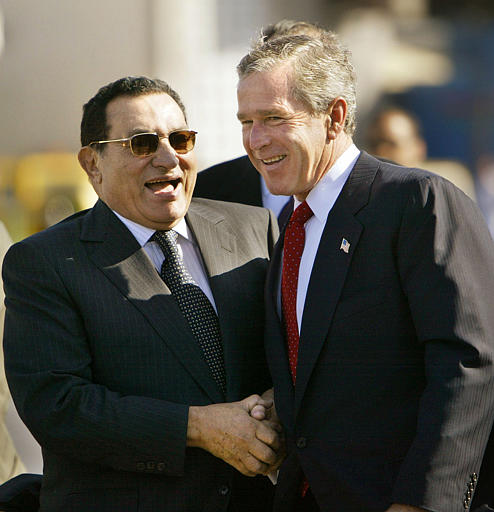
But I’m hard pressed to detect anything moderate in his effusive expressions of fealty and goodwill to American and Israeli leaders. (Mubarak with George W. Bush on 4 June, 2003 in Sharm al-Shaykh, and with Ehud Olmert on 4 June, 2006 in Sharm al-Shaykh). Can you feel the love?

Where Mubarak and his advisers see pragmatism, critics see at best ineffective use of Egypt’s regional clout and at worst complete surrender to American and Israeli dictates. In my opinion, the most provocative and sustained critique of the Mubarak regime’s understanding of the national interest is former judge Tariq al-Bishri’s series of 2002 essays, collated in a booklet titled The Arabs in the Face of Aggression. As with all of his ideas, bits and pieces of Bishri’s critique have been adopted by independent and opposition pundits in their commentaries on the recent war. They have characterized Egypt as no more influential than a courier, ferrying messages between the Americans, Israelis, and Palestinian officials. Hizballah’s fortitude in the face of the Israeli onslaught has once again proven Bishri’s point that the choice of “pragmatism” is just that: a choice (and an undemocratic one to boot), not the superior product of wise statesmanship nor an inevitable outcome of the regional power balance.

Throughout July and August, dozens of public meetings were held, manifestoes penned, opinion pieces printed, and demonstrations organised to vocally challenge the regime’s fundamental foreign policy choices. Dozens of protest slogans, citizen petitions, and household conversations violated the American-Israeli-Egyptian government-imposed taboo on questioning existing “strategic alliances” by wondering how Egyptian national security is preserved when 1.4 million Gazans are systematically impoverished and disenfranchised, dozens of Iraqis are killed each day, and the whole of Lebanon is destroyed.

I want to single out just one out of the mounds of protest ephemera produced since 12 July: the Judges Club statement issued on 3 August, reminiscent of earlier Club resolutions such as the anti-Iraq war statement, and of course, the classic statement of March 1968. In a seven-point resolution, judges declared their “faith that popular resistance is the only path to protect the Arab nation and maintain its honour,” called on Arab regimes “to take clear positions representative of their people to dispel the suspicion that their task is to protect American interests and guard the borders of the Zionist entity,” and said that “it is no longer acceptable for Egypt to comply with the peace treaty with the Zionist enemy, after Israel has assassinated any hope of achieving peace and declared unequivocally that it will not return the land it has occupied, including Jerusalem.”

The judges concluded: “The most salient cause of this ordeal is the weakness that has afflicted the nation due to corruption and repression, evading granting Arab peoples their right to participation and self-governance by diminishing judicial independence, restricting freedoms of expression and political association, neglecting fair elections while taking care to monopolise power, and obstructing the realisation of real democracy.”

This spring, I remember that the international press was a having grand old time making heroes out of Egyptian judges and waxing poetic about their stately Club. I wonder, will they continue to do so now that it’s clear that to be pro-democracy does not mean to be pro-American, pro-normalisation, and pro-“pragmatism,” hmmmmm?


Democracy?


(al-Destour, 26 July 2006)


If criticising the president now knows no bounds, and challenging the regime’s version of national security is now commonplace, does this constitute a net gain for Egyptian democratisation? I think yes. Almost all regional wars have had democratising effects on Egyptian politics, meaning that they have shattered political taboos, widened the opportunities for ordinary people to make their voices heard, and increased the number and potency of popular organisations challenging or monitoring the government. The Israeli war on Lebanon and Gaza fed the increasingly adversarial press, further whittled the president down to size, and broadened debate on national security. To the extent that very little is now sacred, that we have a rambunctious watchdog press curbing and embarrassing public officials, and that basic tenets of the regime’s national security doctrine are no longer off-limits, then the war has had democratising effects.

I see no evidence and little logic to the claim that Arab democracy was the big loser in the war. Unless of course democracy is defined as being “moderate,” “pragmatic,” pro-American, pro-normalisation, etcetera. This is an influential definition, but a very rotten and disingenuous one, mish keda?

But democratic gains are fragile and not irreversible. Regime crackdowns are always possible, and imminent. American, Israeli, and Arab government campaigns to discredit their challengers as “nationalist,” “fascist,” “demagogic,” “extremist,” etcetera are always in the making. A lively, muckraking press can dissolve into shrill inefficacy if not bolstered by a professional, investigative press that asks hard questions and puts forth creative solutions to social problems. Broad public debate on the components of national security is just talk if not accompanied by effective organising that can translate into policy change. Time will tell if the latest regional war has indeed democratised Egyptian politics, and how durable and transformative those democratic gains will be.

Wednesday, August 09, 2006

The Games Regimes Play

Gamal Hosni Mubarak has never met a tragedy he couldn’t use. Remember when he staged a “moment of silence” for the al-Salam ferry victims back in February? Or when he led an “anti-war rally” in Cairo stadium during the American invasion of Iraq in 2003? Now, nearly a month into the Israeli destruction of Lebanon, Mr Gamal Hosni Mubarak finds it fitting to lead a “delegation” of government hacks and assorted nobodies to “express support” for the benighted country. They descended on Beirut in an Egyptian military plane, but not before they sought and received the permission of the Israeli government. As we all know, Egyptian and Jordanian military planes are the only ones Israel is allowing to land at Beirut’s Rafiq Hariri International Airport.


My, my, my. Look at Mr Gamal Hosni Mubarak, with the best seat in the house, posing for the cameras. Notice the facial expression, all steely-jawed gravitas. Proper, no? Mark the badge with the Egyptian and Lebanese flags on his lapel. Nice touch. He told Lebanese television that the trip “reflected the Egyptian people’s solidarity with the Lebanese people and government.” Marvelous.

Once again, Mr Gamal Hosni Mubarak dares to speak for the Egyptian people. But this time, he added insult to injury by pretending to care for the Lebanese people.

But why should I be surprised? What else should one expect from the Mubarak regime but grovelling to the Israelis, using the Lebanese for a photo op, and keeping one nervous eye on the outraged Egyptian public and another on the demanding American bosses? A despised, depleted regime desperately clinging to power should never be cause for wonderment. A despised, depleted regime seeking to salvage some paltry war profits should not be cause for surprise.

And yet, the sense of outrage never wanes.

Hosni Mubarak’s regime is doing what it does during every regional war. It manages a precarious balancing act between following American and Israeli orders to a T while simultaneously engaging in theatrics to prove to its people that it represents their sentiments. In April 2002, when Sharon re-invaded the West Bank and the Jordanian queen led a “solidarity procession” for Palestinians, Gamal’s mummy was not to be upstaged. She staged her very own stunt, leading a caravan of relief supplies to Rafah.


In March 2003, Gamal and friends staged-managed an “anti-war rally” featuring that veteran Egyptian anti-war activist: Adel Imam. And last year, Gamal made sure to attend Rafiq al-Hariri’s funeral and bond with his pro-American mate Saa’d. Today, it’s this business of the military plane carrying relief supplies and the photo op with the embattled Lebanese government. But not before Hosni Mubarak blamed Hizballah for ill-considered “adventurism” and merely pooh-poohed the crimes in Qana as “irresponsible.”


The regime’s dilemma is real, and never more acute than today. Its stock with both foreign bosses and domestic public is dangerously depleted, its credibility with both irrevocably undermined. Mubarak no longer carries any regional clout with the Americans and the aspiring regional hegemon, Israel. Ironically, his long years of dedicated advocacy of their interests have eroded rather than bolstered his value in their eyes. While he has not yet become a liability, he has turned into something of a nuisance, a bumbling old man bereft of intelligence or finesse, just barely doing his job as the go-between of last resort. He’s repeatedly called upon to thwart Hamas and press the Syrians to pressure Hizballah, he’s instructed to utter inanities about Arab Shia’s loyalty to Iran. And then he’s told to hunker down in Sharm al-Shaykh and shut up for a while until his next assignment.

Domestically, of course, Mubarak and his cronies are on an even more precarious footing. His compliant foreign policy has dramatically hastened his domestic fall from grace, ever since that fateful day in March 2003 when his huge poster was ripped off the NDP headquarters by anti-war protestors. Since then, his policies and his family have drawn nothing but non-stop condemnation and derision in the press, on the streets, and in salons. Another irony: Mubarak’s presidential elections manoeuvre actually unleashed new challenges to both his person and his office, instead of shoring up his legitimacy as planned.

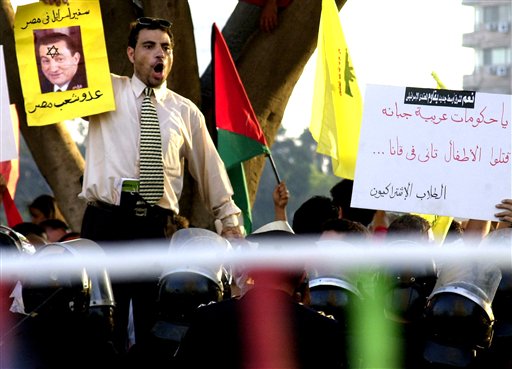
It’s no longer shocking to accuse Mubarak of being a faithful guardian of foreign interests, as these protestors did in Cairo on 6 August.

The biggest irony of all is that the Mubarak regime’s predicament may be sustainable, constituting an equilibrium state rather than some harbinger of imminent downfall or transformation. Undemocratic client regimes, even incompetent ones, can survive indefinitely. Tempting and logical as it may sound, there’s no inevitable sequence that starts with regional war leading to an angry public rising up and ending in regime change or collapse.

That means that one should brace oneself for the unbearable but very likely possibility that Mubarak and son may yet continue their miserable existence, having no compunction about capitalising on the suffering of the Lebanese people to cling to power. In fact, the Israeli destruction of Lebanon (and the American destruction of Iraq before it) offers quite an opportunity for Gamal Hosni Mubarak to further insinuate himself into Egyptian public life. He can “express solidarity” all he likes and at the same time emphasise the fait accompli of his public, political role.

There remains the stubborn little fact that the Egyptian and fellow Arab publics are not for one second fooled by their regimes’ pathetic ploys. If anything, the games these regimes play provide delicious fodder for activists and oppositions to underline how unrepresentative and cynical their rulers are. Rather than lull or confuse people, such games expose how these regimes endanger rather than protect national interests. Rather than entertain or edify, the games offend, injure, and galvanise.

To find out how the games end, we have to wait and watch closely, as Arab regimes, the American and Israeli regimes, and Arab publics duke it out on the battlefield of conflicting interests.

*AP Photos

Saturday, July 29, 2006

Power Politics

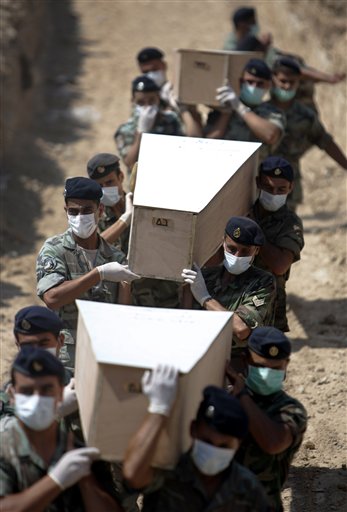
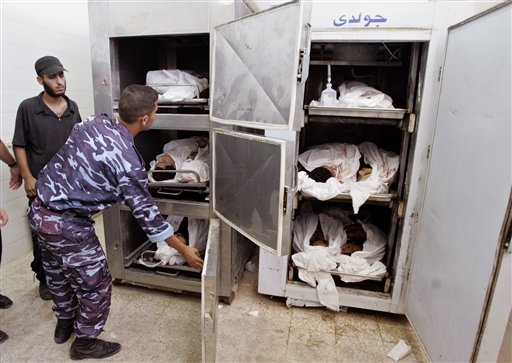
In Tyre (Soure) today, 31 victims killed by Israeli bombs over the past week were buried en masse. The youngest victim is one-day old Sawsan Tajeldin (left), killed along with her mother, when the car they were fleeing from the nearby village of Bazouriyeh was hit by an Israeli warplane missile.


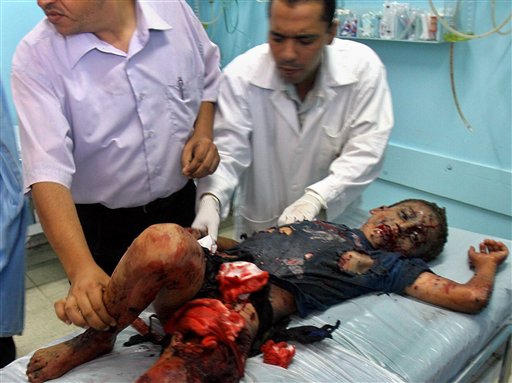
The war on Lebanon has eclipsed the unremitting Israeli offensive in Gaza, obscenely codenamed "Samson's Pillars." Late last week, Palestinians buried Anas Zoumlot, 12 (above), Asmaa Okal, 33, and her two daughters Maria, 5, and Shahd, 8 months, all of the Jabaliyya refugee camp.Dr. Mona El Farra writes from Gaza, “Our news isn’t covered, people are feeling disappointed, devastated and abandoned with the world’s reaction, especially the governments.”

On Wednesday alone, 23 Palestinians were killed, the same day that world “leaders” and regional rulers convened in Rome to do whatever it is they do, which did not include agreeing to an immediate cease-fire and compelling Israel to abide by it. Instead, Israeli Justice Minister Haim Ramon declared, “We received yesterday at the Rome conference permission from the world ... to continue the operation, this war, until Hezbollah won’t be located in Lebanon and until it is disarmed.” He continued, “What we need to activate in south Lebanon is tremendous firepower before ground forces enter. Our great advantage against Hezbollah is firepower, not hand-to-hand combat.” Carry on, then.


The Past

Israel’s latest futile war to extinguish Hamas and Hizballah, enthusiastically abetted by the American government, predictably calls to mind earlier “great power” ploys to crush nationalist forces. It’s a very old story, but let’s start 50 years ago, when Israel, France and Britain pooled their efforts to bomb Port Said after Gamal Abdel Nasser nationalised the Suez on 26 July 1956 (above). Three summers earlier, in August 1953, the Anglo-American “Operation Ajax” unseated Iranian Prime Minister Mohammed Mossadeq and forcibly restored the skittish Mohammed Reza Shah. The cause was the same effort to exert national self-determination.
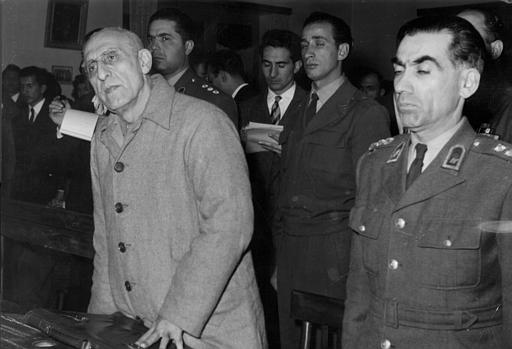
Two years earlier, in March 1951, the Iranian Majlis electrified the world by nationalising Iran’s oil industry and appointing the honourable Mossadeq as prime minister. Such boldness was not acceptable to foreign businesses and governments, so they immediately started plotting. American and British oilmen boycotted Iranian oil, while their governments hatched a secret plan to overthrow the intractable Mossadeq and reinstall the hapless shah. And so it came to pass. In August 1953, royalist military forces captured Mossadeq, and he was tried by a military tribunal (below) and sentenced to three years’ solitary confinement. The nationalist politician who had attempted to democratise Iran spent the rest of his life under house arrest until his death in 1967. As for the Pahlavi Shah, he was kindly assisted by American and Israeli advisers in the creation of his internal security organ, SAVAK, the organisation responsible for the comprehensive surveillance and torture of political dissidents during the shah’s uninterrupted reign from 1953 to 1979.

Now, it’s very tempting to draw parallels between foreign powers’ machinations in the 1950s and today’s war. There’s much to be said about the American, British, and Israeli governments’ constant fear and loathing of any attempts at national self-determination (and the French government’s too when it comes to the Maghreb). In fact, the American government’s pathetic claims about democracy promotion and the Israeli government’s transparent propaganda about “fighting terror” are mediocre carbon copies of colonial Britain and France’s claims to educate the natives about self-government and purge them of “bolshevism” (what attempts at self-determination were branded back then).

Indeed, Israeli Minister Haim Ramon’s lust for firepower to quell the Lebanese natives echoes Mandatory Britain’s bombing campaigns of recalcitrant Iraqi tribes in the 1930s and Mandatory France’s massive bombardment of Damascus in 1945. So let’s not waste time debating the “democracy promotion” and “fighting terror” rubbish. The United States and Israel want pliant Arab (and Iranian) populations and recumbent regional regimes, end of story. No amount of U.S. “public diplomacy” or Israeli deployment of victimhood will dispel this stubborn fact.


The Present


But there's a key difference between the 1950s and now. Today’s nationalists are far more formidable foes for the hell bent powers. Hamas and Hizballah are immeasurably more significant than Nasser and even Mossadeq. Why? Because unlike Nasser, their legitimacy rests on a firm electoral base and decades of dogged constituency service. As Nasserists are the first to admit, Abdel Nasser did things for the people, not by them. His legitimacy was real, his popularity was palpable, but his undoing was swift. He did not put in the effort to build the links that would tide him over in rough times. And so when his system came under attack in 1967, it was unable to withstand the shock. The massive popular protests that erupted on 9 June 1967 to rally around the diminished president soon turned into destabilising popular protests in February 1968 demanding real accountability and meaningful political opening, while the judicial sector staged its first intrepid bid for both autonomy from and oversight over a rotten regime.

And though Mossadeq was a far more credentialed democrat than Nasser, with real links to those he represented, his National Front was a tenuous agglomeration of diverse interests that began to fragment when the international vise around Iran tightened. That was when the communist Tudeh party emerged as a real alternative to the imploding National Front. By contrast, both Hamas and Hizballah are disciplined, internally coherent political organisations. They have been remarkably adept at maintaining organisational resilience in the face of overwhelming centrifugal pressures.

What’s more, they have few to no competitors on the Arab political scene in terms of the clarity of their political message, the performance of their deputies, and the independence of their leadership. Leftists are unable to build durable links to the public, much less gain more than a handful of seats in any election. “Liberals” are unable to set down credible roots untainted by American sponsorship. As the ever-insightful Diaa’ Rashwan wondered recently, we know what they’re against, but what on earth are they for? And as for the ruling regimes, well, that’s a cruelly unfair comparison now, isn’t it? Please observe the unmistakeable mystique of the dignified, unbowed Islamists compared to the bloated, servile, imbecilic Arab incumbents, with their unfailingly awkward gestures and those moronic grins plastered on their faces all the time.


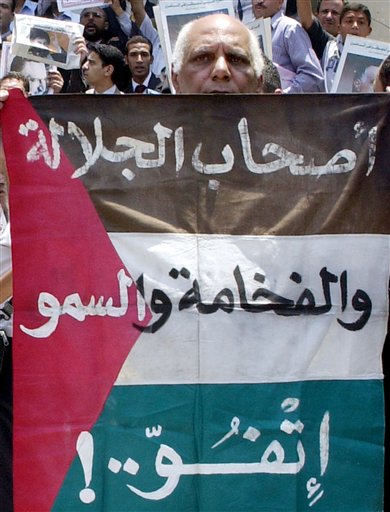
This placard at a Cairo protest on 26 July sums it up best: Hasan Nasrallah is a master, the trio of jokers on the left are nothing but slaves.

In a word, Hamas and Hizballah are underwritten by the gold standard of democratic legitimacy in a region replete with fakes and knock-offs. For obvious reasons, fragile revolutionary legitimacy à la Nasser no longer captures the public’s imagination. Tradition-based legitimacy is wearing thin in the monarchies, its rickety founding myths increasingly scrutinised and challenged. No one believes in economic performance-based legitimacy anymore, since nearly all the region’s governments long ago stopped delivering or enabling any sort of economic performance to the majority of the governed.

Democratic legitimacy is the criterion now, on the full understanding that those who don’t deliver are to be voted out. The real significance of the January elections in Palestine is that they offered an opportunity to demystify Hamas, to subject it to the unforgiving test of governance. Instead, the U.S. and Israel were gripped by an insane frenzy, orchestrating an international boycott of the Hamas-led government while bleating inanities about not dealing with “terrorists.” Of course, the boycott did nothing but intensify Hamas’ popularity and reinforce its aura of purity, while life for Gazans reached crisis levels.


The Future


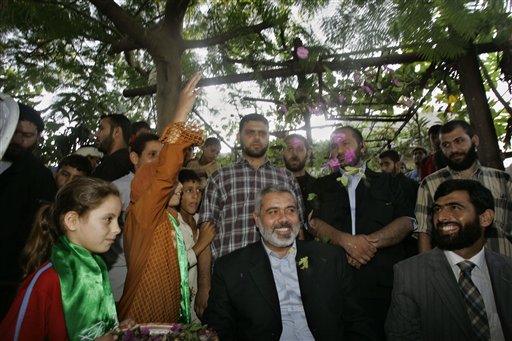
Discipline, organisation, and hard work at the grassroots give today’s nationalists a formidable foundation for resistance. Hizballlah’s robust advocacy on behalf of the Shia untouchables of Lebanese society and Hamas’ credible representation of the Palestinian quest for dignity and justice are assets that are unlikely to erode as easily as Nasser and Mossadeq’s resources were diminished. It’s not a matter of social movements versus government officials, either, since both Hamas and Hizballah now boast plenty of government officials. It’s the nature of the linkage between leadership and the rank-and-file, and between the organisation and the public. Charisma alone is no longer sufficient. Democratic accountability and constituent service are now indispensable. A small but moving gesture: When Palestinian premier Ismail Haniyeh along with other government officials received half his salary earlier this month, he donated 7,600 shekels (US$ 1,700) to the family of Hadeel Ghabn (above), an eight-year-old girl killed by an Israeli shell back in April.

It is a delectable irony to me that Ms Condoleezza Rice’s much-maligned remark about the “birth pangs of a new Middle East” is actually accurate, but not in the manner she and her glib wordsmiths intended. The new Middle East that the US and Israel must now confront is a fundamentally different animal from the one their predecessors faced in the 1950s. Neutralising nationalist regimes was a cakewalk compared to the current task of attempting to pacify robust popular movements. This is the paradigm shift transpiring in the Middle East for the past quarter-century. As the US, Israel and fellow travellers reaped spectacular success in taming erstwhile intractable regimes (just look at the laughingstock Hosni Mubarak), they spawned a new class of modern socio-political movements that have held out the promise of inclusion and emancipation to millions of ordinary people, on a scale unseen since the dawn of mass politics in the late 19th century.

(Choueifat, southern Beirut, 18 July 2006).

These movements don’t just offer monetary loans, cleaned streets, affordable schools, and functioning hospitals. They offer the dignity and honour that comes from resistance, the same dignity and honour that motivated the anti-fascist resistance, the same dignity and honour that bolstered the Jews of the Warsaw Ghetto. I want to know, does the Israeli government and its American enabler think they can extinguish this quest for human dignity with cluster-bombing, the destruction of infrastructure, and the killing of infants and toddlers?

*AP Photos

Thursday, July 20, 2006

Graphic Content

While Arab kings and presidents grinned from ear to ear and conferred on the “crisis” under the watchful eyes of their security details, displacement, death, and destruction blanketed Gaza and Lebanon. The massive Israeli offensive by air, sea, and land spares no one and shows no signs of abatement.

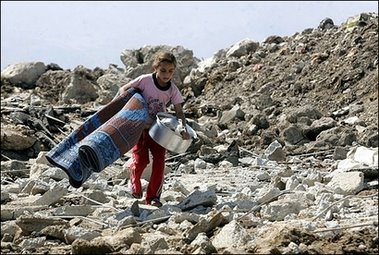
A Lebanese girl crosses a destroyed bridge in the village of Ferzoul, near Zahle city in the Bekaa valley of Lebanon, and a Palestinian boy is severely wounded during an Israeli army attack on the Mughazi refugee camp in Gaza (20 July).


Palestinian policemen inspect bodies of Palestinians killed in the Israeli offensive against the Mughazi refugee camp before they are released to their families (20 July). Medics help a woman who was injured in an Israeli aircraft attack that destroyed a house in Tyre, Lebanon (16 July).

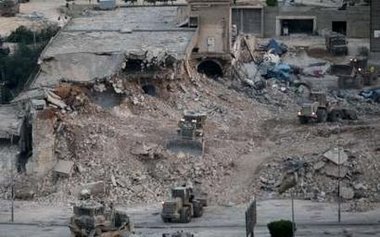
In Nablus, Israeli bulldozers destroyed a building used by the Palestinian Interior Ministry (20 July).

To date, well over 100 Gazans and 300 Lebanese have been killed; Israelis killed number 28.

While world "leaders" hemmed and hawed and repeated that "Israel has the right to defend itself," ordinary people have taken action. In the past week, Arabs and non-Arabs all over the world have expressed their outrage at Israeli aggression and solidarity with the Lebanese and Palestinian peoples. Protests of varying sizes erupted in Brazil, Greece, Mexico, Turkey, Pakistan, Jordan, Egypt, Yemen, Venezuela, Britain, Bangladesh, Malaysia, Chile, El Salvador, the United States, Ukraine, Kuwait, Spain, Iraq, Indonesia, Syria, the Philippines, and Argentina.

Meanwhile, yesterday American Secretary of State Condoleezza Rice dined with UN Secretary-General Kofi Annan at the Waldorf Astoria Hotel in New York and "discussed the situation in the Middle East." The United States and Israel oppose the UN's call for an immediate ceasefire. Perhaps they feel that not enough Arab civilians have been killed to warrant a ceasefire. Israel's ambassador to the UN said, "When you operate on a cancerous growth you do not stop in the middle, sew the patient up and tell him keep living with that growth until it kills you...You make sure it is totally removed."

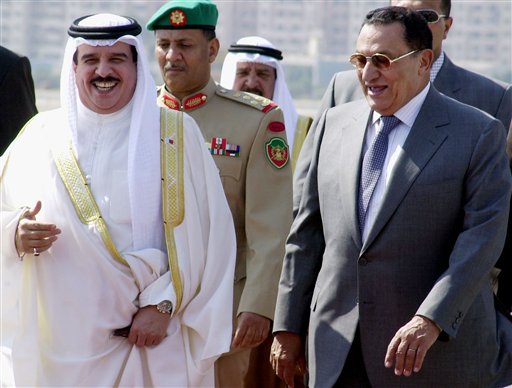
Today’s al-Ahram indicates that in their summit, Mubarak and the Bahraini potentate "emphasised the importance of stability in the Middle East, and preventing the escalation of the situation in a manner difficult to control, and prioritising the language of dialogue instead of the language of force."

On 16 July, in a protest in Cairo, al-Karama movement's Muhammad al-Ashqar held up a sign that made its first appearance in March 2003, during the American invasion of Iraq: “Your majesties and excellencies: spit on you!”

*Photos from AP, Reuters, AFP.

Saturday, July 08, 2006

Egyptian Laws and Other Afflictions

Mr Anwar Sadat had a notorious but particularly apt expression whenever he embarked on one of his endless authoritarian manoeuvres. “It’s all by law!” (kullu bil qanun!) he would intone. Indeed, Egypt’s rulers have always understood that violent repression alone is never enough to control a complex society of guilds. So they have found in rule by law an utterly indispensable tool to certify and smooth the project of social control. Gamal Abdel Nasser understood this, and so does Sadat’s less colourful though no less devious successor.

From day one of his tenure, Mubarak invoked the handy legal tools bequeathed to him by his predecessors. But given how systematically and uninterruptedly he has been pilloried for the past three years, it was only a matter of time before his regime resorted to obscure legal provisions that had long fallen into disuse. And so the improbable subject of law has permeated nearly every political struggle of the past few years.


If we focus on just the past six months, there’s the judges’ saga and its many intricate details. And the farrago of charges brought against demonstrators assaulted and detained for peacefully expressing their solidarity with judges. And the criminal case against journalist Wael al-Ibrashi et al for publishing the “black list” of judges alleged to have participated in election fraud. And the lower court ruling against al-Dustour editor Ibrahim Eissa and journalist Sahar Zaki for simply reporting on a routine suit. And the current battle over new legislation governing “press offences.” There’s no single thread connecting all of these events, except that they all dramatise the modern political struggle between a repressive state wielding draconian laws, and citizens seeking the repeal and reform of such oppressive ordinances.


A Cornucopia of Crimes


As with any authoritarian state worth its salt, the Egyptian version has stacks upon stacks of repetitive, overlapping, ambiguously worded laws designed to control and constrain every aspect of life. Let’s take the notorious Assembly Law 10/1914 (right), crafted immediately after the outbreak of WW I. Still very much in use, provisions of this law are repeatedly invoked against peaceful demonstrators, most recently those detained in April and May for expressing their solidarity with judges. Articles 1 and 2 criminalise any gathering of at least five people that “endangers public peace,” “obstructs the implementation of laws and statutes,” or “influences authorities carrying out their duties.” The punishment is imprisonment for no more than six months or a fine that does not exceed £E20 (if weapons are involved, the punishment is increased to two years or £E50).

In addition to crimes scattered throughout individual ordinances and those compiled in the Code of Criminal Procedure (Qanun al-Ijra’at al-Jina’iyya), the magnum opus of Egyptian crime is of course the trusty Penal Code, Qanun al-‘Uqubat, promulgated on 31 July, 1937 (the image at top is a copy of its antique 1904 forbear). I confess to an utterly zany fascination with this tome, though I cannot read through it for more than 20 minutes before a deep, trembling fear grips me and I feel like the perpetually panic-stricken Ismail Yassin when he says, “Ya mama!”

The Penal Law makes it seem as if anything is potentially criminal. There’s the notorious Article 48 on criminal conspiracy, etched into the Code after the assassination of Prime Minister Boutrus Ghali by the young pharmacology student Mahmoud al-Wardani in 1910. In his 1910 Annual Report, Lord Cromer’s successor Sir Eldon Gorst assured British parliamentarians, “The investigation of this case showed that the Egyptian Government did not possess sufficient power to deal with conspiracies for the commission of illegal acts, and that certain other measures were also necessary, especially as regards the section of the Code dealing with press offences, to repress evils which had manifested themselves during these proceedings. Laws…were therefore passed without delay to remedy these legislative defects.”

Article 48 was worded in such a way as to offer authorities maximum leeway in criminalising any action of which they did not approve. It essentially allowed police to detain any two people talking to each other on a street corner. After all, they could be deviously conspiring to commit a crime, even if no actual crime has been committed. Predictably, the Article proved very serviceable for subsequent rulers. In 2001, Professor Saad Eddin Ibrahim and his fellow defendants were accused of criminally conspiring to bribe television officials to air positive programming on Ibrahim’s research centre. While convicting Ibrahim on other charges, the court rejected this particular charge, without explanation. Fortunately for all Egyptians, a few days later (in a separate case) the Supreme Constitutional Court deemed this notorious Article unconstitutional. It is a matter of bitter irony to me that one of the principal architects of the sham legal case against Saad Eddin Ibrahim, the deeply unpopular and disreputable Maher Abdel Wahed, is now, incredibly, the Chief Justice of the sadly extinguished Supreme Constitutional Court.

Let’s continue on our pleasant little stroll through the Egyptian Penal Code, shall we? Section II Chapter 7 of the Code is all about Resisting Rulers and Not Obeying their Orders and Assaulting them with Slander and Other Means (actual title). Chapter 13 has everything you wanted to know about Obstructing Communications (including some specific charges levelled at the pro-democracy demonstrators). If you’re interested in how you can criminalise worker strikes and sit-ins, kindly turn to Section II Chapter 5 and Section III Chapter 15. Section III Chapter 7 enumerates the ways and means of slander and libel, including harassing a female in public (Article 306(bis), while Chapter 12 deals with gambling and lottery-related crimes (what on earth?!....). Finally, Section IV is a comprehensive list of petty violations such as throwing trash in the Nile, siccing dogs on others (such as police who sic dogs on peaceful protestors?), and causing a ruckus at night that disturbs the neighbours (good to know next time the crazy upstairs neighbours start screaming insanely at 4 am).


Harming the Government and Other Misdemeanours


Of course, Penal Codes are by definition…punitive! But the issue is how crimes are conceived and worded, and whether they’re added through the proper parliamentary channels after careful debate, or rather smuggled in by executive diktat when parliament is in recess. Given the ubiquity of Articles enumerating crimes against the government and their linguistic elasticity, it’s obvious that the Penal Code is a palimpsest of successive rulers’ efforts at political control rather than a compendium of international “best practices” in criminal legislation, as the government routinely claims. If anything, as the much-mourned and sorely missed Nabil al-Hilali taught us, Egyptian criminal provisions have more often than not copied international worst practices.

Take Article 98(A), levelled at Egyptian communists in 1979. It stipulates punishment of 10 years’ imprisonment for “anyone who establishes, organises, or steers organisations aiming to impose the control of one social class over others or aims to eliminate a social class or seeks to subvert the state’s social or economic foundations.” As Hilali explained, the Egyptian importers of the offending Article admitted that it was copied from a fascist law promulgated by Mussolini in 1930 to combat communists. After an aborted attempt by Ismail Sidqi to add the Article to the Penal Code in 1946, it was successfully included by Gamal Abdel Nasser soon after the March crisis of 1954 and the assassination attempt in Alexandria’s Manshiyya square.

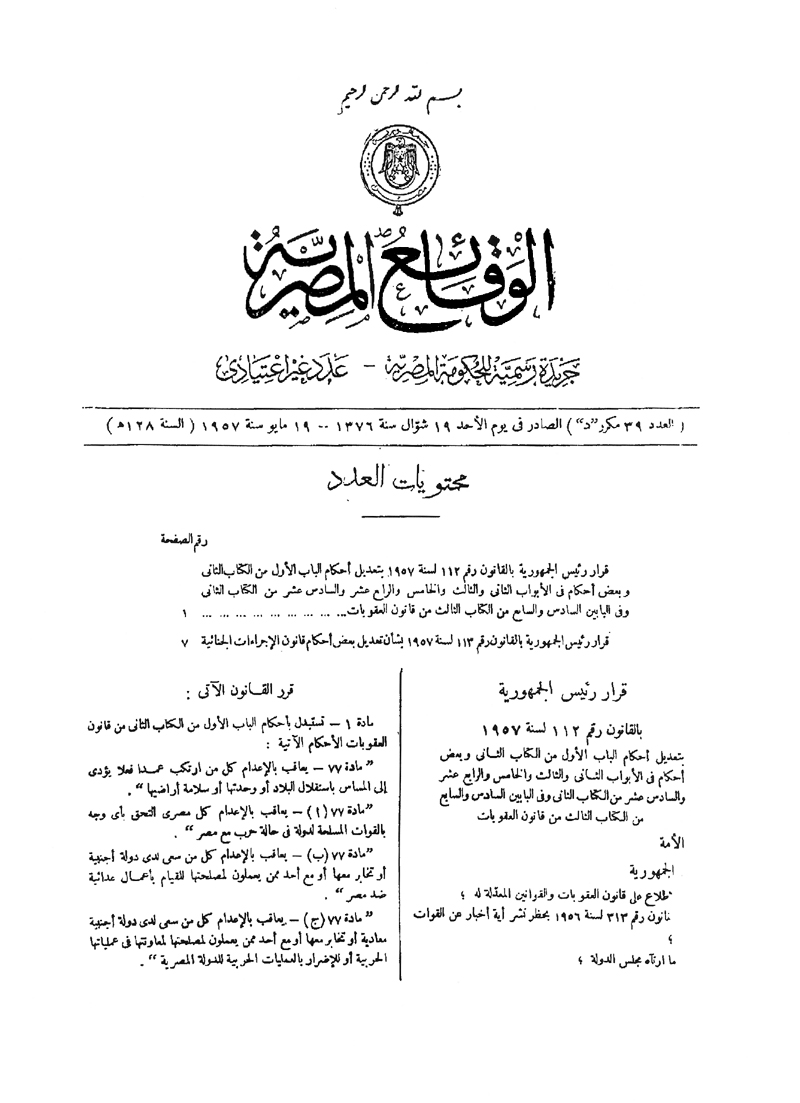
Another infamous legal product of rulers’ will to power is the notorious Article 80(d), added to the Penal Code in 1957 as part of a package of “crimes and misdemeanours emanating from abroad harmful to government security,” (left). The Article stipulates imprisonment for “every Egyptian who intentionally disseminates abroad false news, reports, or rumours on domestic conditions, with the result of weakening the financial confidence in the state.” The legislation was in part a response to the landed, anti-Nasser Abul Fath family and their radio station “Free Egypt Broadcasting” (Idha’at Misr al-Hurra), which disseminated material critical of the Egyptian regime from Beirut during the 1956 tripartite aggression. The Article remained buried in the Code unused until Mubarak’s legal henchmen found it useful and invoked it against sociologist Saad Eddin Ibrahim in 2001 and 2002, for allegedly “tarnishing the state’s image abroad” with his research on the status of Egyptian Copts.

And yet for all that, the Penal Code is not without some unexpectedly promising provisions. Section II Chapter 6 for example is all about public officials’ maltreatment of citizens. Article 129 specifies one year imprisonment or an (admittedly paltry) £E200 fine for any functionary who “relying on his position uses cruelty with the people in a manner that violates their honour or causes pain to their bodies.” Sounds like the perfect answer to Mubarak’s legion of torturers. But here’s the rub: While Article 126 stipulates a jail term of 3-10 years’ hard labour for any government agent utilising torture, its definition of torture is confined only to cases where the torture is applied to extract a confession, eliding the myriad cases of abuse inflicted for other purposes or for no purpose at all. Rights groups have long advocated a minimum of five years’ hard labour and the amendment of Article 126 to make the definition of torture consistent with Article 1 of the Convention Against Torture. The bitter irony here is that Egypt was the first Arab state to accede to the Convention, in 1986.


Crimes Occurring via Newspapers and Other Means
(such as Insulting the Ruler)


All of these crimes and we’ve yet to discuss the mother of them all: insulting the ruler. This particular offence falls within the infamous and forever controversial Section II, Chapter 14 of the Code titled: Crimes Occurring via Newspapers and Other Means, which enumerates in painstaking detail all the dastardly deeds that newspapers are inclined to. Perhaps the most persistent and outrageous provision in this Section is Article 179, first dubbed “Offence to the Monarchical Self” when Egypt was a monarchy. It stipulated imprisonment of up to five years for anyone “who causes offence to the royal self,” the queen, the heir to the throne, or regents. What’s more, the punishment was doubled if the offence occurred in the presence of any of the above! As our friend Sayed Ashmawi has colourfully shown, this was a particularly popular charge in the late 1940s and early 1950s, when the royal family came in for increasingly biting criticism from feisty newspapers and popular political forces.

Instead of being relegated to the trash bin of the royalist past after the republican transition in 1953, the Article’s language was simply amended in 1957 to read “insult the president,” and punishment was reduced to imprisonment for one year. And so it remains on the books to this day, yet invoked only once: against the people’s bard Ahmad Fu’ad Nigm in 1978 for mocking Anwar Sadat in his poem, “An Important Announcement,” (Bayan Ham). The Article remained dormant from 1978 until spring 2006, when the State Security Prosecution charged the peaceful demonstrators with, among other unforgivables, insulting the president of the republic through open defamation and slander (horrors!)

As if the very term “insulting the president” is not surreal enough and juridically nonsensical, last month there was an even more bizarre twist when the Warraq Misdemeanours Court invoked this Article and sentenced three ordinary citizens to one year in prison. The details are familiar by now. Citizen Said Muhammad Abdallah did what dozens of ordinary citizens do every day: he sued the president qua president, as per Article 68 of the Constitution guaranteeing resort to the courts as a basic right. His case was accepted by the administrative courts under number 3019/60th JY. al-Destour reporter Sahar Zaki reported on the suit, which though routine did have the distinction of targeting Hosni Mubarak personally for misuse of public funds and other abuses of power. But it’s common for newspapers to report on the filing of interesting, unusual, significant, or simply frivolous suits, particularly if they involve those in power as defendants.

The truly irregular aspect in all this is that seven individuals in the same neighbourhood of Warraq, hearing of Abdallah’s suit, took it upon themselves to sue him, Ibrahim, and Zaki for “insulting the president” and “intentionally broadcasting news or false rumours that disturb the public peace or strike fear in the people or harm the public interest,” (Penal Code Article 102bis). Though the plaintiffs had no standing (locus standi), and it is wholly unclear what action they were asking the court to rule on, lower court judge Osama Salah ruled for them. Unusually, he also went much further, castigating journalists for abusing the generous doses of freedom provided for them by the president.

Its oddity and legal dubiousness aside, the case underlines the nefarious contents of the Penal Code. A quick glance through Section II Chapter 14 reveals the extensive tools available for those in power to perfectly legally silence the advocates of the adversarial (if not yet investigative) press. Prison sentences abound for anyone who insults or defames a foreign king or president (Art. 181), an agent of a foreign government residing in Egypt (Art. 182), parliament, the military, the courts, or public agencies (Art. 184), and public servants or representatives (Art. 185).

The government’s proposed amendments to these and other offences is nothing but a manoeuvre designed to stem the tide of intensifying opposition and press scrutiny of powerholders’ wealth and assets. Instead of the current punishment of a monetary fine and 2-5 years’ imprisonment for slandering a public official (Art. 303), the government’s proposal is gaol time not to exceed 2 years or a fine of £E15,000-30,000. Journalists have long demanded the complete abolishment of imprisonment for ‘press offences,’ and a maximum amount of £E10,000 for fines.


Mafeesh Fayda v. The Spirit of Nabil al-Hilali

Just as it did with the amendments to the judiciary law, the government this week will surely ram through parliament the press-related amendments to the Penal Code, thus further fortifying the legal infrastructure of authoritarian rule. It’s nothing we haven’t seen before. Just think back to Anti-Terrorism Law 97/1992, Professional Associations Law 100/1993, replacing bottom-up election of university deans and village mayors with top-down appointment in 1994, Press Law 93/1995, and NGO Laws 153/99 and 84/2002. Just as with all of these previous laws, there will surely be valiant stands by individual, honourable members of parliament. There will be street protests, strikes, sit-ins, and emergency general assemblies. There will be considerable furore in the press. And there will be many futile meetings with the entertaining Mr Fathi Sorour, who is a picture to behold with his ravishing comb-over, shameless sophistry, and generalised air of thorough venality and inanity.

The current stand-off between the government and organised sectors of society isn’t some unexpected “clampdown” or “backtracking on reform” (by the way, I’d love to meet this fetching Mr Government Reform if anyone can introduce him to me). Let’s not be silly and parrot this most repeated and meaningless take on current developments, then raise up our hands and exasperatedly cry “mafeesh fayda!” (as Saad Zaghloul is supposed to have said) simply because the rulers have got their way. No one in their right mind expected judicial independence to be actuated this spring, or a robust and effectively protected Fourth Estate to materialise this month. It’s not just that these are long-drawn out, marathon battles that span out over decades, nor that they rarely conform to neat little storylines with satisfying endings and unambiguous “outcomes,” nor even that large, dramatic transformations are wrought from small, obscure struggles.

It’s that there’s intrinsic value in understanding the details of large power plays, to honouring those who toil in obscurity to fight this or that repressive law, to appreciating those who sue the president to make a point, and recognising those parliamentary deputies who vote against an unjust bill that they know for certain will be passed, and standing in awe of those voters who brave tear gas and rubber bullets to record their choice. I’ve never heard any of them utter the dismissive, indifferent, and offensive “mafeesh fayda.”