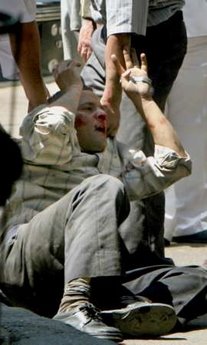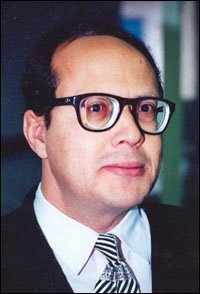
Saturday, July 29, 2006

Power Politics

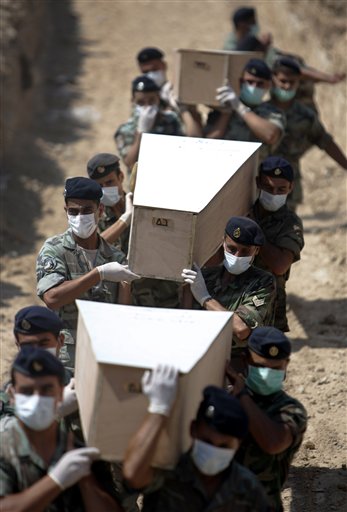
In Tyre (Soure) today, 31 victims killed by Israeli bombs over the past week were buried en masse. The youngest victim is one-day old Sawsan Tajeldin (left), killed along with her mother, when the car they were fleeing from the nearby village of Bazouriyeh was hit by an Israeli warplane missile.


The war on Lebanon has eclipsed the unremitting Israeli offensive in Gaza, obscenely codenamed "Samson's Pillars." Late last week, Palestinians buried Anas Zoumlot, 12 (above), Asmaa Okal, 33, and her two daughters Maria, 5, and Shahd, 8 months, all of the Jabaliyya refugee camp.Dr. Mona El Farra writes from Gaza, “Our news isn’t covered, people are feeling disappointed, devastated and abandoned with the world’s reaction, especially the governments.”

On Wednesday alone, 23 Palestinians were killed, the same day that world “leaders” and regional rulers convened in Rome to do whatever it is they do, which did not include agreeing to an immediate cease-fire and compelling Israel to abide by it. Instead, Israeli Justice Minister Haim Ramon declared, “We received yesterday at the Rome conference permission from the world ... to continue the operation, this war, until Hezbollah won’t be located in Lebanon and until it is disarmed.” He continued, “What we need to activate in south Lebanon is tremendous firepower before ground forces enter. Our great advantage against Hezbollah is firepower, not hand-to-hand combat.” Carry on, then.


The Past

Israel’s latest futile war to extinguish Hamas and Hizballah, enthusiastically abetted by the American government, predictably calls to mind earlier “great power” ploys to crush nationalist forces. It’s a very old story, but let’s start 50 years ago, when Israel, France and Britain pooled their efforts to bomb Port Said after Gamal Abdel Nasser nationalised the Suez on 26 July 1956 (above). Three summers earlier, in August 1953, the Anglo-American “Operation Ajax” unseated Iranian Prime Minister Mohammed Mossadeq and forcibly restored the skittish Mohammed Reza Shah. The cause was the same effort to exert national self-determination.

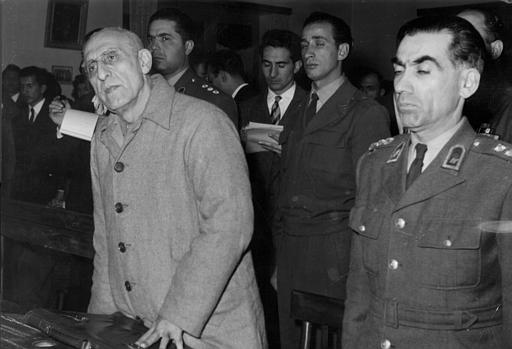
Two years earlier, in March 1951, the Iranian Majlis electrified the world by nationalising Iran’s oil industry and appointing the honourable Mossadeq as prime minister. Such boldness was not acceptable to foreign businesses and governments, so they immediately started plotting. American and British oilmen boycotted Iranian oil, while their governments hatched a secret plan to overthrow the intractable Mossadeq and reinstall the hapless shah. And so it came to pass. In August 1953, royalist military forces captured Mossadeq, and he was tried by a military tribunal (below) and sentenced to three years’ solitary confinement. The nationalist politician who had attempted to democratise Iran spent the rest of his life under house arrest until his death in 1967. As for the Pahlavi Shah, he was kindly assisted by American and Israeli advisers in the creation of his internal security organ, SAVAK, the organisation responsible for the comprehensive surveillance and torture of political dissidents during the shah’s uninterrupted reign from 1953 to 1979.
Now, it’s very tempting to draw parallels between foreign powers’ machinations in the 1950s and today’s war. There’s much to be said about the American, British, and Israeli governments’ constant fear and loathing of any attempts at national self-determination (and the French government’s too when it comes to the Maghreb). In fact, the American government’s pathetic claims about democracy promotion and the Israeli government’s transparent propaganda about “fighting terror” are mediocre carbon copies of colonial Britain and France’s claims to educate the natives about self-government and purge them of “bolshevism” (what attempts at self-determination were branded back then).

Indeed, Israeli Minister Haim Ramon’s lust for firepower to quell the Lebanese natives echoes Mandatory Britain’s bombing campaigns of recalcitrant Iraqi tribes in the 1930s and Mandatory France’s massive bombardment of Damascus in 1945. So let’s not waste time debating the “democracy promotion” and “fighting terror” rubbish. The United States and Israel want pliant Arab (and Iranian) populations and recumbent regional regimes, end of story. No amount of U.S. “public diplomacy” or Israeli deployment of victimhood will dispel this stubborn fact.


The Present


But there's a key difference between the 1950s and now. Today’s nationalists are far more formidable foes for the hell bent powers. Hamas and Hizballah are immeasurably more significant than Nasser and even Mossadeq. Why? Because unlike Nasser, their legitimacy rests on a firm electoral base and decades of dogged constituency service. As Nasserists are the first to admit, Abdel Nasser did things for the people, not by them. His legitimacy was real, his popularity was palpable, but his undoing was swift. He did not put in the effort to build the links that would tide him over in rough times. And so when his system came under attack in 1967, it was unable to withstand the shock. The massive popular protests that erupted on 9 June 1967 to rally around the diminished president soon turned into destabilising popular protests in February 1968 demanding real accountability and meaningful political opening, while the judicial sector staged its first intrepid bid for both autonomy from and oversight over a rotten regime.

And though Mossadeq was a far more credentialed democrat than Nasser, with real links to those he represented, his National Front was a tenuous agglomeration of diverse interests that began to fragment when the international vise around Iran tightened. That was when the communist Tudeh party emerged as a real alternative to the imploding National Front. By contrast, both Hamas and Hizballah are disciplined, internally coherent political organisations. They have been remarkably adept at maintaining organisational resilience in the face of overwhelming centrifugal pressures.

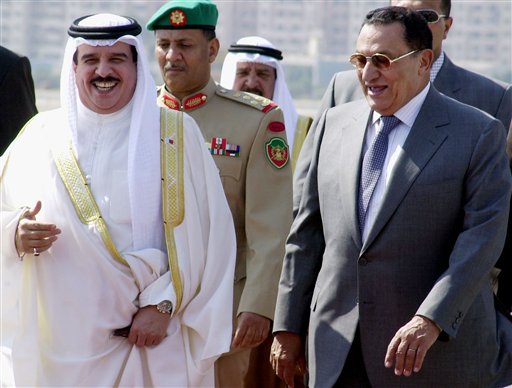
What’s more, they have few to no competitors on the Arab political scene in terms of the clarity of their political message, the performance of their deputies, and the independence of their leadership. Leftists are unable to build durable links to the public, much less gain more than a handful of seats in any election. “Liberals” are unable to set down credible roots untainted by American sponsorship. As the ever-insightful Diaa’ Rashwan wondered recently, we know what they’re against, but what on earth are they for? And as for the ruling regimes, well, that’s a cruelly unfair comparison now, isn’t it? Please observe the unmistakeable mystique of the dignified, unbowed Islamists compared to the bloated, servile, imbecilic Arab incumbents, with their unfailingly awkward gestures and those moronic grins plastered on their faces all the time.


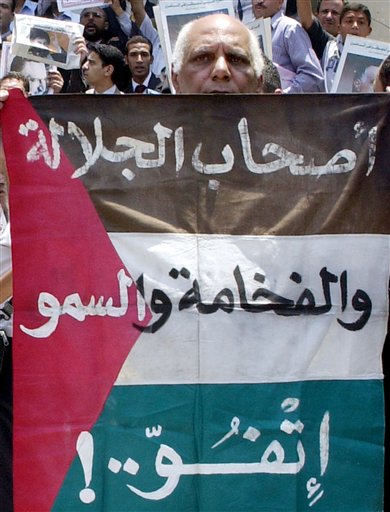
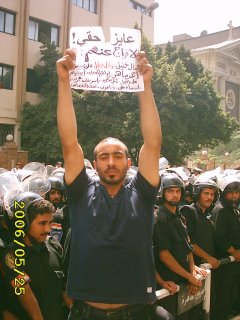
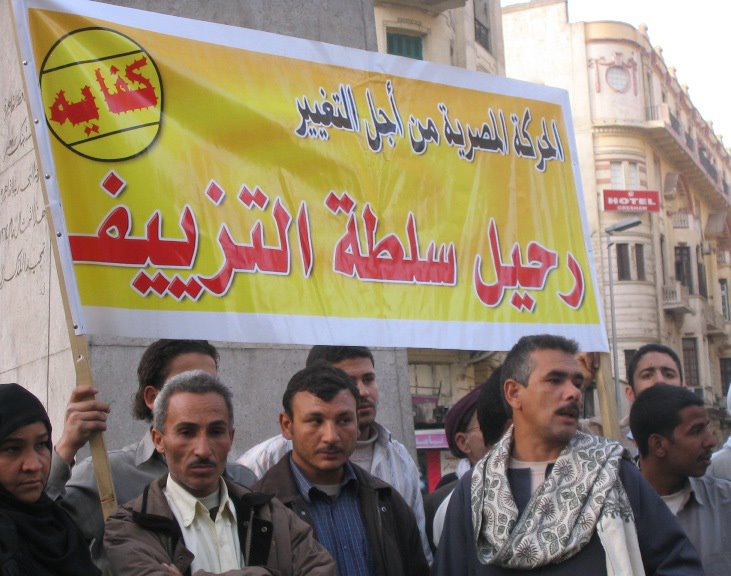
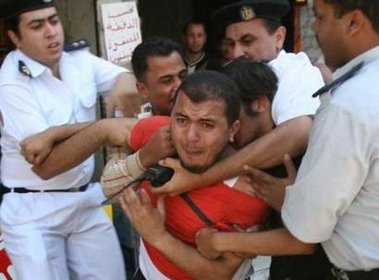
This placard at a Cairo protest on 26 July sums it up best: Hasan Nasrallah is a master, the trio of jokers on the left are nothing but slaves.

In a word, Hamas and Hizballah are underwritten by the gold standard of democratic legitimacy in a region replete with fakes and knock-offs. For obvious reasons, fragile revolutionary legitimacy à la Nasser no longer captures the public’s imagination. Tradition-based legitimacy is wearing thin in the monarchies, its rickety founding myths increasingly scrutinised and challenged. No one believes in economic performance-based legitimacy anymore, since nearly all the region’s governments long ago stopped delivering or enabling any sort of economic performance to the majority of the governed.

Democratic legitimacy is the criterion now, on the full understanding that those who don’t deliver are to be voted out. The real significance of the January elections in Palestine is that they offered an opportunity to demystify Hamas, to subject it to the unforgiving test of governance. Instead, the U.S. and Israel were gripped by an insane frenzy, orchestrating an international boycott of the Hamas-led government while bleating inanities about not dealing with “terrorists.” Of course, the boycott did nothing but intensify Hamas’ popularity and reinforce its aura of purity, while life for Gazans reached crisis levels.


The Future


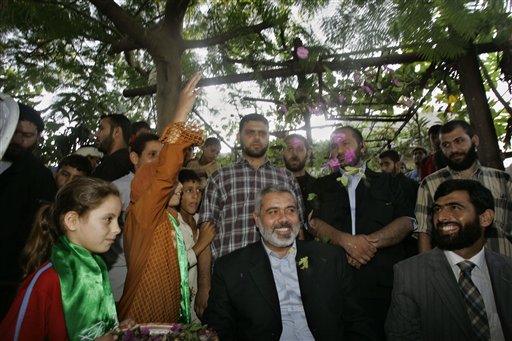
Discipline, organisation, and hard work at the grassroots give today’s nationalists a formidable foundation for resistance. Hizballlah’s robust advocacy on behalf of the Shia untouchables of Lebanese society and Hamas’ credible representation of the Palestinian quest for dignity and justice are assets that are unlikely to erode as easily as Nasser and Mossadeq’s resources were diminished. It’s not a matter of social movements versus government officials, either, since both Hamas and Hizballah now boast plenty of government officials. It’s the nature of the linkage between leadership and the rank-and-file, and between the organisation and the public. Charisma alone is no longer sufficient. Democratic accountability and constituent service are now indispensable. A small but moving gesture: When Palestinian premier Ismail Haniyeh along with other government officials received half his salary earlier this month, he donated 7,600 shekels (US$ 1,700) to the family of Hadeel Ghabn (above), an eight-year-old girl killed by an Israeli shell back in April.
It is a delectable irony to me that Ms Condoleezza Rice’s much-maligned remark about the “birth pangs of a new Middle East” is actually accurate, but not in the manner she and her glib wordsmiths intended. The new Middle East that the US and Israel must now confront is a fundamentally different animal from the one their predecessors faced in the 1950s. Neutralising nationalist regimes was a cakewalk compared to the current task of attempting to pacify robust popular movements. This is the paradigm shift transpiring in the Middle East for the past quarter-century. As the US, Israel and fellow travellers reaped spectacular success in taming erstwhile intractable regimes (just look at the laughingstock Hosni Mubarak), they spawned a new class of modern socio-political movements that have held out the promise of inclusion and emancipation to millions of ordinary people, on a scale unseen since the dawn of mass politics in the late 19th century.

(Choueifat, southern Beirut, 18 July 2006).

These movements don’t just offer monetary loans, cleaned streets, affordable schools, and functioning hospitals. They offer the dignity and honour that comes from resistance, the same dignity and honour that motivated the anti-fascist resistance, the same dignity and honour that bolstered the Jews of the Warsaw Ghetto. I want to know, does the Israeli government and its American enabler think they can extinguish this quest for human dignity with cluster-bombing, the destruction of infrastructure, and the killing of infants and toddlers?

*AP Photos

Thursday, July 20, 2006

Graphic Content

While Arab kings and presidents grinned from ear to ear and conferred on the “crisis” under the watchful eyes of their security details, displacement, death, and destruction blanketed Gaza and Lebanon. The massive Israeli offensive by air, sea, and land spares no one and shows no signs of abatement.

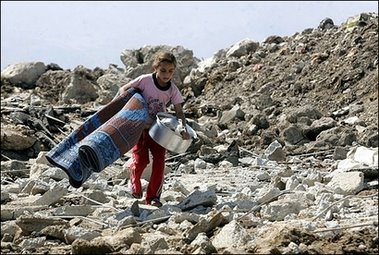
A Lebanese girl crosses a destroyed bridge in the village of Ferzoul, near Zahle city in the Bekaa valley of Lebanon, and a Palestinian boy is severely wounded during an Israeli army attack on the Mughazi refugee camp in Gaza (20 July).


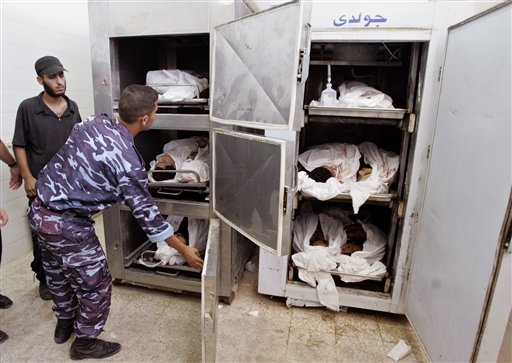
Palestinian policemen inspect bodies of Palestinians killed in the Israeli offensive against the Mughazi refugee camp before they are released to their families (20 July). Medics help a woman who was injured in an Israeli aircraft attack that destroyed a house in Tyre, Lebanon (16 July).

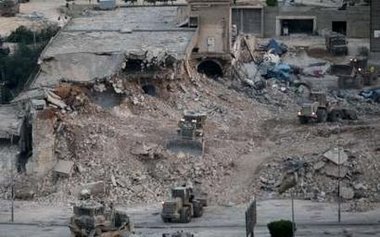
In Nablus, Israeli bulldozers destroyed a building used by the Palestinian Interior Ministry (20 July).

To date, well over 100 Gazans and 300 Lebanese have been killed; Israelis killed number 28.

While world "leaders" hemmed and hawed and repeated that "Israel has the right to defend itself," ordinary people have taken action. In the past week, Arabs and non-Arabs all over the world have expressed their outrage at Israeli aggression and solidarity with the Lebanese and Palestinian peoples. Protests of varying sizes erupted in Brazil, Greece, Mexico, Turkey, Pakistan, Jordan, Egypt, Yemen, Venezuela, Britain, Bangladesh, Malaysia, Chile, El Salvador, the United States, Ukraine, Kuwait, Spain, Iraq, Indonesia, Syria, the Philippines, and Argentina.

Meanwhile, yesterday American Secretary of State Condoleezza Rice dined with UN Secretary-General Kofi Annan at the Waldorf Astoria Hotel in New York and "discussed the situation in the Middle East." The United States and Israel oppose the UN's call for an immediate ceasefire. Perhaps they feel that not enough Arab civilians have been killed to warrant a ceasefire. Israel's ambassador to the UN said, "When you operate on a cancerous growth you do not stop in the middle, sew the patient up and tell him keep living with that growth until it kills you...You make sure it is totally removed."

Today’s al-Ahram indicates that in their summit, Mubarak and the Bahraini potentate "emphasised the importance of stability in the Middle East, and preventing the escalation of the situation in a manner difficult to control, and prioritising the language of dialogue instead of the language of force."

On 16 July, in a protest in Cairo, al-Karama movement's Muhammad al-Ashqar held up a sign that made its first appearance in March 2003, during the American invasion of Iraq: “Your majesties and excellencies: spit on you!”

*Photos from AP, Reuters, AFP.

Saturday, July 08, 2006

Egyptian Laws and Other Afflictions

Mr Anwar Sadat had a notorious but particularly apt expression whenever he embarked on one of his endless authoritarian manoeuvres. “It’s all by law!” (kullu bil qanun!) he would intone. Indeed, Egypt’s rulers have always understood that violent repression alone is never enough to control a complex society of guilds. So they have found in rule by law an utterly indispensable tool to certify and smooth the project of social control. Gamal Abdel Nasser understood this, and so does Sadat’s less colourful though no less devious successor.

From day one of his tenure, Mubarak invoked the handy legal tools bequeathed to him by his predecessors. But given how systematically and uninterruptedly he has been pilloried for the past three years, it was only a matter of time before his regime resorted to obscure legal provisions that had long fallen into disuse. And so the improbable subject of law has permeated nearly every political struggle of the past few years.


If we focus on just the past six months, there’s the judges’ saga and its many intricate details. And the farrago of charges brought against demonstrators assaulted and detained for peacefully expressing their solidarity with judges. And the criminal case against journalist Wael al-Ibrashi et al for publishing the “black list” of judges alleged to have participated in election fraud. And the lower court ruling against al-Dustour editor Ibrahim Eissa and journalist Sahar Zaki for simply reporting on a routine suit. And the current battle over new legislation governing “press offences.” There’s no single thread connecting all of these events, except that they all dramatise the modern political struggle between a repressive state wielding draconian laws, and citizens seeking the repeal and reform of such oppressive ordinances.


A Cornucopia of Crimes


As with any authoritarian state worth its salt, the Egyptian version has stacks upon stacks of repetitive, overlapping, ambiguously worded laws designed to control and constrain every aspect of life. Let’s take the notorious Assembly Law 10/1914 (right), crafted immediately after the outbreak of WW I. Still very much in use, provisions of this law are repeatedly invoked against peaceful demonstrators, most recently those detained in April and May for expressing their solidarity with judges. Articles 1 and 2 criminalise any gathering of at least five people that “endangers public peace,” “obstructs the implementation of laws and statutes,” or “influences authorities carrying out their duties.” The punishment is imprisonment for no more than six months or a fine that does not exceed £E20 (if weapons are involved, the punishment is increased to two years or £E50).

In addition to crimes scattered throughout individual ordinances and those compiled in the Code of Criminal Procedure (Qanun al-Ijra’at al-Jina’iyya), the magnum opus of Egyptian crime is of course the trusty Penal Code, Qanun al-‘Uqubat, promulgated on 31 July, 1937 (the image at top is a copy of its antique 1904 forbear). I confess to an utterly zany fascination with this tome, though I cannot read through it for more than 20 minutes before a deep, trembling fear grips me and I feel like the perpetually panic-stricken Ismail Yassin when he says, “Ya mama!”

The Penal Law makes it seem as if anything is potentially criminal. There’s the notorious Article 48 on criminal conspiracy, etched into the Code after the assassination of Prime Minister Boutrus Ghali by the young pharmacology student Mahmoud al-Wardani in 1910. In his 1910 Annual Report, Lord Cromer’s successor Sir Eldon Gorst assured British parliamentarians, “The investigation of this case showed that the Egyptian Government did not possess sufficient power to deal with conspiracies for the commission of illegal acts, and that certain other measures were also necessary, especially as regards the section of the Code dealing with press offences, to repress evils which had manifested themselves during these proceedings. Laws…were therefore passed without delay to remedy these legislative defects.”

Article 48 was worded in such a way as to offer authorities maximum leeway in criminalising any action of which they did not approve. It essentially allowed police to detain any two people talking to each other on a street corner. After all, they could be deviously conspiring to commit a crime, even if no actual crime has been committed. Predictably, the Article proved very serviceable for subsequent rulers. In 2001, Professor Saad Eddin Ibrahim and his fellow defendants were accused of criminally conspiring to bribe television officials to air positive programming on Ibrahim’s research centre. While convicting Ibrahim on other charges, the court rejected this particular charge, without explanation. Fortunately for all Egyptians, a few days later (in a separate case) the Supreme Constitutional Court deemed this notorious Article unconstitutional. It is a matter of bitter irony to me that one of the principal architects of the sham legal case against Saad Eddin Ibrahim, the deeply unpopular and disreputable Maher Abdel Wahed, is now, incredibly, the Chief Justice of the sadly extinguished Supreme Constitutional Court.

Let’s continue on our pleasant little stroll through the Egyptian Penal Code, shall we? Section II Chapter 7 of the Code is all about Resisting Rulers and Not Obeying their Orders and Assaulting them with Slander and Other Means (actual title). Chapter 13 has everything you wanted to know about Obstructing Communications (including some specific charges levelled at the pro-democracy demonstrators). If you’re interested in how you can criminalise worker strikes and sit-ins, kindly turn to Section II Chapter 5 and Section III Chapter 15. Section III Chapter 7 enumerates the ways and means of slander and libel, including harassing a female in public (Article 306(bis), while Chapter 12 deals with gambling and lottery-related crimes (what on earth?!....). Finally, Section IV is a comprehensive list of petty violations such as throwing trash in the Nile, siccing dogs on others (such as police who sic dogs on peaceful protestors?), and causing a ruckus at night that disturbs the neighbours (good to know next time the crazy upstairs neighbours start screaming insanely at 4 am).


Harming the Government and Other Misdemeanours


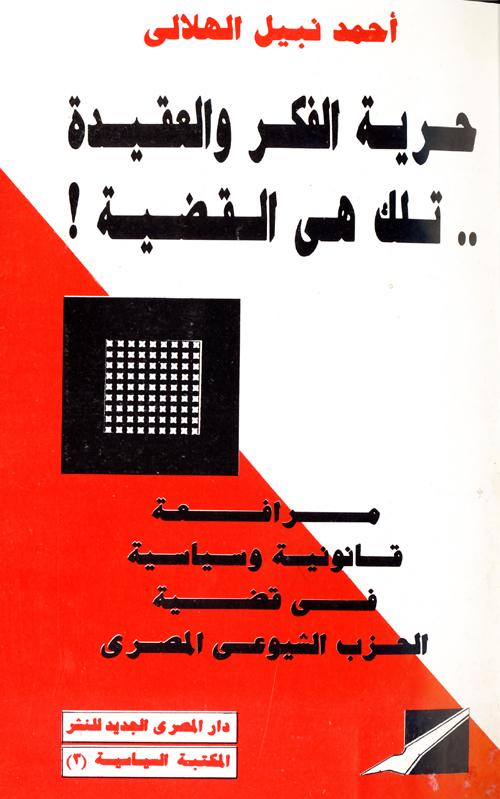
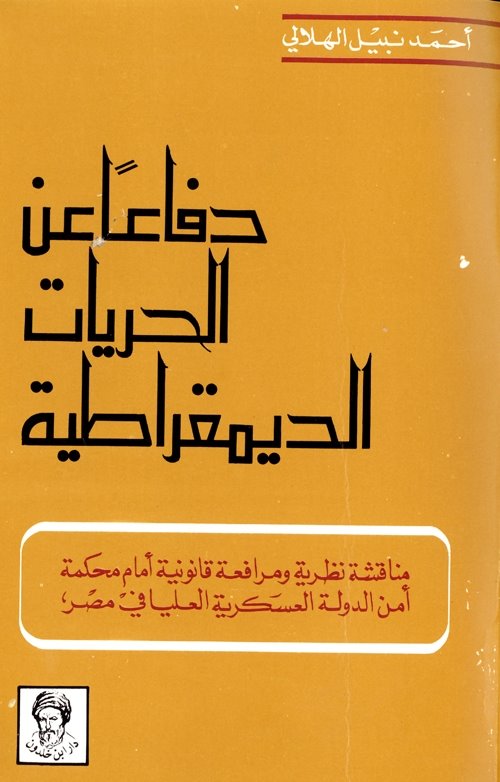
Of course, Penal Codes are by definition…punitive! But the issue is how crimes are conceived and worded, and whether they’re added through the proper parliamentary channels after careful debate, or rather smuggled in by executive diktat when parliament is in recess. Given the ubiquity of Articles enumerating crimes against the government and their linguistic elasticity, it’s obvious that the Penal Code is a palimpsest of successive rulers’ efforts at political control rather than a compendium of international “best practices” in criminal legislation, as the government routinely claims. If anything, as the much-mourned and sorely missed Nabil al-Hilali taught us, Egyptian criminal provisions have more often than not copied international worst practices.

Take Article 98(A), levelled at Egyptian communists in 1979. It stipulates punishment of 10 years’ imprisonment for “anyone who establishes, organises, or steers organisations aiming to impose the control of one social class over others or aims to eliminate a social class or seeks to subvert the state’s social or economic foundations.” As Hilali explained, the Egyptian importers of the offending Article admitted that it was copied from a fascist law promulgated by Mussolini in 1930 to combat communists. After an aborted attempt by Ismail Sidqi to add the Article to the Penal Code in 1946, it was successfully included by Gamal Abdel Nasser soon after the March crisis of 1954 and the assassination attempt in Alexandria’s Manshiyya square.

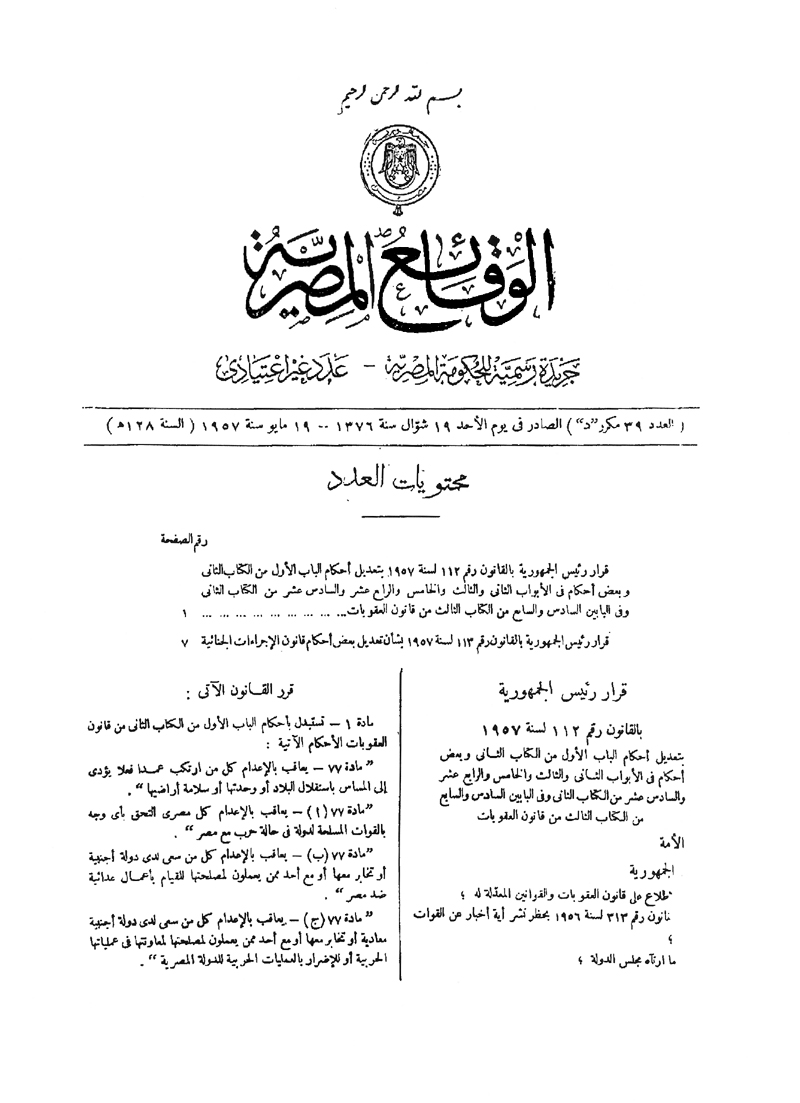
Another infamous legal product of rulers’ will to power is the notorious Article 80(d), added to the Penal Code in 1957 as part of a package of “crimes and misdemeanours emanating from abroad harmful to government security,” (left). The Article stipulates imprisonment for “every Egyptian who intentionally disseminates abroad false news, reports, or rumours on domestic conditions, with the result of weakening the financial confidence in the state.” The legislation was in part a response to the landed, anti-Nasser Abul Fath family and their radio station “Free Egypt Broadcasting” (Idha’at Misr al-Hurra), which disseminated material critical of the Egyptian regime from Beirut during the 1956 tripartite aggression. The Article remained buried in the Code unused until Mubarak’s legal henchmen found it useful and invoked it against sociologist Saad Eddin Ibrahim in 2001 and 2002, for allegedly “tarnishing the state’s image abroad” with his research on the status of Egyptian Copts.

And yet for all that, the Penal Code is not without some unexpectedly promising provisions. Section II Chapter 6 for example is all about public officials’ maltreatment of citizens. Article 129 specifies one year imprisonment or an (admittedly paltry) £E200 fine for any functionary who “relying on his position uses cruelty with the people in a manner that violates their honour or causes pain to their bodies.” Sounds like the perfect answer to Mubarak’s legion of torturers. But here’s the rub: While Article 126 stipulates a jail term of 3-10 years’ hard labour for any government agent utilising torture, its definition of torture is confined only to cases where the torture is applied to extract a confession, eliding the myriad cases of abuse inflicted for other purposes or for no purpose at all. Rights groups have long advocated a minimum of five years’ hard labour and the amendment of Article 126 to make the definition of torture consistent with Article 1 of the Convention Against Torture. The bitter irony here is that Egypt was the first Arab state to accede to the Convention, in 1986.


Crimes Occurring via Newspapers and Other Means
(such as Insulting the Ruler)


All of these crimes and we’ve yet to discuss the mother of them all: insulting the ruler. This particular offence falls within the infamous and forever controversial Section II, Chapter 14 of the Code titled: Crimes Occurring via Newspapers and Other Means, which enumerates in painstaking detail all the dastardly deeds that newspapers are inclined to. Perhaps the most persistent and outrageous provision in this Section is Article 179, first dubbed “Offence to the Monarchical Self” when Egypt was a monarchy. It stipulated imprisonment of up to five years for anyone “who causes offence to the royal self,” the queen, the heir to the throne, or regents. What’s more, the punishment was doubled if the offence occurred in the presence of any of the above! As our friend Sayed Ashmawi has colourfully shown, this was a particularly popular charge in the late 1940s and early 1950s, when the royal family came in for increasingly biting criticism from feisty newspapers and popular political forces.

Instead of being relegated to the trash bin of the royalist past after the republican transition in 1953, the Article’s language was simply amended in 1957 to read “insult the president,” and punishment was reduced to imprisonment for one year. And so it remains on the books to this day, yet invoked only once: against the people’s bard Ahmad Fu’ad Nigm in 1978 for mocking Anwar Sadat in his poem, “An Important Announcement,” (Bayan Ham). The Article remained dormant from 1978 until spring 2006, when the State Security Prosecution charged the peaceful demonstrators with, among other unforgivables, insulting the president of the republic through open defamation and slander (horrors!)

As if the very term “insulting the president” is not surreal enough and juridically nonsensical, last month there was an even more bizarre twist when the Warraq Misdemeanours Court invoked this Article and sentenced three ordinary citizens to one year in prison. The details are familiar by now. Citizen Said Muhammad Abdallah did what dozens of ordinary citizens do every day: he sued the president qua president, as per Article 68 of the Constitution guaranteeing resort to the courts as a basic right. His case was accepted by the administrative courts under number 3019/60th JY. al-Destour reporter Sahar Zaki reported on the suit, which though routine did have the distinction of targeting Hosni Mubarak personally for misuse of public funds and other abuses of power. But it’s common for newspapers to report on the filing of interesting, unusual, significant, or simply frivolous suits, particularly if they involve those in power as defendants.

The truly irregular aspect in all this is that seven individuals in the same neighbourhood of Warraq, hearing of Abdallah’s suit, took it upon themselves to sue him, Ibrahim, and Zaki for “insulting the president” and “intentionally broadcasting news or false rumours that disturb the public peace or strike fear in the people or harm the public interest,” (Penal Code Article 102bis). Though the plaintiffs had no standing (locus standi), and it is wholly unclear what action they were asking the court to rule on, lower court judge Osama Salah ruled for them. Unusually, he also went much further, castigating journalists for abusing the generous doses of freedom provided for them by the president.

Its oddity and legal dubiousness aside, the case underlines the nefarious contents of the Penal Code. A quick glance through Section II Chapter 14 reveals the extensive tools available for those in power to perfectly legally silence the advocates of the adversarial (if not yet investigative) press. Prison sentences abound for anyone who insults or defames a foreign king or president (Art. 181), an agent of a foreign government residing in Egypt (Art. 182), parliament, the military, the courts, or public agencies (Art. 184), and public servants or representatives (Art. 185).

The government’s proposed amendments to these and other offences is nothing but a manoeuvre designed to stem the tide of intensifying opposition and press scrutiny of powerholders’ wealth and assets. Instead of the current punishment of a monetary fine and 2-5 years’ imprisonment for slandering a public official (Art. 303), the government’s proposal is gaol time not to exceed 2 years or a fine of £E15,000-30,000. Journalists have long demanded the complete abolishment of imprisonment for ‘press offences,’ and a maximum amount of £E10,000 for fines.


Mafeesh Fayda v. The Spirit of Nabil al-Hilali

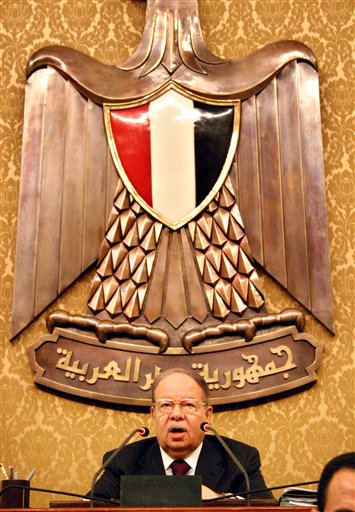
Just as it did with the amendments to the judiciary law, the government this week will surely ram through parliament the press-related amendments to the Penal Code, thus further fortifying the legal infrastructure of authoritarian rule. It’s nothing we haven’t seen before. Just think back to Anti-Terrorism Law 97/1992, Professional Associations Law 100/1993, replacing bottom-up election of university deans and village mayors with top-down appointment in 1994, Press Law 93/1995, and NGO Laws 153/99 and 84/2002. Just as with all of these previous laws, there will surely be valiant stands by individual, honourable members of parliament. There will be street protests, strikes, sit-ins, and emergency general assemblies. There will be considerable furore in the press. And there will be many futile meetings with the entertaining Mr Fathi Sorour, who is a picture to behold with his ravishing comb-over, shameless sophistry, and generalised air of thorough venality and inanity.

The current stand-off between the government and organised sectors of society isn’t some unexpected “clampdown” or “backtracking on reform” (by the way, I’d love to meet this fetching Mr Government Reform if anyone can introduce him to me). Let’s not be silly and parrot this most repeated and meaningless take on current developments, then raise up our hands and exasperatedly cry “mafeesh fayda!” (as Saad Zaghloul is supposed to have said) simply because the rulers have got their way. No one in their right mind expected judicial independence to be actuated this spring, or a robust and effectively protected Fourth Estate to materialise this month. It’s not just that these are long-drawn out, marathon battles that span out over decades, nor that they rarely conform to neat little storylines with satisfying endings and unambiguous “outcomes,” nor even that large, dramatic transformations are wrought from small, obscure struggles.

It’s that there’s intrinsic value in understanding the details of large power plays, to honouring those who toil in obscurity to fight this or that repressive law, to appreciating those who sue the president to make a point, and recognising those parliamentary deputies who vote against an unjust bill that they know for certain will be passed, and standing in awe of those voters who brave tear gas and rubber bullets to record their choice. I’ve never heard any of them utter the dismissive, indifferent, and offensive “mafeesh fayda.”

Tuesday, June 20, 2006

Requiem

The certainty of death is no preparation for the actual arrival of the Reaper. In the early hours of 18 June, the honourable Ahmed Nabil al-Hilali succumbed to renal failure and passed away in hospital. Thus ends a truly remarkable and exceptionally productive life, a life devoted to the rule of law, the rights of the dispossessed, and the quest for real democracy and political representation for all Egyptians. Ahmed Nabil al-Hilali was not just the most prominent and principled member of the Egyptian bar, a first-rate lawyer who knew the nooks and crannies of every courtroom and the whys and wherefores of every legal clause. He would wince in genuine embarrassment at this description, but Hilali was quite literally a living legend, someone who inspired unanimous awe, respect, and admiration.

In his lifetime, he was christened “the saint of the national movement,” the “liberties lawyer,” and “the Egyptian people’s advocate,” since he spent nearly all of his waking hours defending those accused of engaging in free expression, association, and assembly. And so at his funeral, “all of Egypt was there, from the Communist factions to Judges Club board members to Islamists, and everyone in between,” says a well-known rights lawyer. Though much loved and respected, Hilali was far from being some bland “consensus figure” with no clear commitments. He was an ardent, lifelong Communist, one for whom Communist values were spurs to action, not theoretical props or abstruse arguments. He was a Communist who constantly warned against the chronic fractiousness of the Egyptian left, a Communist who respected and defended Islamists of various hues, a Communist who believed in the deliberative capacities of ordinary people, and a Communist who was fiercely loyal to his chosen ideology yet understood and appreciated other projects of emancipation. Quite simply, Nabil al-Hilali was a true democrat, and a sweet, retiring, extremely kind man to boot. Words fail to capture the immensity of this latest loss.


The Romance of the Pasha’s Son


Ahmed Nabil al-Hilali was born in August 1928 to a family of landed notables. As is well known, he was the son of Naguib Pasha al-Hilali, minister of education, trade and industry, and Prime Minister in the final months of the monarchy before the Free Officers’ coup. As part of the culture’s abiding titillation by the mixing and mingling of classes, Hilali’s chosen riches-to-rags trajectory has been turned into something of a mystique surrounding the man, though he himself never fed this and if anything seemed hobbled and embarrassed by his lineage. But leftist hagiography emphasized and magnified the romanticised narrative of elite Egyptians turned Communists, finding in the likes of Hilali, the late Mohamed Sid Ahmed, Injy Aflaton, and Ismail Sabri Abdalla the perfect fodder. It’s as if a leftist ideological commitment is somehow more authentic if it’s professed by a member of the upper crust.

No surprise then that each of Hilali’s attempts to chart his own, disciplined path have been folded into the narrative. There’s the well-known story of how he gave up his family’s landed assets in Upper Egypt to the poor peasants who tilled them. And his spurning of his father’s elite law firm in Mostafa Kamel Square for a modest practice in Bab al-Luq that he established with fellow law school graduate and comrade Paulos Lotfallah. And of course his marriage to firebrand and fellow traveller Fatma Zaki, one of the founding members of the 1946 Students and Workers Committee and a key figure in the history and development of Egyptian communism.

Hilali met Zaki when they were both still university students and members of the very short-lived, underground Egyptian Communist Organisation (al-Munazzama al-Shu’uiyya al-Misriyya), founded in December 1948. Zaki was one of its four elected leaders and Hilali was the head of the oversight committee (lajnat al-riqaba), the organisation’s internal disciplinary body tasked with rigorous Marxist training and evaluation of all members. In addition to spawning their lifelong union from 1949 until Zaki’s death in 2004, the ECO had another profound effect on the young Hilali. He experienced first-hand the problems of organisational decay, dictatorial leadership, and police crackdowns that have long bedevilled Egyptian opposition groups of all stripes. Under the weight of internal disintegration and police repression, the ECO ceased to exist by 1950, only one year after its founding.

In one of the very rare interviews that he granted, Hilali told Rif’at al-Said in 1975 that the ECO and its autocratic leader Odette Hazan caused such high levels of mistrust between organisation members that when he and Lotfallah opened their law firm in 1954, they agreed never to talk politics with one another for fear of their views getting back to a potentially reconstituted ECO, even as Hazan had renounced her Egyptian citizenship and left the country for good. The ECO experience forever sensitised Hilali to the classic problems of organisation: recruitment, retention, trust, durability, and innovation, challenges that he spent his activist life trying to overcome in the inauspicious environment of republican Egypt.


Nasser’s Prisons


After he resumed membership in other underground Marxist organisations but before he could launch his legal career, Hilali was snatched up in the notorious New Year’s day raids of 1959, when more than 200 socialists and Communists were rounded up following a similar crackdown on Syrian leftists. The roster of the accused reads like a who’s who of the Egyptian activist intelligentsia, past and present: Fu’ad Mursi, Ismail Sabri Abdalla, Mohamed Sid Ahmed, Mahmoud Amin al-Alem, Abdel Azim Anis, Adli Barsoum, Lotfi al-Kholi, Yusuf Darwish, Sherif Hetata, Son’allah Ibrahim, Adil Hussein, Fu’ad Haddad, Mohsena Tawfiq, Rif’at al-Said, Salah Hafez, Fatma Zaki, Eryan Nasif, Nabil Zaki.

Perhaps the most well-known name in the 1959 group was English teacher Shuhdi Atteya al-Shafi’, an articulate writer and pamphleteer who would become the leading martyr of the Egyptian left. He died in 1960 after a brutal assault by prison guards, and his life and death are still studied and commemorated by Egyptian leftists.

Before and after the 1950s, defendants in Egyptian political trials have availed themselves of the courtroom as a platform to air their ideas to the public, and the Communists were no exception. They were concerned less with constructing careful legal arguments than with spreading their ideological message and exposing the political motivations of the kangaroo trials. So they were not shocked by their sentencing, and immediately set about constructing a remarkable, alternative world in their confinement based on mutual solidarity and organised cooperation.

In addition to various schemes of edification and self-improvement (poetry recital competitions, lessons on specialised topics, translation projects), prisoners of conscience engaged in a rich array of cultural activities, often with the cooperation of prison authorities. They staged plays and skits in makeshift Roman theatres in prison yards that were often attended and much enjoyed by prison officials, they put out “magazines” and news bulletins that they read out loud to the assembled prisoners, held song recitals, and beautified their grim spaces by planting herbs and plants and painting their cells. Nabil al-Hilali was the editor of the popular, satirical magazine “Doktor Shooma,” and he surprised everyone by showing real acting talent when he played the lead role in Jean-Paul Sartre’s underappreciated sleeper Nekrassov.


The Value of Quixotic Acts


Hilali emerged from prison in 1964 as one of the few who opposed the disbanding of the Egyptian Communist Party and co-optation of its members into the state’s well-funded cultural organs. He then embarked on the career for which he would become a legend, defending all prisoners of conscience regardless of political commitment, often pro bono publico. He defended Communists in 1977, poet Ahmad Fu’ad Nigm in 1978 (tried by a military tribunal for mocking president Sadat), the Nasserist organisation “Thawrat Misr” in 1986, striking railway workers in 1987, Islamist radicals throughout the 1980s and 1990s, and freedom of expression cases such as Shohdy Naguib Sorour’s and the Revolutionary Socialists. He was a fixture of bar association politics, from the 1970s when he was elected to the board to the ideologically polarised 1980s, government receivership in the 1990s, and return to elections in 2001 and 2005.

He crossed paths with student leader Ahmed Abdalla many times, first as an attorney for the students in 1972 (he was briefly detained and charged with inciting them to subversion), then during the growth of the human rights movement in the 1980s and early 1990s (Hilali received the Egyptian Organisation for Human Rights’ award in 1991), then the formation of Kifaya in July-August 2004, then during Abdalla’s bid for parliamentary elections in autumn 2005, where Hilali was one of the featured speakers at a campaign event. To me, both men embodied an exceedingly rare and even maligned trait in these times of “pragmatism”: they were faithful, stubborn believers in the consequences of seemingly quixotic acts. They had a remarkable patience and long term vision, and I doubt they even understood (much less cared about) the word “setback.” They knew that the struggle for a democratic Egypt began before their lifetimes and would continue long after they exited from the scene.

I want to emphasize two of Hilali’s most quixotic endeavours, which in my mind are also his most significant legacies for the Egyptian struggle for democracy. He was a staunch believer in the possibility and efficacy of opposition coordination, and he had a visionary sense of the politically creative impact of law. Both may seem very quaint but ineffectual tools with which to resist an overwhelming police state. Here’s why they’re not.

Hilali was an extremely persistent and lucid exponent of a coordinated opposition front to advance democratic gains. He was neither the first nor the only propagator of such an idea, but I daresay he was its most sincere, articulate, and credible defender on the left. In 1992, he wrote a series of elegant pieces elaborating on the necessity of strategic, not merely tactical, coordination between Islamist factions and leftist factions, each holding fast to their ideological non-negotiables, yet making room for concerted action to challenge the Mubarak regime. It matters little that such mobilisation has rarely materialised, or that when it has it was unable to reach large swaths of the public. Given how brutally and swiftly Mubarak’s regime has repressed members of nearly every opposition sector, during electoral and non-electoral junctures, it is not difficult to imagine the magnitude of the threat posed by a coordinated opposition effort. Nabil al-Hilali knew that and harped on this same point year after year, not least this ringing
democratic manifesto and anti-tawrith declaration in 2003.

Similarly, Hilali’s deep knowledge of the law enabled him to see opportunities where others saw nothing. His courtroom work was not simply a principled stand for rights, but an appeal to one of the few viable public institutions left in Egypt. Hilali understood that the judiciary had the capacity and will to produce autonomous rulings, that even if unimplemented, such rulings constituted a potent weapon in the struggle for rights, and that the majority of judges relished a masterful oral argument. His closely argued briefs were thus models of erudition, combining dense facts on the suspect sources of Egyptian penal provisions, quotations from parliamentary proceedings, comparative insights drawn from American and French jurisprudence, and evocative trimmings such as quotes from Turkish poet Nizam Hikmet.

Hilali was known to go on at considerable length in his oral arguments, only to be invited to continue by the bench. By banking on the partial autonomy of the Egyptian judiciary and the professional spirit of individual judges, Hilali helped to wrest many small legal victories that are more than the sum of their parts. Well before domestic and international pundits
discovered Egyptian judges, Nabil al-Hilali knew that they were an effective crutch in the struggle for rights, and perhaps even envisioned that they would be at the frontlines as they are today.


Coda


Nabil al-Hilali always politely but firmly refused to let me profile him, partly as a matter of principle and partly because he never sat still, moving from one courtroom and niyaba office to another by day, then attending political meetings and salons in the evenings. Once, when I failed to get a hold of him after seven straight days of persistence, a member of his office staff advised me, “Look, the best way is to come here and wait at the office and then ambush the adversary the minute he walks in! But don’t you dare tell him I told you that!”

I didn’t give up on trying to interview al-Hilali, and began composing an oral argument in my head that I planned to deliver to him on why he should give me the time of day. But he passed before I could execute my brilliant plan. Now I will never get to ask him about this or that law, opaque clause, mystifying procedure, or specific case. I’ll never have the privilege of listening to him reflect on the unexpected power of law in a repressive, undemocratic state. I won’t have the chance to goad him to share some of his rich memories, or elaborate on his vision of a united front for democracy. Most of all, I won’t be able to simply be in the presence of his boundless energy and love for his metier, and his endearing and disarmingly genuine modesty.

Once, walking down the sooty, congested Sharia al-Gala’ on an early afternoon, I ran into Nabil al-Hilali on his way to the courthouse. He shook my hand firmly and gave me a courtly bow and a wide smile, then continued walking purposively and in big strides, large legal briefcase in hand. I stood watching his determined frame recede into the crowds. And that is how I shall always remember him.

Thursday, June 08, 2006

A Man Apart

I can’t believe that the extraordinarily sprightly and kindhearted Ahmed Abdalla is no longer with us on this earth. He passed away earlier this week, and his funeral procession from Sayyeda Nafisa mosque took place yesterday afternoon. Thus departs a great Egyptian patriot, citizen-scholar, and man of commitment, leaving behind much grief and a yawning sense of loss.

Ahmed Abdalla Rozza was born on 15 January, 1950 to a working class family in Ain al-Sira, the Masr al-Qadeema neighbourhood to which he remained wedded throughout his life, save for the decade of 1974-1984 when he was working on his doctoral thesis in England. He was the most prominent leader of the student activist wave of 1972-1973, and went on to forge a productive career as both an astute political analyst and an uncompromising independent activist. He had a mirthful, loquacious manner and spoke Arabic, English, and French beautifully. Above all, he was that exceedingly rare specimen of intellectual who neither disdains nor romanticises ordinary people. Instead, he lived among them, understood them, loved them, shared their burdens, and did his utmost to alleviate them.


“A Dynamic Element”


Ahmed Abdalla attained national prominence when he was only 22 years old, in his final year at the Cairo University Faculty of Economics and Political Science. On 13 January, 1972, Anwar Sadat delivered what soon became a notorious address in which he claimed that the outbreak of the Indo-Pakistan war prevented him from delivering on his promise that 1971 would be a “decisive year,” meaning the year when troops would liberate Egyptian territory seized by Israel in the 1967 war. Memorably, Sadat attributed his inaction to “the fog” created by the South Asian war.

The speech outraged college students and spurred them to action. They joined several existing groups into the umbrella Higher National Committee for Cairo University Students (HNCCUS), and Ahmed Abdalla was elected president. For one year, HNCCUS became easily the most vital popular organisation in Egypt, a vehicle through which students negotiated directly not simply with top university administrators but the highest officials of state, from ministers to parliamentarians to the president himself via a slew of emissaries. Buoyed by the first, intense wave of student and labour activism of February 1968, and a new regime still finding its bearings, students literally became a vanguard social movement, exerting real pressure on the regime to act on the two cardinal issues of occupied territory and democratisation.

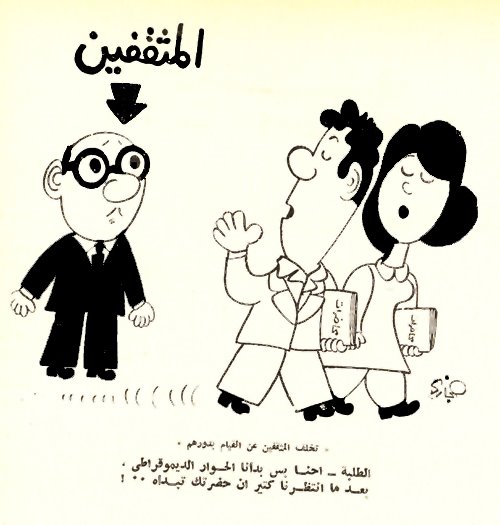
These extraordinarily young and extraordinarily articulate students went head to head with very powerful people, upstaging intellectual elites with pretensions to societal leadership (see Higazy cartoon, top, Rose al-Yusuf, 21 February 1972). For a little over a week, students and state elites engaged in intricate bargaining sessions, including a heated debate between parliamentary deputies and a 200-strong student delegation inside the parliament building. Students escalated their activism, inaugurating a sit-in at Cairo and Ain Shams universities. The state then took off the velvet gloves. At dawn on 24 January, the Interior Minister gave the order for security forces to storm the university and arrest students sitting in Nasser Hall. Hearing of the capture of their colleagues, the thousands of college students coming for classes that morning flocked to Tahrir Square and staged a sit-in there, where they were well-supplied with food and blankets by sympathetic onlookers and citizens. Recalling these events, I can’t resist noting the parallel with the outpouring of popular support for today’s vanguard social sector.

Abdalla was arrested and appeared before a university disciplinary board, which released him with a warning. He responded by intensifying his activism for the rest of 1972-1973. At that moment in Egyptian history, university campuses were humming dens of collective action and consciousness-raising, featuring creative and feisty wall magazines (the grandparents of the contemporary political blog), endless debates and meetings, a steady stream of pamphlets and communiqués, and the formation of bonds with social institutions beyond the university gates.

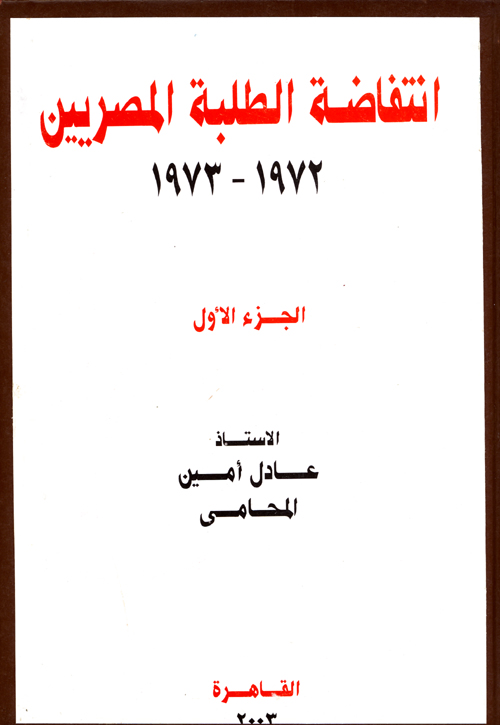
Authorities studiously recorded and pored over the contents of Abdalla’s personal wall magazine, The Rough Copy (al-Muswadda), as is evident by lawyer Adel Amin’s valuable compilation of State Security documents on student activism during 1972-73 in his book, The Egyptian Students' Intifada (2003, right). Here is a December 1972 assessment by State Security Intelligence of the intrepid, outspoken, and dangerous Ahmed Abdalla:

“This student was one of the leaders of the January 1972 movement...and led the call for sit-ins, strikes, and demonstrations. He was arrested with the students occupying Nasser Hall, interrogated by the prosecution, and then released. He remains at the peak of activism, a dynamic element around whom revolves the majority of resistant elements in universities. He continues to carry out his activism, establishing numerous links with these elements and writing wall magazines that attack the state and political leadership and some Arab states and their regimes. The aforementioned and his supporters also seek to unify the student movement in the different universities and to extend its activism to other mass sectors, especially the professional unions. He is also active in the conferences convened at the Economics faculties and other university faculties and had the leading role in designing and steering these conferences. He and his group focus on recruiting first-year students in the Economics faculty, considering them a new asset that must be won over to their side.”

The final crackdown on the student movement came in June 1973, when the chief State Security Prosecutor placed Abdalla first on a list of 56 defendants referred to trial, charged with a slew of the familiar crimes that have long ensnared Egypt’s past and present honourable activists: spreading rumours and false information, repeating seditious slogans, engaging in criminal conspiracy, and inciting assembly, demonstrations, and (my favourite) resisting the authorities. The list included luminaries such as Kifaya leader Ahmed Bahaeddin Sha’ban, rights lawyer Ahmed Seif al-Islam Abdel Fattah, writer and critic Safinaz Kazem, the people’s bard Ahmad Fu’ad Nigm, journalist Hani Shukrallah, and the late Arwa Saleh.

But then the judiciary stepped in. In the summer of 1973, judges ordered many defendants released on bail while awaiting trial, and upheld those decisions despite the president’s angry appeals. As Abdalla recounts in his doctoral dissertation-turned-book, The Student Movement and National Politics in Egypt, 1923-1973 (London: al-Saqi, 1985), “when the core of student activists was finally brought to trial, the chief justice who was to try the first group of defendants opened the proceedings with a speech assuring his defendants of the court’s impartiality and even of its patriotism.” In the lead-up to the October 1973 war, Sadat ordered a halt to all student trials and released all detainees.


Scholarship, Activism, Advocacy


Ahmed Abdalla opted to write his doctoral thesis at Cambridge on students and politics in Egypt, and its book form remains the single most valuable English-language contribution to the topic, second to none. It is a scholarly, historical oeuvre written in a staid, analytical style, with significant bits of auto-critique and reflection, scrupulous documentation, and many gems buried in the footnotes. There is no awkward tension between the scholar and the activist, no grand unsubstantiated claims, no self-exoneration, and—-just as important-—no irritating and pointless second-guessing or hand wringing.

Throughout his life, Abdalla miraculously and effortlessly merged analytical scepticism with ideological commitment. For me, he is a model of a thinker who had no truck with the fiction of objectivity, yet never allowed his political passions to blunt his analytical judgement. His example even suggests that—gasp!—each faculty can actually enrich the other. After his return to Egypt in 1984, he joined his erstwhile comrades in the burgeoning human rights movement, not because he harboured any illusions about the transformative potential of such an undertaking, but rather because he viewed it as a promising vehicle to forward democratic demand-making.

For Abdalla, human rights activism was not an ethical project devoid of politics (à la the professional human rights salariat), nor a lucrative cottage industry driven by personal entrepreneurship (à la perpetual cynics), nor a sinister foreign design (à la nationalists), but a deeply political undertaking that would further a modest yet highly significant goal. “The human rights movement is a political movement par excellence, and it should courageously present itself as such,” he wrote. “It should advertise itself as the largest reservoir of consensus politics.”

The language of human rights would be creatively deployed to transcend the historical animosities bedevilling Egypt’s opposition groups, perhaps even pave the way for some form of collective action between them. Though he retained the Egyptian left’s signature suspicion of Islamists, Abdalla thankfully steered clear from the vile stance of individuals like Rif’at al-Said, a putative leftist who takes great pleasure in collaborating with the authoritarian regime to repress and do violence to Islamists. However, by the mid-1990s, Abdalla’s take on human rights activism grew
dimmer, after the groups’ decision to accept foreign funding brought in powerful international institutions with their own agendas, agendas that were far removed from helping Egypt’s opposition groups overcome their collective action problems.

If activism and analysis coexisted in Ahmed Abdalla, so did advocacy and analysis. One of his most abiding concerns was the respectful, dignified depiction and treatment of ordinary people too marginalised to represent themselves, and too powerless to “talk back” to those who represent them. His first book is memorably dedicated to the denizens of his native Ain al-Sira: “To the People of Masr al-Qadeema, the illiterate who gave me knowledge; the poor who enriched my conscience.” He was a truly great and noble advocate for poor Egyptians, whose stock he shared, yet he never abandoned the critical stance necessary to dissect their life conditions and give them the tools to carve out a foothold in a power structure built on their exclusion.

Advocacy mixed with analysis was the driving force behind Abdalla’s energetic bid for parliament in the
2005 elections, and his years long focus on the vexing condition of child labour. Eschewing both the easy, moralising condemnation of the practice and indifference to it as yet another “social problem,” Ahmed Abdalla made the difficult choice of actually doing something about it. He established the Jeel Centre for Youth and Social Studies, both a research and information centre and an actual space where working children convened each week to, simply, live their childhood. They drew artwork, made puppets, played music, had a meal, and subjected their bodies to physical activity of a different order than the gruelling labour that marked the rest of their week. It was a place unlike any that I’ve ever been in, where the concrete reality of child exploitation coexisted with an utterly charmed environment full of laughter, love, and an aura of being blessed.


A Personal Note


I don’t remember the first time I met Dr. Ahmed, but I always remember his uproarious laugh and his moments of quiet, conversational reflection. He had a charming ability to be both hilariously funny and dead serious in one breath, and a devilish knack for teasing that apparently found in me an irresistible target! I do remember the last time I saw him; it was at the Shaykh Yassin concert in Ramadan outside Bayt al-Harrawi in 2000. It felt like spotting a loveable celebrity. We waved and smiled across the giddy crowd, in the moments of anticipation right before Yassin began to chant.

When I remember Dr. Ahmed, I always see him sitting in animated, relaxed conversation around a table on the scraggly lawn outside Markaz al-Jeel one friday, as the children played all around us and the setting sun turned a fiery orange. Dr. Ahmed’s maternal older sister was busy making sure that every child had eaten his koshari and cucumber; she was a woman of few words and enormous kindness whose death took a serious emotional toll on her younger brother. The day that I visited the Centre, I met a boy named Gharib, who worked in the tanneries. He held on to my hand tightly for the whole five hours I was there, leaving me only to take part in the karate lesson, but not before making me promise to sit and watch him kick. Dr. Ahmed kept playfully chiding him to leave me alone for a while and go eat his koshari, but Gharib only lowered his huge eyes bashfully and smiled.

Under a drooping tree branch we all sat, savouring the final hours of a purgative day.


Friday, May 26, 2006

Prisoners of Conscience

Thursday’s marking of referendum day 2005 unfolded as planned, with relatively less state violence directed at peaceful protestors, compared to the past month of brutal repression. Judges were able to stage their silent stand on the High Court steps after all, when court custodians relented and security forces backed off from occupying the building.

A solid month of solidarity demonstrations with judges has left hundreds of peaceful activists detained, in conditions that are a clear violation of international standards of pre-trial detention. Almost all of them have experienced mistreatment, and some of them such as Muhammad al-Sharqawi (right) have been subjected to torture and sexual abuse (read his testimony here).

The focus now is on releasing all detainees, regardless of their political beliefs. Naturally, Kifaya, the socialists, and the Ikhwan emphasise the plight of their own. But we should remember that all of them are paying an equally steep price. All of them are fighting for our citizenship rights. And all of them are worthy of maximum respect, admiration, and gratitude.

Their political beliefs are immaterial. Their immediate release is imperative.


*Photos from AP, Wa7damasrya, Manalaa.
Pictured top: Kamal Khalil (2005) and Essam al-Eryan (1995).

Thursday, May 18, 2006

Are Judges Heroes?

First things first. Thankfully, Justice Hisham al-Bastawisi is in stable condition after suffering a heart attack early Wednesday morning (pictured left, 17 March 2006). He’s scheduled to leave the hospital in a few days for a much-needed period of recuperation. Hisham al-Bastawisy is not just a frontline leader of the judicial independence movement and a tough-as-nails man of principle. He’s also a very generous, kind man and a model of an upstanding Egyptian professional. The news of his affliction was devastating, so thank God he’s now doing well. I’d like to extend my heartfelt wishes for a speedy recovery to Justice Bastawisy and his family, especially his wonderful, brave sons.

Next, in a verdict that defied many breathless expectations of dismissal, the disciplinary tribunal absolved Mahmoud Mekky (right, centre) of all charges and censured Bastawisy, as per Article 108 of the existing judiciary law. Two points bear emphasis. First, the law actually does not specify acquittal as a possible outcome of disciplinary proceedings, only dismissal or censure (Article 104, 108). Bizarrely, then, acquitting Mekky actually goes against the letter of the law. Second, the punishment of censure carries no professional or personal repercussions, especially for a senior judge at the very top of the judicial hierarchy such as Bastawisy. It is nothing more than a form of moral blame that, under the blatantly politicised circumstances of the original referral to the tribunal, carries no weight whatsoever (AFP Photo).


Ironically, then, the verdict reinforces both the shortcomings of the existing law and its obvious manipulation by pro-regime judges to silence and discredit their outspoken colleagues working for real judicial independence. There is no clear legal rationale for acquitting Mekky while censuring Bastawisi, lending credence to claims that this is a face-saving manoeuvre by disciplinary tribunal head Fathi Khalifa, perhaps in response to pressures from on high.

Though the verdict is not subject to any form of appeal (a major failing of the current law (Article 107) that the Judges Club has long sought to rectify), it was immediately interpreted as a retreat by the government and a respectable victory for the judges. For reasons I cannot fathom, and with not a shred of credible evidence, rumours had been flying about that the leadership of the Judges Club would accept some sort of a “deal” with the powers that be. I won’t devote any time to such ignorant tongue-wagging, except to note the extraordinary levels of misinformation, hyperbole, and ceaseless second-guessing about all matters judicial these days. The Judges Club did not strike a deal, but managed the crisis with admirable poise and resolve, and did not give in to myriad pressures, rumours, and all the rest. It has now called off the judges’ sit-in held since 18 April in solidarity with Mekky and Bastawisi.


Once again, uniformed and plainclothed police agents used much violence against peaceful demonstrators expressing their solidarity with judges and with Ayman Nour, whose appeal was rejected today by a circuit of the Court of Cassation, to the shock and dismay of many, though I’d like to reserve judgment until I read the actual court ruling. In a laughable statement issued early this week, the Interior Ministry had attempted to portray its violence against citizens as perfectly legal. Several hundred demonstrators from the Ikhwan and Kifaya were arrested yesterday, adding to the earlier waves of arrests over the past month, all of them peaceful people expressing their solidarity with judges. (Reuters Photo).

Perhaps it’s worth pausing here and reflecting on one year of consistent and highly unusual public visibility for judges since the April 2005 general assembly of the Alexandria Judges Club. Judges’ quiet, ceaseless, years-long struggle for autonomy and full electoral supervision has now become a national and even international obsession, carrying in its wake intense attention and potentially negative repercussions that I flagged back in December. Judges never set out to be heroes, saviours, rebels or any of the other ridiculous adjectives coined for them by international observers for whom it's suddenly fashionable to praise Egyptian judges.

When judges repeatedly say that they only want their independence, this is not some coy demurral or false modesty, but a reasoned recognition of the risks of public adulation. On the one hand, judges thrive on and appreciate the extraordinarily intense public support for their goals. On the other, there are real concerns about the harmful professional effects of the growing bonds between judges and public. Judges not only do not seek but actually frown upon any form of public approbation of their rulings or persons, rightly fearing any dilution of their impartiality. This strange predicament is made all the more acute by the vexing issue of electoral supervision. Let’s remember that the reason we’re seeing judges at the centre of politics today is because of their constitutionally-stipulated role of electoral oversight.

Every time an election rolls around, judges find themselves wrested from their courtrooms and entrusted with ensuring the integrity of elections in a country with a rich history of electoral fraud. A young judge gives voice to the dilemma: “As a judge, of course I don’t want to be involved in elections, it’s not my purview. But as a citizen, I know that the judiciary is the only institution capable of standing up to the police and making sure elections are clean.”

Why and how judges came to be election trustees in the first place is a story for another day. But now they have made it their mission to fully supervise each and every election that takes place in the country. This is bound to put them on a collision course with a regime not content to manipulate simply parliamentary and now presidential elections, but has its grubby paws in every other internal electoral exercise of any social institution, from sports clubs to labour unions to professional associations to student unions to whatever is left of public sector companies.

Under these conditions of a repressive regime unable to extinguish the fact of elections yet still able to fix them, it makes sense that a tacit alliance develops between citizen voters and the judges entrusted with monitoring the polls. Just as citizens have been manifesting their solidarity with judges, so is the leadership of the Judges Club now deliberating on working to release all those detained by the police over the past month for their support of Mekky and Bastawisy. But there is a different between a strategic alliance for a focused goal, and an easy but harmful deification of judges.

Expecting judges to be the heroes and saviours of Egypt is expecting far too much. It is true that the country is desperately in need of inspiring leaders and symbols. It is true that judges cut intriguing and honourable figures. And it is true that judges have always been held in high esteem and even awe by almost all sectors of Egyptian society. But these are no reasons to have judges replace elected officials as national leaders. In my opinion, effectively supporting judges means backing their demand for a new judiciary law, and backing their mission to meaningfully supervise elections so that we can get the clean and capable leaders we deserve. And then so we can throw them out when they don’t deliver. (17 March, 2006).

It goes without saying that this is a protracted battle that has been ongoing for decades and will continue for several more. But the battle is not forwarded by treating judges as infallible Olympian beings who will rid the country of all that ails it. It does no good to sensationalise their plight and trip over ourselves coining terms such as “rebel judges” and a “judicial intifada” and all the other breathless assertions. As a citizen, I instinctively love the now-famous slogan “Judges, judges, deliver us from the tyrants!” that is a staple at every solidarity demonstration. But as a professional and an analyst, I cannot succumb to the fantasy that judges are the deus ex machina that will realise democracy, restore justice, and make life wonderful. Judges are already grappling with tremendous stresses. It’s highly unfair to saddle them with the hopes of a nation.

Thursday, May 11, 2006

Regime, Judges, and Public: Take Five

“The streets of downtown looked as if a foreign country had declared war on Egypt,” quipped a judge. Indeed, Thursday 11 May was even more brutal than Thursday, 27 April, as security forces deployed maximum and indiscriminate force to sunder the growing bonds between judges and public.

While the head of state was busy surveying Pharaonic artefacts in Berlin, security forces in Cairo were busy quashing peaceful demonstrators showing their support for judges.


Journalists were not exempt from police brutality; al-Jazeera’s camera and sound crew and Associated Press reporter Nadia Abou El-Magd were roughed up by both uniformed and plainclothes police agents.


And as per usual in the last few years, police officers did not exempt women from their violence. Kifaya has this harrowing account of what happened to al-Destour journalist Abir al-‘Askari, no stranger to police terror. She was one of the many women assaulted on referendum day, 25 May 2005.

Lives were lost yesterday. On its way to reinforce the already overwhelming security presence in downtown Cairo, a truck carrying CSF recruits overturned on 6 October bridge at Abbasiyya, killing 8-10 conscripts (reports vary) and injuring 20.

Unlike 27 April, security forces occupied the inside of the High Court building and obstructed even workaday judges from reaching their courtrooms to adjudicate among ordinary litigants. On the orders of disciplinary tribunal head and Cassation Court president Fathi Khalifa, none but the two accused judges and seven members of their defence team were allowed entry into the courthouse. As Cassation Court justice and head of the defence committee Hossam al-Ghiryani went inside to negotiate with Khalifa, about 400 judges attending with accused judges Mekky and Bastawisi waited outside, rigorously separated from members of the public by elaborate phalanxes of CSF recruits.

Khalifa refused to budge and the judges refused to comply. The hearing was adjourned yet again to 18 May. Judges returned to their Club for further deliberation, which culminated in a resolution to continue the weeks-long sit-in that has so perturbed the Mubarak regime. Two proposals were also floated: boycotting the hearing on 18 May until Fathi Khalifa recuses himself from the disciplinary board, and a more compromise proposal to attend but only under the condition that security forces evacuate from the courthouse.

What is happening in Egypt today has caught the men of the regime off guard. They never anticipated the resolve of judges to follow through on their mission of ensuring clean elections. They never anticipated the persistence and depth of popular support for the judges. And they never imagined that indiscriminate and brute force would only reinforce the resolve of both judges and activist segments of the public. Most of all, they never thought that election-time mobilisation would continue well after elections were over.

Sometimes, it is the simple but fatal mistake of miscalculation that is the undoing of the high and mighty.


*Photos from AP, Reuters, AFP.

Wednesday, May 10, 2006

مدد

Yet another significant day dawns, as judges Mahmoud Mekky and Hisham al-Bastawisy prepare to reappear before the disciplinary board entrusted with reviewing their “competence” to hold their judicial posts. They may very well be dismissed, censured, or the hearing adjourned yet again.

There’s also the slight possibility that the ministerial order referring them to the board will be voided, in exchange for judges disbanding their weeks-long sit-in at the Judges Club. A farrago of government emissaries to the Club and to disciplinary board president Fathi Khalifa have been attempting to broker just such a deal, but it appears that all negotiations have reached an impasse.

Meanwhile, in what may very well be a first, sitting Egyptians judges have penned an opinion piece in a major foreign newspaper. Mekky and Bastawisi wrote this article in the British Guardian outlining their views, thus considerably widening the audience for this remarkable drama. Particularly notable are the two judges’ firm avowals of self-reliance in their battle for autonomy. As is to be expected, powerful third parties are now intensely interested in what used to be the marginal and rarefied affair of Egyptian judicial independence, viz. American and European governments. I read Mekky and Bastawisi’s concluding statement as a clear signal that they will have no truck with attempts to appropriate their struggle by those who have their own agendas: “In Egypt we don’t have any confidence in US policy because it is a contradictory policy that pays lip service to democracy while supporting dictatorships. We have confidence in the Egyptian people. We welcome support from any quarter, but we won’t rely on it. We will depend on ourselves in our campaign for reform and change.”

Organised elements of the Egyptian public continue to declare their solidarity with judges. There are now some 100 activists of all political persuasions being detained for their unceasing support of the judges, among them three women activists (Nada al-Qassas, Asma’ Ali, Rasha ‘Azab), feisty bloggers-demonstrators Alaa Abdel Fattah, Malek Mustafa, and Muhammad al-Sharqawi, veteran demonstrator Kamal Khalil, journalists Ibrahim al-Sahari and Saher Gad, and some 50 members of the Muslim Brothers.

A medley of “Egyptian National Forces” have signed a short statement calling for the release of all detainees and reaffirming solidarity with judges. The signatories are Kifaya, the Nasserist Party, the Communist Party, Freedom Now, the Muslim Brothers, the 9 March movement for university’s independence, Writers and Artists for Change, The Street is Ours, Journalists for Change, the Egyptian Socialist Party, the Tagammu’ Party, the Socialist People’s Party, the Labour Party, the Ghad Party, the Karama Party, Youth for Change, the Revolutionary Socialists Organisation, the Pharmacists’ and Physicians Syndicates.

The date and time: 11 May, 10 am

The place: High Court building

The slogan: Yes to judicial independence, no to tyranny and to the state of emergency, long live the Egyptian national movement.

*AP Photo, April 27, 2006.

Monday, May 01, 2006

Mubarak: Fin du Régime?

Forecasts of a fin de siècle fill the air, alternately breathless and reasoned. They point to the swiftly cascading natural and man-made disasters, terrorist bombings, political movement (hirak siyasi), recurring sectarian conflict, and economic malaise, all mingling in a portentous brew. Murmurs abound that Mubarak’s regime is in its final throes, that delaying local elections, swiftly renewing emergency law, and repeatedly cracking down on protest are signs of the beginning of the end. Predictably, current events are compared to the combustible final years of Anwar al-Sadat’s tenure, when the tussle between an increasingly irrational president and an angry, organised society ended so abruptly, violently, and dramatically.

There is an equally compelling though less ambient view that such predictions are facile and rather foolish. How can anyone really predict anything as complex as regime change? And even if change occurs, there’s no way to determine precisely why it happened, leaving the field wide open for every disingenuous two-bit pundit to retrospectively pronounce that he/she guessed it all along. Above all, there’s no inevitable connection between one or a few social crises and a fin du régime. Regimes have imploded in the absence of major crises or societal discontent, and regimes have survived despite multiplying crises and intense discontent. Hosni Mubarak’s regime has been dogged by crises and intensifying street protest since at least 2000, yet it totters on.


Déja Vù

I remember the same feeling of an untenable status quo on the verge of explosion. It was in spring 2003. As the American invasion of Iraq was imminent, the government speedily secured the renewal of emergency law. Massive anti-war protests then shook the country, and biting anti-Mubarak slogans electrified the streets. Security forces viciously beat protestors and threatened the women among them with rape; two opposition parliamentarians were savagely attacked by hired thugs; Hosni Mubarak’s obscenely huge visage was torn off the NDP headquarters, and Gamal Mubarak “led” a hastily organised government anti-war protest in Cairo stadium, flanked by the bankrupt and sycophantic Adel Imam and the erstwhile powerbroker Kamal al-Shazli (those were the good old days, Kimo. How cruel are the times).

Back then, Abdel Halim Qandil (right) and Abdellah al-Sennawi took turns savaging the regime, and with considerable rhetorical force, too. It was difficult to resist their weekly forecasts of impending doom, of a spent regime devoid of any ounce of legitimacy, stupidly hastening its own ignominious demise. When several presidential emissaries failed to tame the intrepid duo, Qandil was plucked from his Cairo street in the dead of night and stuffed into a speeding car by four massive individuals in suits. They savagely beat him, demanded that he stop writing about “the big people,” stripped him of all his clothes, and left him to die on a deserted highway on that frigid November night. Of course, this only widened his popularity and fortified his resolve, earning him the respect he deserves. As for Sennawi, he continues to tirelessly deliver weekly auguries of regime downfall, apparently untroubled by plenty of evidence to the contrary.


Old but Sturdy?


If Mubarak and his retinue survived the upheavals of 2003, which were arguably the gravest challenge to their rule, then why shouldn’t they be able to muddle through the current difficulties? The regime is still intact, internal fissures exist but are manageable, and there have been no spectacular defections of any key pro-regime figures or blocs. The ministers are all siphoning off our public funds and tying up traffic as usual, governors are slavishly doing their jobs as glorified security personnel, and NDP independents are kept in line and are only really troublesome during elections.

The ballyhooed “reformists” surrounding Gamal Mubarak are busy walking their delicate tightrope of just the right amount of loyalty coupled with a healthy helping of, shall we say….flexibility. The hubbub manufactured by the unctuous Osama Ghazali Harb a few months back was an amusing but essentially harmless little sideshow. Much as he clambered to claw his way into the inner circle, Harb was never more than a pathetic, marginal hanger-on, perpetually pleading and grovelling at the gates, only to be unceremoniously rebuffed every time. So he finally grew tired and embarked on his latest project of reinvention. Mr Harb is apparently contemplating founding a “liberal” political party with other “respectable” social personages.


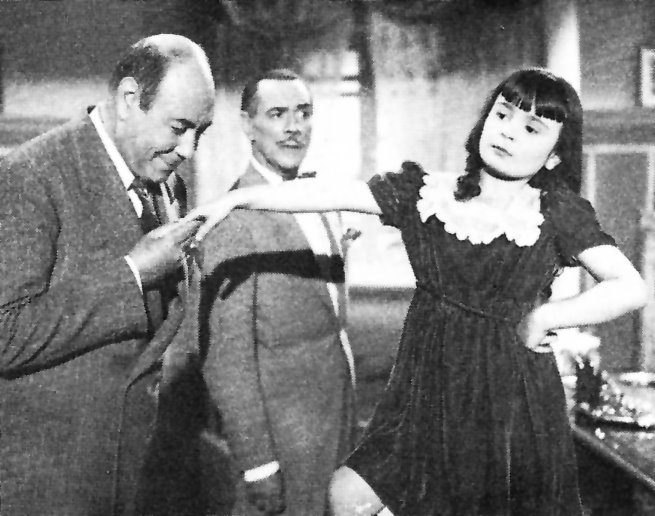
As the truly great Stefan Rosti (centre) used to say, “diabolical!” (gahannami!).

If the commanding heights of repressive rule are holding together, so seem to be the nuts and bolts. The enforcers of repression continue to follow orders and to smash dissidents. Everyone from governors to security directors at the top to police chiefs, officers, and simple recruits at the bottom are doing their bit (if not more) to run the coercion machine. If anything, it seems as if the new Cairo security chief, Ismail al-Shaer, is even more ruthless than his predecessor Nabil al-Ezabi, who’s moved on to greener pastures. For his efforts in policing the numerous contentious episodes of 2005, Ezabi has been rewarded with a big, fat governorship (mabrouk ya siyadat al-liwa).

For the regime to end, state security personnel must splinter and some then join the reform movement, even if secretly à la Ukraine. At the very least, a critical mass must shirk their duties and withhold their cooperation. Everyone was excited by the 1986 CSF mutiny precisely because it seemed as if the agents of repression were turning on their masters, at a time when other social forces (particularly labour) were also rebelling. But the formidable capacities of the Egyptian state effectively contained that brief upsurge, and draconian new control mechanisms were instated to prevent any second acts. If the sinews of state control remain intact and loyal to the regime, it’s difficult to imagine how the latter can be dislodged.

Much has been made of the security forces’ crushing of protestors over the past few days, and at least one person has written that the culture of police brutality and impunity is itself a portent of impending chaos. However, aside from the one incident of the police beating of judge Mahmoud Hamza on 24 April, recent police brutality is nothing new. Has some invisible threshold been crossed?

What of the most inscrutable institution in Egyptian politics? There’s a lot of talk about what the military will and won’t do in X, Y, or Z event, but frankly, I don’t know how anyone can credibly claim to know anything about the potential behaviour of this institution. I don’t care how many “Western diplomats” are anonymously quoted in foreign news accounts pontificating on this matter. Nor how many informal conversations were had with “top-ranking generals” while strolling on the beach at Marina (or is it Ain al-Sukhna?). Or any of the other laughable gossip and tall tales that enliven the cocktail party functions of the foreign and local blathering classes. Some Nasserists seem to think that the valiant military will step in at just the right moment to prevent a handover of power to Gamal or to save Egypt from other nightmarish prospects. I beg to differ. If this logic holds, the military would have stepped in a long long time ago, mesh keda walla eih?

The most intriguing thesis I’ve heard (and wish I could claim credit for) is that the military no longer acts as a coherent, corporate entity. Since the Abu Ghazala affair, Hosni Mubarak has ironically presided over the comprehensive depoliticisation of the Egyptian military. Although he does not explicitly make this argument, the most astute and respected scholar of Egyptian organisations had this suggestive yet still crucial information to share on current military practices, facts that have gone strangely undiscussed. Anyone who claims that the military can still act as the final arbiter and guardian of the republic must contend with both severe lack of information and internal organisational practices that suggest quite the opposite.


The End Draws Nigh?


If there are very good reasons to doubt forecasts of imminent regime demise, there are equally good reasons not to uncritically accept assertions of regime “stability.” After all, no serious observer can dismiss the significant, perhaps seismic shifts over the past few years in how the regime interacts with its domestic and international interlocutors. A regime that was able to effectively quell a militant Islamist insurgency from 1992-1997 now seems unable to manage peaceful voters, peaceful judges, and peaceful street demonstrations.

A regime that convinced the country and the world that it was waging a brutal but necessary campaign to rid Egypt of terrorism now cannot muster a single convincing explanation for any of its increasingly irrational and often hysterical actions. In September 1999, Hosni Mubarak began his fourth term with only the faintest murmurs of elite opposition, confined to closed rooms and abstruse constitutional conversations at that.

In September 2005, Hosni Mubarak was being pilloried and humiliated in public and private just as he was putting himself up for "election" (AP Photo, September 10, 2005).

The signs of decay are numerous and multiplying all around us, but in my opinion, two in particular stand out as indices of a potential cataclysmic upheaval. First is the extent to which Hosni Mubarak and especially his family have become the target of popular hatred, biting ridicule, or mild distaste (depending on who you talk to). There is no disaster, policy decision, or daily inconvenience that is not popularly believed to originate at the doorstep of the presidential residence. Whether it’s the series of tunnels and overpasses near Heliopolis and Madinat Nasr, or the fancy, air-conditioned “capital cabs” complete with digitised meters, or the crackdown on opposition candidates and voters during elections, or the crackdown against alleged homosexuals, or the decision of the Minister of Justice to refer two senior judges to a disciplinary board, it is truly remarkable how swiftly such actions are attributed to Gamal, Alaa, and Suzanne Mubarak, by both patrician and plebeian alike.

It matters little whether these and other decisions are actually the work of the ruling family. What matters is the near-unanimous public perception, the incessant jokes, the rich rumours, and the flourishing samizdat. If Suzanne Mubarak is continuously presented to us as the First Lady of Virtue and Beneficence and her son is foisted upon us as the Visionary Young Moderniser with a Heart of Gold, is it any wonder that Egyptians believe the president’s family runs the country? Add to this additional tangible facts such as the yawning succession vacuum, the marriage between business and power (of which the ruling family is a neat exemplar), and the never-missed opportunities to exploit and insult Egyptians.

I cannot contain my outrage at this last trait. When the ferry sank and the Dahab bombings happened, the state-owned media made sure to highlight that Gamal bey’s “Policies Secretariat” observed a moment of silence for the ferry victims, and Suzanne Mubarak oh-so-graciously cancelled her trip to a “businesswomen’s conference” in Turkey so she could visit the Dahab injured. Does this not reveal an extraordinary level of indifference to the loss of human life and to the grief of family members? (Family members of ferry victims, Cairo, March 13, 2006).

If the ruling family is increasingly viewed as the problem, an unlikely sector is increasingly viewed as the solution. The second sign of regime decay is the Mubarak regime’s unexpectedly drawn-out and now extremely public confrontation with judges. This could have remained a contained and rather marginal intra-state affair, were it not for the highly unusual and intensifying public support of judges as the only trustworthy, inspiring, and capable force in public life. Every major pundit has written about the judges’ saga over the past two weeks. Nearly every major social group has visited the Judges Club to express solidarity for the ongoing sit-in. And as we know, the extremely brave and committed young activists who have staged their parallel sit-in supporting the judges were attacked three times by security forces and finally forcibly removed one day before Bastawisy and Mekky’s hearing.

That day was a turning point of sorts. The outpouring of public support for judges on 27 April took everyone by surprise, most of all the judges themselves. It surpassed the solidarity demonstrations of 13 May, 14 August, and 2 September 2005, and it surpassed the turnout on 17 March 2006. As a judge and member of Bastawisi and Mekky’s defence team reflected, “One amazing thing is that on our way from the Club to the courthouse and back, security failed completely and we were hugged by the masses, they knew us by name, they were singing for us, one of them kissed my hand! It was a huge day in the history of our country, I know that our days will be dearly remembered as part of our great history for years to come, thank God I was part of it no matter how small, and thank God I was on the right side.”

An intriguing proposal was floated on that day, first by Nasserist parliamentarian Hamdeen Sabahy in the library of the Cassation Court, as throngs of judges, journalists, and lawyers waited for the disciplinary board’s verdict (adjournment until 11 May). He said that if the two judges are dismissed, Egypt will have gained two candidates for president. The electrifying suggestion was met with enthusiastic applause and of course percolated to high places. The authorities are reportedly now scrambling to contain the whole matter before 11 May.

The Judges’ Club resolution after its 27 April emergency general assembly is a powerfully worded document. Its last paragraph in particular has a momentous ring to it, at least for me: “Egypt’s judges, and they represent one branch of state power, realise that the nation is the source of all powers, and that achieving security and stability has it source in the prosperity of the nation and the consent to its rulers, and that the rulers’ esteem is in responding to the desires of citizens, not in haughtiness and intransigence. There is no way of achieving security and stability in the country merely through the repression of force and the control of power. Rather, the people’s hope in justice must be preserved, as well as preserving their dignity and honour, and reviving their hope in reform, and establishing a true democratic life through fair elections and real transfer of power, and lifting all exceptional laws including ending the state of emergency, and unleashing freedom of expression, and the freedom to form parties, unions, and associations, without any restrictions, so that Egypt can regain its place among nations.”


Aporia


There are firm grounds for confidence in regime stolidity, and equally robust signs of impending implosion. Comparing current events to the twilight of Sadat’s rule or Hosni Mubarak to Romania’s Ceauşescu is good for dramatic effect, I suppose, but I wonder how those comparisons are made, and to what extent they are simply parroting a currently very trendy idea. I am also confounded by those who think that nothing has changed, who dismiss popular ferment as so much frippery that doesn’t dent the “real” sources of power, who assert that only external pressure matters.

I think only an oracle (if there are such things) can know which “path” will be trod at this “crossroads” that so many people keep announcing. If Egyptian politics have indeed arrived at a crossroads, then I’d like to savour the extraordinary uncertainties and hence possibilities that characterise such points. Unless you’re Teiresias, loud assertions about the likelihood of this or that “scenario” are rather dubious, mesh keda?

*Mahmoud Mokhtar, “Keeper of Secrets” (Katematul Asrar)