Friday, June 15, 2007

Respite


Arty Topalian, Seated Fellaha (ca. 1950s).

Monday, March 19, 2007

A Parliament to Watch

In what I think is a first in Egyptian political history, on Sunday 18 March, 102 opposition legislators began a boycott of parliament’s plenary sessions. The sessions are devoted to swiftly passing what the Mubarak regime is calling “amendments” to the 1971 constitution. In reality, the alterations augment executive powers and constitutionalise the exclusion of Mubarak’s challengers. Naturally, what gave the protest its heft was the presence of 88 Muslim Brother deputies, but equally significant was the active participation of Hamdeen Sabahy and Saad Abboud from the Karama party, noteworthy independents such as Gamal Zahran and Alaa Abdel Moneim, and maverick Wafdist Mohamed Abdel Haleem, among others.

Under a blinding high noon sun, the deputies stood swaddled in black sashes protesting the “constitutional coup” and carried bright-yellow signs announcing the death of the constitution, the end of personal liberties, and the extinction of free elections. Some wore black ties in mourning. Ikhwan MP Mohsen Radi brandished the constitution and called out, “Here’s the constitution that the NDP wants to destroy.”


As prominent deputies made fiery statements to an army of jostling reporters and cameramen, I couldn’t help pondering a couple of glaring ironies. First, Mubarak’s tampering with the constitution has transformed a flawed and musty document into a significant contract of basic rights worth defending. Second, the regime’s attack on the last vestiges of constitutional freedoms is unintentionally fostering coordination and collective action by the parliamentary opposition. For the past several days, independent deputies have been deliberating round the clock to weigh various courses of action, including collective resignation. Ultimately, that option was dropped because (a) lack of time to investigate the full legal and political ramifications of such a momentous decision, (b) the regime would like nothing more than to be rid of the high percentage of opposition deputies and to engineer new, better controlled elections, and (c) the boycott proposal was floated by a dubious source: the revolting and utterly untrustworthy Mustafa Bakri, State Security’s point man in parliament (who of course was not among the 102 boycotters).

Obviously we’re still a very long way from a real parliament capable of both checking and bargaining with the executive and forging durable extra-parliamentary coalitions. But I can’t shake off the feeling that what happened Sunday portends something new, perhaps even the spark that may ignite the parliamentarisation of Egyptian politics. The group of 88 are complicating business as usual under the rotunda. Recall their stand against the extension of emergency rule last spring, their participation in the pro-judges’ protests, and their tireless challenges to Fathi Sorour. If coordination between them and other opposition deputies continues on a variety of issues, then we may have to start taking parliament seriously.


For a few hours on Sunday, the grounds of parliament were overrun by the authentic representatives of the people, not the overfed, under-qualified cronies of the ruling regime. Parliament security guards, administrative staff, and buffet personnel gaped in awe at the independent deputies and the media menagerie they attracted, recognising that they had done something new and important. Passers-by lingered to stare and listen. An elderly woman smiled and wondered out loud to no one in particular, “Today is your day. Is this going to be on television?”


This here is Hussein Abdel Hafeez. He was on his daily round of errands in government buildings when he saw the colourful protest, so he decided to watch what’s going on. He had no idea what the protest was about and didn’t care that much, but he did care that it took him entire days to get basic services from the government bureaucracy. He said the MPs looked like good people who would listen to ordinary people’s problems, so he joined in to support them in whatever it is they’re demanding.

But then again, public support is trifling compared to what was heaped on judges last spring. Parliament is still very much perceived as the home of crooks, charlatans, and crazies, an institution best dismissed and mocked, and always steadfastly avoided. I can’t imagine Egyptians taking to the streets to rally around their legislators. But I also can’t stop wondering when and how the People’s Assembly will turn into a real institution. When will parliament make a real claim to represent the people and check the executive branch? I have no idea, but I’d bet on the role of independent MPs, regardless of their political affiliation. Their burgeoning collective action, the linkages they forge with constituents, and their ability to annoy and perturb the ruling regime and break up its power monopoly are the real building blocks of representative democracy.

Monday, March 05, 2007

The Perils of Succession

There are few more profoundly grotesque and unjust practices in Egypt’s republican history than presidential referrals of civilians to military tribunals, civilians who have done nothing more than peacefully express their political beliefs. Each of Egypt’s three presidents has tried and failed to defeat his challengers by using this faux-legal instrument. Nasser referred communists and Muslim Brothers to trial, Sadat referred our beloved bard Ahmad Fu’ad Nigm to a military court (because he couldn’t handle being mocked by the great one), and since 1995 Mubarak has sent to trial the most effective cadres of the Muslim Brothers, usually in the run-up to elections. Sadly, his 6 February referral of 32 members of the Muslim Brothers to trial is nothing new, and neither is the crackdown that has netted the group’s leaders and economic assets. What has changed this time around is the political context.
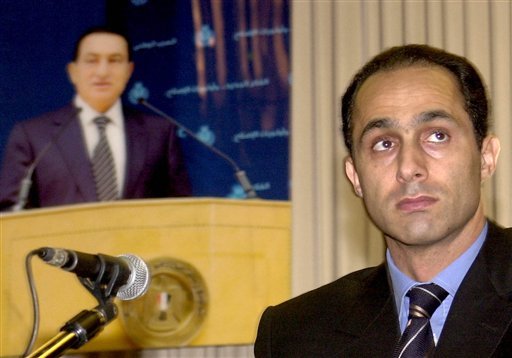
What distinguishes Mubarak’s current manoeuvres from both his own earlier tactics and predecessors’ actions is the extraordinary degree of uncertainty surrounding his regime’s future. This does not mean that it will collapse any day now. It means that the regime is on the cusp of a very risky succession. With Hosni Mubarak’s rapidly advancing senility and Gamal Mubarak’s incremental supremacy, the moment of power transfer is imminent and its direction appears clear. But there are so many wild cards and possible eleventh-hour developments at this juncture that the only certainty is that extraordinary uncertainty will accompany the process of succession.


A Risky Proposition


Succession is always a tetchy matter for undemocratic regimes, but the danger is even more acute in this case where the man in charge has hogged power for 26 years without cultivating a successor other than his own dull and despised offspring. To thicken the plot, the succession scheme appears to involve elections as both the mechanism and the legitimation of the power handover. How else to interpret the engineering of new constitutional rules to disqualify the regime’s most effective electoral opponent (the Ikhwan) and defang effective electoral monitoring (by the judges)? But as we know, elections are an extraordinarily complicated, exhausting project involving intricate coordination between many sites and very high levels of uncertainty. It’s as if Mubarak’s regime picked the most risky successor possible and planned to install him using the riskiest method possible.

If we adopt the logical though not inevitable scenario that Gamal is the heir apparent, what Mubarak and his newly nuclear son have going for them is the tacit endorsement of foreign patrons, principally the Americans, the self-interested enthusiasm of a circle of crony businessmen, and the co-opted top officials of the sprawling bureaucracy. That leaves organized sectors of the domestic public to be neutralised and/or crushed. As for the preferences and proclivities of the rest of the population, that is a total enigma.

Thus, the official retaliation against university students for organizing free and fair parallel elections; the crackdown on the Ikhwan for making trouble in parliament and generally acting like a real political force; the ostensibly legal throttling of the Karama and Wasat parties; the low-intensity battle against recalcitrant judges waged by the new strongman Minister of Justice, and of course the brazen plan to doctor the 1971 constitution. These strikes are needed not simply because many of these sectors are deeply opposed to a Gamal Mubarak presidency, and not simply because all are campaigning for honest and fair elections, but because the regime feels the need to signal toughness. It fears that its opponents will catch whiffs of its vulnerability during this transitional phase and attempt to use it to their own advantage. Like an ageing neighbourhood bully who lives by the credo of force, Hosni Mubarak’s regime is all about projecting strength.

Signalling toughness is especially critical given the steady stream of crises over the past year. There’s the cascade of transportation disasters starting with the February 2006 al-Salam 98 ferry sinking and the August Qalyoub train collision; the socio-economic fallout from the avian flu outbreak, the spring 2006 pro-judges’ street protests; the remarkable string of labour strikes in 2006 and 2007; bloggers’ and independent newspapers’ broadcasting of citizen torture in police stations; protests over the construction of mobile phone towers, and the recent scandal over collusion between the Health Ministry and a Gamal crony in disseminating contaminated blood bags.

For the most part, these are separate incidents, but their rapid cascade and government agents’ entanglement in each heighten the ambient sense of an embattled regime unable to control society. To make matters worse for the architects of succession, Egyptians have been a very contentious lot for some time now, yelling and screaming and complaining in a most unbecoming manner. They’ve been downright impudent and grabby, wanting rights and dignity and independence and fairness and so forth. And they’ve been organising to get those things. That can’t be allowed to stand.


Crushing the Ikhwan


Embarking on an electoral-hereditary succession means eliminating your most potent electoral rival. Hence the regime’s current crackdown on the Ikhwan. But there’s just one annoying kink: the Brothers are stronger today than at any time during Mubarak’s tenure. This is because of their relative success over the past ten years in building bridges with key actors: voters, nationalist and secular intellectuals and competing political forces, foreign parties, and their own sprawling membership base. Before and after their stunning performance in the 2005 elections, the Ikhwan put considerable effort in a reputation-building project aimed at normalising their position in Egyptian political life and transcending the silly but real constraint of their nominal illegality. They built effective, regularised links to constituents, courted secular rivals and assuaged their fears, and piqued the interest of foreign governments, whose agents began to probe the possibilities of engagement with the officially banned group. Equally important, the Ikhwan in the last few years have been working on their internal organisation. They have tried to re-establish ruptured ties between the leadership and rank-and-file, and worked to manage ideological, generational, and personality conflicts among their top decision-makers.

It doesn’t take a genius to see why this would constitute a nightmare for Hosni Mubarak. The Ikhwan’s capture of 88 seats in the 2005 vote was very inconvenient, causing the shaken regime to postpone municipal elections to avoid a damaging repeat, and to gain some breathing space to cook up the succession scheme. At first, the counter-mobilisation against the Ikhwan was predictable, reinforcing the group’s plucky underdog image and increasing public sympathy. In spring 2006, hundreds of Ikhwan were arrested for months for participating in the pro-judges’ protests (including Essam al-Eryan and Muhammad Mursi). Then, in a repeat of the 2005 vote, the government came out in full force to block the group from participating in the Alexandria Chamber of Commerce elections.

In April, to prevent professors affiliated with the group from holding faculty club elections, Alexandria University administrators locked the campus gates; professors had to convene their general assembly in the open air on the corniche. Meanwhile in parliament, the Ikhwan’s 88 deputies have been complicating the regime’s command and control tasks in this important arena, constantly sparring with Speaker-for-life Fathi Sorour and pressing parliamentary investigation of such inconvenient issues as very high-ranking official malfeasance in the Salam 98 sinking.

But it was an incident that took place on 10 December that was the regime’s real opportunity to roll back Ikhwan gains. On that day, Ikhwan students at al-Azhar were protesting their university administration’s obstruction of student union elections. During the protest, a contingent of students performed martial arts exercises, their faces swaddled in black, Hamas-style. Seizing this heaven-sent gift, the regime orchestrated a highly organised campaign in all of its publications and broadcast outlets designed to repel and frighten public opinion, just when it had gingerly begun to accept the group. The regime’s agents (from the president of al-Azhar University to State Security investigators to the lowliest government scribe) successfully portrayed the Ikhwan as a sinister, secretive organisation methodically infiltrating all critical societal institutions with the intent of taking over the country and turning it into an Islamic caliphate. Naturally, the specific context of the students’ act was obliterated to sow indiscriminate mistrust and fear, especially among those segments of the public that had always eyed the Ikhwan with some suspicion.

The spectre of the group’s 1940s violent wing was craftily invoked, in one fell swoop erasing years of work by the Ikhwan’s members to fend off claims that they’re nourishing militant underground cells ready to strike at the right moment. It was only a logical step for the government to then round up the organisation’s best cadres and send them to a military tribunal that would reliably put them behind bars for at least three years, thus depriving the group of critical skills and assets and fomenting internal dissension and confusion.

Abetting the regime’s offensive was the flustered response of the Ikhwan’s leadership. First they wrote off the martial arts exercise as a harmless skit, then they pooh-poohed it as a silly act by immature students, then they compelled the students to issue an ‘apology’ (thus reinforcing government claims of a militant organisation run by a handful of shadowy decision-makers), then they said they would form an official political party, then they backtracked and denied this. It would be an exaggeration to claim that Hosni Mubarak’s regime has wrought permanent damage to the Ikhwan’s carefully built political reputation. What the regime has done is recoup some of its own reputation for effortless control. This need to project strength is vital when considering the government’s unexpectedly non-violent response to striking workers.


Caressing Labour


The last thing the regime wants is a labour mutiny on its hands when all its energies need to be devoted to engineering succession. So aggrieved labourers need to be neutralised. I don’t think anyone has failed to notice the comparatively ‘soft’ manner in which Mubarak’s regime has handled the series of worker strikes at textile and cement factories and the national railways. This is noteworthy not just because of the contrasting gruffness with which Muslim Brothers and judges have been treated, but because of Mubarak’s past handling of organised labour action: the 1984-1987 wave of worker protest was met with swift police violence, mass arrests, and grave legal reprisals: in 1986, striking train drivers were referred to a High State Security court (it eventually acquitted them).

There’s one obvious reason why labour is treated differently: the regime’s security agents calculate that it would be suicidal to put down thousands of very angry labourers radicalised by years of substandard work conditions, maimed by avoidable workplace injuries, and steeped in a culture of collective action and protest. Putting down a few dozen white-collar demonstrators in the centre of the capital is easy, but wading into a sea of livid blue-collar protesters is another story entirely. Violent suppression at one plant could unleash a hellish cycle of copycat strikes, increased public outrage, more violence, and real instability that could seriously threaten regime survival.

There’s another important element in this wave of strikes that distinguishes it from past waves and gives the regime pause. Workers are not only demanding fair wages, payment of delayed bonuses, safer working conditions, and more benefits. And they’re not just blaming management anymore. They’re making concrete moves to recall their local union officials by organising massive petition drives for votes of no-confidence, and failing that, they’re threatening to simply withdraw from local union membership. Why does this matter? Because for as long as they’ve existed, the local unions have served as critical levers of state control over labour rather than as mechanisms for the representation of workers’ interests. The present wave of worker strikes is intimately connected to workers’ struggle for real representation.

Last year, workers began their collective action in the run-up to trade union elections to gain some leverage during a vote they knew would be cooked. When, as expected, independent candidates were barred from running and the same old cronies were elected, workers resumed their strike action. Their goal is to overhaul the structures that ostensibly represent their interests but in reality work to monitor their behaviour and abort incipient collective action. This is deeply threatening to the regime: a gathering mutiny against local union officials strikes at the heart of the state’s control and command structure over the critical sector of labour.

Thus, in a manner not seen in other areas of Egyptian politics, high-ranking officials have personally and publicly intervened to negotiate with and cajole striking workers, promising to deliver their unpaid bonuses and incentives in hopes of snuffing out grievances over representation. Everyone from the chairman of ETUF to the Minister of Labour to provincial governors have waded into the midst of the strikers, laden with conciliatory words and promises and a generous smattering of paternalistic discourse, as when Aisha Abdel Hady volunteered the information that Hosni Mubarak cannot sleep at night if he feels there is a single unhappy worker. Madame Abdel Hady has also recently exhibited a strong allergy to the term “civil disobedience.” During a parliamentary discussion of a possible wave of societal disobedience led by striking workers, she firmly averred that “civil disobedience” is not part of the make-up (khameera) of the Egyptian worker.


Containing Judges


Mubarak’s regime knows that we know that it has conceded to worker demands, and that this knowledge might provoke other forces to engage in collective action to gain concessions from a regime that has built its reputation on never negotiating. So it is of critical importance that it apply maximum toughness with the one other sector that can make a credible bid at negotiation: judges. Indeed, one reason why Minister of Justice Mahmoud Abou el-Layl was removed was that he showed too much readiness to negotiate and give and take with judges. His replacement is a perfect embodiment of the credo of non-negotiation.

Mamdouh Marei’s personal style and professional background are all about issuing orders: as a person, he’s brusque and bossy. Professionally, he does not practice collegiality but is condescending and supercilious, qualities he acquired from years at the helm of the judicial internal affairs department in the Ministry of Justice. Let’s not forget that his recent term of service as Chairman of the Presidential Elections Commission (PEC) drove a huge wedge between him and thousands of reformist judges. All in all, he is the perfect candidate for the job of quashing the movement for judicial reform and clean elections.

Marei and his bosses know from last spring that a PR campaign to discredit reformist judges will carry no weight with a public that adores and idolises leaders of the judicial independence movement. So Marei has cunningly selected an alternative, much more effective plank: judicial modernisation. Under this general rubric, Marei will focus on three tracks: judicial training, services and support, and the induction of women into the profession. How will these fragment and weaken reformist judges?
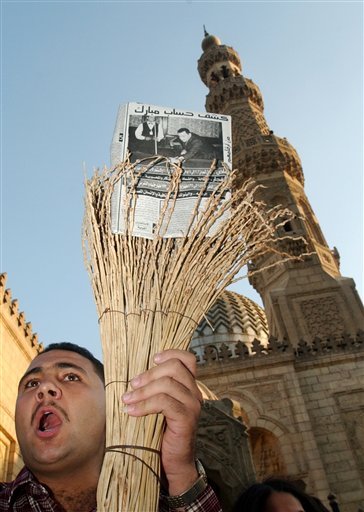
First, Marei will hitch onto the genuine problem of the abysmal training judges receive to push the idea that judicial supervision of elections should be at the bottom of judges’ priorities. Judges belong on the bench, not in the polling station, goes the technically correct argument. Instead of being drawn into the exhausting minutiae of electoral disputes, judges should focus their energies on professional development and the Ministry will help them do that. Judges who insist on “one judge for every ballot box” will appear to be ignoring their duties and ‘becoming involved in politics.’ The judicial training argument has real potential to divide the clean elections movement because it resonates with a strong current of opinion among judges.

Marei’s second strategy is to erode the mobilising potential of judges’ Clubs, particularly in Cairo and Alexandria. To this end, he has already started installing all sorts of critical judicial support services within courthouses (especially primary courts) so that judges won’t ever need to go to their Clubs for bank services and loans, housing and mobile phone benefits, and a host of other auxiliary services. At the same time, earmarked Ministry of Justice funds to the Clubs are being dried up or cut off altogether, and public utility companies are instructed to cut off or scale back water and electricity service. However, reformist judges are very alert to this strategy and have counteracted Marei’s actions by unanimously voting to raise individual monthly dues to their Clubs from £E2 to £E20.

The third strategy portrays the regime as the progressive, courageous champion of women’s rights valiantly resisting sexist, exclusionary judges who preach democracy and reform but refuse to allow women entry into the judiciary. Women’s accession to the judiciary in Egypt has been a hot button issue among judges for at least 10 years, eliciting very strong feelings, with a minority of ardent supporters and a majority of variously motivated detractors. Marei has already selected 124 women legal officers for qualifying exams and training in the National Center for Judicial Studies in preparation for their admission into the profession. By playing the woman card, the regime burnishes its own reputation, casts doubt on the integrity of its judicial critics, and drives a wedge between pro- and anti-women judges within the judicial reform movement that the regime hopes will block further collective action.

It’s far too early to call Marei’s strategies unequivocal successes or failures. So far, he has managed to bring together the conventionally separate administrative judges with the rest of the judicial corps in unified opposition to his policies and tough guy persona. The cynical bid to appear as the champion of women’s rights is waved off by judges as Marei’s toadying to Suzanne Mubarak’s wishes, and of course Suzanne’s imprimatur is a political kiss of death. Whether the regime will attain its real objective of wresting electoral supervision away from the Judges Club and entrusting it to a pliable central Commission remains an open question.


Savouring the Irony


Would Mubarak’s regime be crushing the Ikhwan, containing judges, and managing labour unrest if it wasn’t embarking on a delicate, very unpopular, and sure to be undemocratic succession? Absolutely. The difference that succession makes is that all of these manoeuvres become matters of political survival rather than garden variety political management. By raising the stakes, the regime unwittingly invites political challenges, unforeseen alliances, unexpected mobilisation, and acts of political adventurism and risk-taking unlikely in normal times; think of Ayman Nour’s gamble for the presidency that catapulted him from a small-time politician to a heroic national figure and international cause célèbre. Even if the succession proceeds smoothly, the post-succession days, weeks, and months promise to be full of turbulence as the heir works to consolidate his rule in the all-important early phases.

How ironic that in attempting to secure his regime’s survival, Mubarak is actually ushering in one of the most uncertain political junctures in Egypt’s republican history. It’s just like when his amendment of Article 76 to transfer the presidency to a handpicked successor actually turned into multiple opportunities for political mobilisation and societal protest. I’d like to think that the perils of succession might also hold the possibilities of an incrementally more democratic politics, with new actors plunging into the fray, old actors reinventing themselves, new alliances struck, and more competition in the political arena. Prescience or wishful thinking? I can hardly wait to find out.
*All Photos from AP.

Sunday, January 28, 2007

Bookbag

It’s January, and that means Book Fair time. Here I’ve plucked only three of the most prominent features this year, two worthwhile new novels and a marvellous book lifted straight from the texture of daily life. All of them are wonderful (and quick) reads, easy on the didacticism and heavy on the lived experience of ordinary people.

Sonallah Ibrahim has become that rare novelist whose every new work is eagerly anticipated and turns into a literary event of note. His politics and his courage are only partly to account for this. It’s his knack for innovation and experimentation with new themes, new styles, and new methods for composing a novel that give Ibrahim a vitality rare among his contemporaries. Though all of his novels are written in an extremely shorn, reportorial prose allergic to any embellishment, and everything he writes involves some facet of human alienation from oppressive socio-political structures, his subject matter and methods have varied. That Smell (1966), The Committee (1981), and Zaat (1992) explore individual human alienation under political authoritarianism and capitalism; Star of August (1974) and Warda (2000) are more frankly political novels about concrete political struggles; Honor (1997) and Oases Diary (2005) chronicle the prison experience based on Ibrahim’s incarceration with other Communists from 1959-1964; Beirut Beirut (1984) and Amrikanli (2003) transcribe the rituals of daily life against the backdrop of civil war in Lebanon and late capitalism in America.

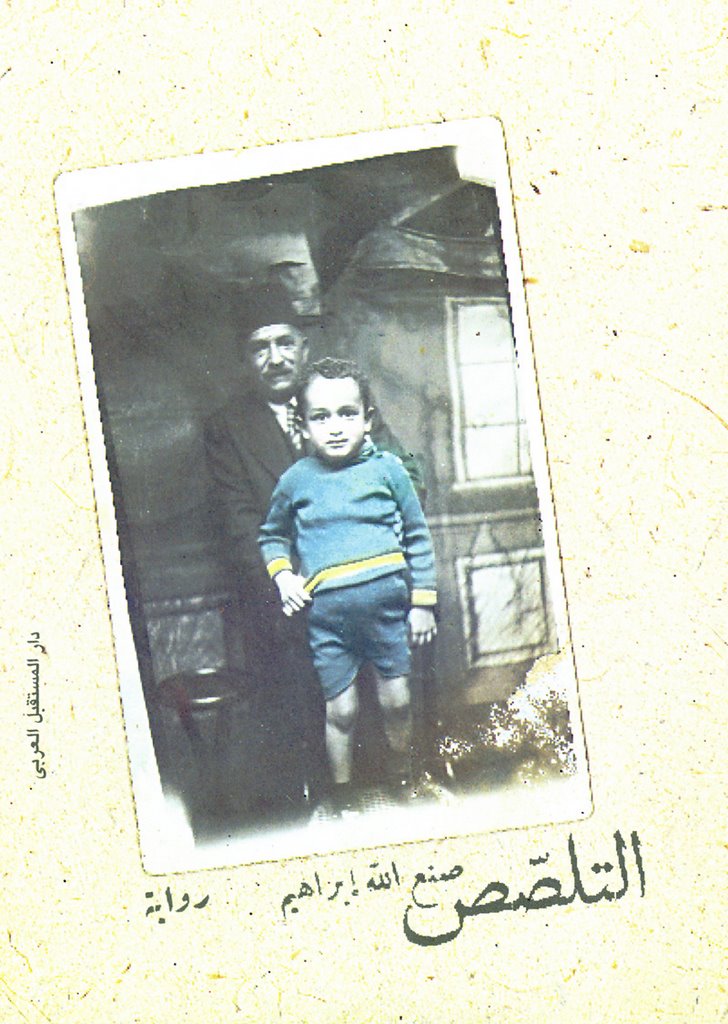
Ibrahim’s latest novel, Sneaking (2007), is his most intimate work yet, mining the author’s unconventional childhood to explore the fundamental human emotion of yearning: yearning for maternal love, for lost youth, for the simple creature comforts of domesticity. The novel is essentially a fictionalised account of the author’s childhood; the cover photograph depicts Ibrahim and his father, a very expressive image embodying the close-knit relationship between an ageing father and his growing son. It is this co-dependent, claustrophobic, yet touching relationship that forms the centrepiece of the narrative.

Born in 1937, Ibrahim was the only child from his father’s second marriage to a much younger nurse hired to tend to his ailing first wife. The 16-year-old nurse kept the husband company, read the newspapers, and talked with him about politics. The respectable, high-ranking civil servant fell in love for the first time in his life and married the nurse in secret. When the first wife died and Ibrahim’s father told his grown children of his second household, they became extremely upset and were cold and unwelcoming toward their half-brother, punishing him for his mother’s modest origins. These and more details unfold in the novel. Particularly remarkable is Ibrahim’s vivid reconstruction of his childhood feelings toward his snooty half-sister, a heartbreaking mixture of eagerness for love and acceptance and fascination by her comfortable bourgeois household.

In several ways, Sneaking bears Ibrahim’s trademark imprint: extremely short, clipped sentences that resemble note-taking more than narrative prose; an extraordinarily detailed, clinical rendition of the minutiae of daily life (down to the bedbugs plaguing the nine-year-old child); and a backdrop of momentous events, in this case the 1947-1948 ferment on Egyptian streets against King Farouq, the Zionist control of Palestine, and bickering political party leaders. But in its lyrical tone and familial setting, the novel is quite a departure from Ibrahim’s previous work. Returning to his childhood, the novelist delves into territory he has never mined (until the very recent Oases Diary).

As might be expected, Ibrahim’s take on childhood is original and unsentimental. There’s no nostalgia here, no rose-colored rendition of time and place, no attempt to juxtapose an idealised past against a grim present. Instead, there’s a gripping, child’s-eye view of the world by a child exceptionally attuned to the moods, habits, and silent yearnings of the adults around him. This child glides through life surreptitiously listening in on adult conversations that he’s not supposed to hear, adult behaviour he’s not supposed to see, adult longings he’s not supposed to understand. So listen, peek, and sneak he does. Indeed, the word talassus (sneaking) is peppered throughout the novel like an idée fixe, signalling the young child’s coming-of-age and induction into the adult world. By sneaking about in his own and others’ apartments and peeking from behind locked gates, the child sees and overhears adults napping, copulating, depilating, flirting, bathing, menstruating, cooking, cleaning, and performing other life cycle rituals.

Ibrahim has adopted a hallowed genre but given it a creative twist, writing a very quirky, intimate, offbeat, yet strangely affecting bildungsroman. Unlike the conventional form, however, his bildungsroman is as concerned with old age as it with youth. As the child’s eyes are opened to the wide adult world, the elderly father grows keenly aware of his own mortality and gradual receding from life. Like an old man, he ruefully reflects on his waning faculties and maintains a strict regimen of fussy rituals (including a hilarious scene where he imposes on the child a series of superstitious exercises designed to improve the latter’s performance on exams). One of the most touching scenes in the novel involves a conversation between the father and his randy friend Ali Safa in which Safa shares his obsession with his 16-year-old neighbour girl. The child, pretending to be lost in sleep, listens on in fascination as Safa relates his fantasies and bemoans his lost youth and his father tenderly recounts his love for his second wife and his joy at experiencing the true taste of fatherhood at a late age. While overhearing both men voice their longings, the child is prompted into his own reverie, remembering fragments of his happier past, of both parents joyfully singing together in a warm house filled with the comforting smell of frying food. The moving scene twines the deep desires of both young and old for feminine warmth and companionship, the theme that Ibrahim has identified as the dominant motif of his new novel.

The intensity of their longing is fuelled by the father and son’s cramped life on the father’s limited pension, renting out rooms in their apartment to save money and living together in one squalid, freezing room infested by bedbugs. The mother has disappeared from their life; the narrator hints that she is confined to a mental institution or has died. Both cope with her absence by clinging to and caring for each other while constantly yearning for a soft female presence. During their holiday visits to his uppity half-sister in Heliopolis, the child is fascinated by the cleanliness of her house, the softness and clean smell of her bedding, the tastiness of the food prepared by her cook. Everything around them reminds impoverished father and son of their emotional and material deprivation. Even when they return to their inevitably dark alley and draughty room in Abbasiyya, they encounter signs of others’ domestic comforts, overhearing their lodgers the constable and his young wife in their room laughing and singing along with love songs on the radio, empty plates of home-cooked food piled up on the dining table.

Stylistically, the novel includes several features that distinguish it from the previous Amrikanli’s mere transcription of daily life. The author signals the child’s longing with portions of bold text that describe his daydreams, vivid memories of his mother, and childhood ditties that remind him of happier years when she was present and his father was happy. Juxtaposing these portions from the past with the father and son’s present spartan existence is especially powerful in conveying the boy’s feelings of loneliness and longing. Words and images recur throughout the text to underscore central motifs and lend the novel structural coherence: the repetition of the word talassus; the inevitably dark alleyway to their house; their claustrophobic, fetid room with the hard bed pillows and ratty mattress.

Sneaking begins and ends with the father and son going about their daily rituals: buying their meagre groceries on credit, working together on the boy’s composition homework. The bond between an aged father and his nine-year-old son is the real subject of Sneaking, Sonallah Ibrahim’s most introspective work yet. This is not a novel about the combustible politics of the late 1940s, nor an account of the ravaging effects of capitalism on individual lives. It is a novel about the emotional world of ordinary people living in a particular time and place, pining for the small creature comforts that make life worth living.


“You’ll read it in a day and come back and buy copies for all your friends,” the bookseller said about Khaled al-Khamisy’s Taxi. He’s right about one thing: the book is impossible to put down (my friends will have to buy their own copies). It's a simple yet profound idea gracefully composed and artfully executed. At first, I cringed at the potential for condescension and cliché when collating the stories of Cairo’s cab drivers. The idea is brilliant, the product could be disastrous. I expected pages of patronising, hackneyed “analysis,” or moralising preaching, or superficial fare the sole purpose of which is to showcase the author’s brilliance. But from the first few pages, screenplay writer and political scientist Khaled al-Khamisy makes it perfectly clear that he’s an excellent listener and a faithful transcriber, with a fine ear for the comical, poignant, and tragic in the stories of the taxi drivers. In other words, the author thankfully does us the favour of withholding his judgment and refraining from lecturing as he conveys undoctored conversations brimming with humour, pathos, and startling insight.

The book includes conversations with drivers from April 2005 to March 2006, a year when the author relied almost exclusively on cabs to move around the city. This exposed him to the extremely diverse human pool that now constitutes the capital’s modern coachmen. Anyone who uses taxis and pays any attention knows that there is no such thing anymore as the prototypical taxi driver (if there ever was). High unemployment and underemployment, skyrocketing costs of living, and a 1990s law allowing any aged vehicle to be turned into a taxi have all conspired to dramatically increase the number and diversity of taxis and their drivers (80,000 cabs in Greater Cairo alone, al-Khamisy says). Drivers now run the gamut from white-collar professionals to blue-collar workers to moonlighting civil servants to college students. They’re of varying age groups, from drivers in their late teens who’ve just secured a license to septuagenarians who started driving in the 1940s. A fair portion of drivers have postgraduate degrees, and all have stories to tell.

After a brief, nimble introduction, al-Khamisy proceeds to recount 58 encounters with drivers from all walks of life (including a creepy yet all too believable exchange between a cab driver and the author’s 14-year-old daughter taking a taxi alone for the first time). The stories are textured, atmospheric, and very diverse, ranging from descriptions of the bitter struggle to earn a few pounds driving a taxi in extremely adverse conditions, to drivers’ evocative memories and personal stories (especially touching is the film buff who had not stepped into a movie theatre for 20 years), to social critique and analysis (especially remarkable here are the driver who dissects the hidden function of television commercials, and the driver who has a stunningly insightful analysis of the eclipse of street protest in Egypt since 1977), to drivers’ poignant hopes and aspirations (the driver who daydreams about an African cross-continent trip).

One of the most remarkable, hilarious, and insightful set of stories are those about politics, especially those conversations that deal with Hosni Mubarak and his presidential elections. It is to al-Khamisy’s great credit here that he faithfully transcribes both those opinions for and against the perennial president, and by doing so he makes a subtle point: it is very misguided to generalise about Egyptian public opinion from a few dozen examples, or to treat taxi drivers as somehow “authentic” voices of “the street.” Mercifully, this kind of essentialism and faux-populism or whatever it is is completely absent from the book. For every foreign correspondent and “analyst” who thinks he’s located the “pulse of the Egyptian street” by exchanging a few words with his cab driver, al-Khamisy’s book is a powerful rebuke. Indeed, one of its great virtues is to rescue taxi-driver opinions from over-analysis and rescue taxi-drivers themselves from the burden of representing some hallowed, comforting, but nonexistent “everyman.”

A textured book takes you on a roller coaster of emotions. Reading Taxi makes one teary-eyed with laughter in one chapter and teary with anger in the next. Particularly enraging are taxi drivers’ stories of their harrowing encounters with predatory and corrupt police officers, and the related nightmare of being stopped for hours when Mubarak’s motorcades are passing through. In unforgettably straightforward detail, one driver relates his experience of being stopped for four hours on the Salah Salem road: “That day, I dropped off the taxi to its owner, gave him all I had, and promised to give him the rest the next day. I went home and I swear to you, we all slept without dinner. My wife and kids were waiting for me like every night for dinner, but I came back empty-handed. My wife cried and put the kids to sleep, and I sat by the window listening to Qur’an to calm myself down.”
Lest the reader think al-Khamisy presents a one-dimensional view of taxi drivers as downtrodden, wronged beings, there are also plenty of encounters with drivers who are liars, bigots, crooks, and jerks. There are unscrupulous drivers who spin tall tales to garner sympathy and extract a higher fare; aggressive, preachy drivers who blast religious sermons at maximum volume; and drivers who prey on their weak, poor, and/or female customers. One of the most haunting vignettes in the book is an interaction between the author, a gruff cab driver, and a shoe shiner that still sends shivers down my spine every time I re-read it.

As anyone who makes heavy use of taxis knows, this mode of transportation is often occasion for unusually intimate, unintended, fleeting encounters, encounters that can be intensely regenerative or extremely upsetting. I don’t think it’s a coincidence that al-Khamisy begins and ends his book with two riveting, purgative encounters that carry loads of inexpressible meaning. The book opens with the story of an antique driver who has been driving a taxi since 1948, and ends with an absolutely magical encounter ten minutes before Ramadan iftar that prompts al-Khamisy to pen some of the most beautiful prose I’ve read in a long while: “He left me with the taste of sugar in my throat, and the scent of night musk in my soul, and he made me break my fast unhurriedly for the first time in a long time, contemplating everything around me…”

I can’t come up with a better descriptor for Taxi than Galal Amin’s blurb at the back of the book that “it’s like a refreshing breeze on a hot day.” Yes, the book is about the resilience of the human spirit, it is a powerful chronicle of the Herculean struggle for survival and dignity, it does document increasing social inequalities, and it does faithfully record the pungency and power of everyday speech. It’s an urban sociology, an empathetic ethnography, a collection of valuable oral histories, and a morphology of ordinary people’s language all rolled into one.

But the book is a lot more than the sum of its parts. It tells us much that we already know and edifies us about much that we don’t, and it does more. It plucks startling beauty and poetry out of the cacophony of everyday life. It arranges it for us to contemplate and appreciate, not as a way to elide the injustices and indignities that permeate life, but as a necessary yet all too rare counterpoint. Khaled al-Khamisy reawakens our dulled sense of wonder, outrage, and sorrow, and that is an awesome achievement.


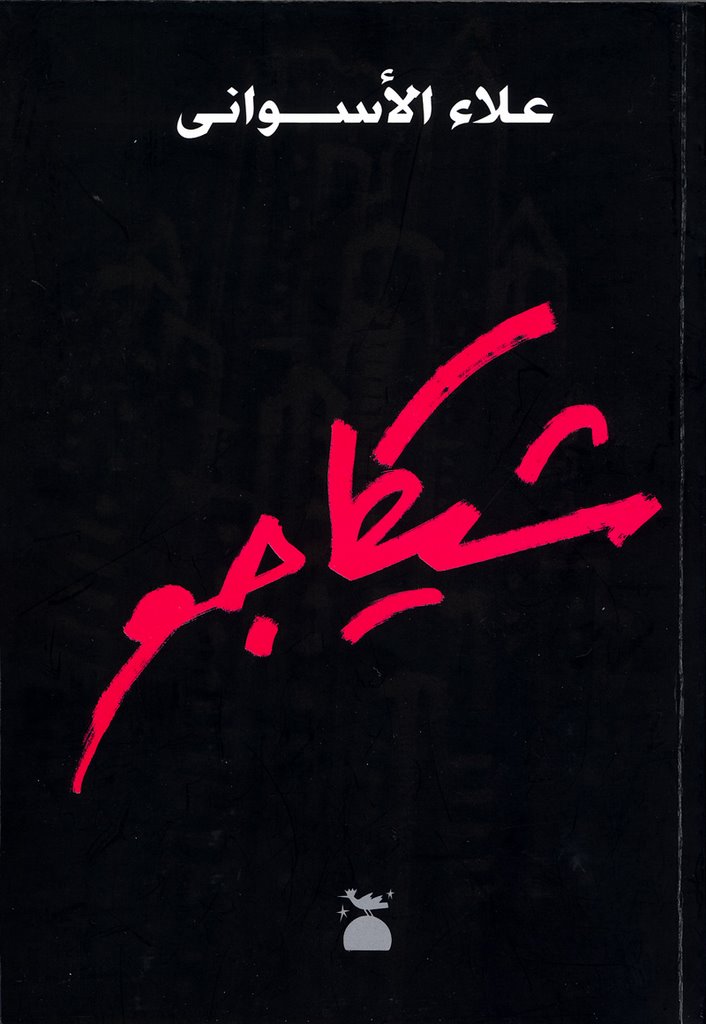
Like his first novel, Alaa al-Aswany’s 450-page second oeuvre is consciously designed to be a page-turner, and therefore it’s extremely readable, briskly-paced, and includes lots of details on sex, friendship, hatred, ambition, defeat, and other well-worn aspects of the human condition. Like ‘Imarat Yacoubian, Chicago is full of plausible, well-drawn characters whose lives intersect in a unifying locale, this time the University of Illinois in the American city of Chicago. The second novel also features the same narrative devices Aswany used in Yacoubian: a blunt denouement and bittersweet ending, an omniscient, sympathetic narrator, and more than a few bits of melodrama packed in at the end. As in Yacoubian, in Chicago Aswany carefully eschews any hint of formal experimentation, linguistic artistry, symbolism and metaphor, or any other literary devices. And perhaps that’s just as well if his laudable aim is to lure the layman to fiction reading and rebuild a novel-reading public (Chicago was first serialized in al-Destour). But Chicago lacks the blunt, resonant social critique that gives Yacoubian its edge and makes it such a phenomenon. In everything else, however, both novels tread the same ground in the same style.
In Chicago, Aswany trains a more analytical eye on his subject matter. The novel begins with a compelling, all-too-brief history of the city, from the massacre of Native Americans by European settlers in the 17th century to the devastating 1871 fire. Appropriately, the novel’s first words are an explanation of the city’s name: “Chicago” is the Algonquin word for “strong smell” that the city’s natives gave to the onion fields that covered its terrain. To signal the motif of human reinvention and survival running throughout the novel, Aswany’s introductory urban history highlights the resilience and recovery of the “Windy City’s” inhabitants after the Great fire, a conflagration that claimed 300 lives, rendered 100,000 people homeless, and destroyed $200 million worth of property. Admiringly, almost proudly, Aswany relishes the speedy, determined recovery of “Chicagoland,” “Second City,” “City of the Big Shoulders,” “City of the Century.” He then delves into his engrossing narrative of Egyptians, Egyptian-Americans, and Americans fumbling for meaning in the giant metropolis, a city the novelist knows well from his days of graduate study there in the late 1980s.

It’s not a coincidence that the novelist begins (and ends) with Shaimaa Muhammady, the very Egyptian name he gives to the very Egyptian, 33-year-old medical student from Tanta studying for her doctorate in histology at the University of Illinois. Shaimaa gets the lion’s share of the narrator’s affection, and perhaps for this reason is one of the most well-crafted characters (though not without some annoying made-for-TV clichés here and there). Like Buthaina al-Sayed of ‘Imarat Yacoubian, Shaimaa is an archetype of the driven, resilient Egyptian woman, a kindly creature struggling to survive in an inhospitable world. Shaimaa, however, is subjected to subtler pressures than Buthaina. The extremely hardworking, plain, muhaggaba medical student goes straight from Tanta to Chicago, mostly to escape social pressures at home in the form of relatives and colleagues who frown upon her academic excellence and unmarried status (Aswany draws a link between the two).

But moving to Chicago is no relief, as Shaimaa experiences harassment and isolation in post-September 11th America. She copes with her crippling homesickness by intensifying her studiousness and reproducing comforting Egyptian rituals at home. An unfortunate but hilarious kitchen accident leads her to meet fellow Egyptian histology student Tareq Hasib, a wiry, surly, equally hardworking graduate student who’s devised his own rituals to cope with loneliness and his awkwardness with women. Their tense first encounter blossoms into romance and intimacy, a potentially maudlin subplot that Aswany uses to effect convincing transformations in both characters. To his credit, the author also uses the unlikely relationship to raise important questions about Egyptian marriage customs, particularly the dynamics of class and status.

As with Yacoubian, Chicago has a large cast of central and peripheral characters crafted with varying levels of depth and psychological insight. Ra’fat Thabet is a handsome Egyptian émigré professor of Histology and baseball enthusiast who has acquired all the trappings of the American dream: American wife Michelle, brand-new Cadillac, large house in a fancy suburb with dog. Thabet deeply disdains all things Egyptian yet can’t shake off some residual cultural traits. His internal contradictions burst to the surface when his only daughter Sarah runs off with a self-styled artist named Jeff and becomes a crack addict. By contrast, Thabet’s departmental colleague Muhammad Salah is gripped by a powerful nostalgia for his native country after a seamless 30-year sojourn in the U.S. He abandons his American wife Chris and retreats into his memories, gingerly establishing contact with his firebrand college sweetheart Zeinab Radwan.

Thabet and Salah’s colleague John Graham is an ageing, wise Hemingway look-alike and former radical from the 1960s who lives with a much younger African-American woman named Carol and her five-year-old son Mark. Dennis Baker is the department’s most senior and distinguished professor, a towering scholar of few words who supervises a third Egyptian graduate student: Ahmed Denana, the head of the Egyptian Student Association in the U.S. A fourth Egyptian student, leftist Nagi Abdel Samad, has a passionate but short-lived relationship with Jewish-American Wendy Schor. The affair ends partly as a result of the interference of Safwat Shaker, the intelligence attaché in the Egyptian embassy who works closely with Denana to monitor Egyptian students studying in the U.S. During his American sojourn, Abdel Samad meets and immediately dislikes John Graham’s friend Karam Doss, a brilliant Coptic heart surgeon who emigrated to Chicago in the 1970s to escape discrimination in Egypt. But Doss rises above the experience in almost angelic fashion; he pipes in Umm Kulthum’s voice in the operating room, and when his bigoted former adviser seeks his help 30 years later, he graciously complies. By the end of the novel, Doss and Abdel Samad’s initial mutual dislike evolves into a close, conspiratorial but not altogether convincing friendship.

As much as he indulges and empathises with nearly all of his characters, Aswany heaps bilious contempt on Denana and Shaker, two agents of the corrupt Mubarak regime. The author seems to relish depicting them as a fraud and predator, respectively. Denana is a failed student who owes his academic standing to his lifelong collaboration with State Security officials; he’s a cheapskate, a liar, and treats his wife Marwa horribly to boot. And Shaker is a womanizing sadist who preys on the poor, broken wives of the Islamist activists that he persecutes and imprisons. To drive home the point, Aswany is keen to portray both men’s base natures by ascribing to them revolting sexual habits.

Aside from a handful of obvious political commentaries, Chicago has few social messages. It eschews preaching and didacticism in favour of a compelling portrayal of contemporary American life, with all its triumphs and failures. The land of opportunity that rescued Doss from discrimination excludes its own citizens, as the subplot involving Carol makes clear. The values of the land of freedom that Thabet praises also frown upon his instinctive protectiveness towards his daughter. And the land of licentiousness routinely condemned by Egyptian conservatives is the setting for a touching romance between Tareq and Shaimaa that would scarcely have been possible in Egypt. Aswany’s narrative also invites subtle connections between characters ostensibly belonging to different worlds and cultures. For example, Denana’s Egyptian wife Marwa and Salah’s American wife Chris have more in common with each other than with their presumptive peers. And as if to pre-emptively counter the reflexive, unthinking charge that Chicago is “anti-American”, two of Aswany’s most honourable, likeable characters are the Americans John Graham and Dennis Baker.

It’s clear that Aswany has ambitions other than the writing of serious literary fiction that nobody reads. His neorealist style avoids The Big Ideas in favour of the small dramas that animate everyday life. His narrative energy spurns highbrow symbolism and complicated structural devices in favour of straightforward, old-fashioned storytelling. In fact, both of Aswany’s novels read very much like screenplays. But so what? If this increases novel readership among the public and returns the novel to the centre of cultural life, bringing on film adaptations, public controversies, and imitation by younger writers, then Aswany will not only have breathed new life into a flagging neorealist genre. He will have created a new genre straddling the stuffy bastions of highbrow art with the cacophony of lowbrow entertainment.

But to avoid slipping into mass-market mediocrity, Aswany will have to start crafting more complex characters. He ought to resist the urge to continue to invent one-dimensional soap opera personages with no compelling inner lives, and instead plumb the rich tradition of afflicted, conflicted characters in the best works of Taha Husayn, Naguib Mahfouz, Tawfiq al-Hakim, and Yussef Idris.

Sunday, January 07, 2007

Party Politics

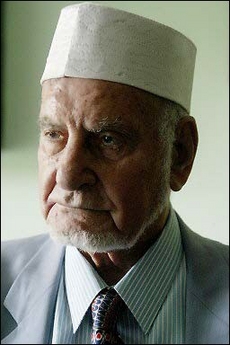
One of the many political absurdities left behind by Mr Anwar Sadat is something called “The Political Party Affairs Committee.” This thing, composed exclusively of NDP members, gets to cherry pick the regime’s opposition (see Law 40/1977). This means that we have opposition parties headed by the likes of Shaykh Ahmad al-Sabahy, president of al-Umma Party (right). Shaykh al-Sabahy includes among his many preoccupations the mandatory return of the fez, the intricacies of dream interpretation, and the mysteries of astrology, all veritable burning issues in Egyptian politics. During the presidential elections campaign of 2005 in which he served as one of the principal contestants, al-Sabahy simply could not contain his admiration and support for President Mubarak, and vowed to vote for him on election day. Yes. Shaykh Ahmad al-Sabahy presides over a legal opposition party in Egypt, but Islamist Abul Ela Mady and Nasserist Hamdeen Sabahy (no relation to Shaykh Ahmad) are repeatedly and unequivocally turned down when they avail themselves of established channels for forming legal opposition parties. What’s wrong with this picture?

On Saturday, when Sabahy and Mady were turned down by the Political Parties Court for the second and third times, respectively, they greeted the news with a nonchalance that verged on the triumphal. Mady and members of his Wasat party unfurled pre-made banners that condemned the verdict; they had arrived hoping for the best but expecting the worst. Wasat member Essam Sultan (top) made biting remarks to the media: “This verdict today means that all young people in this country are barred from entering politics to make room for one person only and his name is Gamal Hosni Mubarak.” Al-Karama party’s Hamdeen Sabahy was similarly blunt: “This is a clear message from the regime to all Egyptians: forget about forming real political parties.”
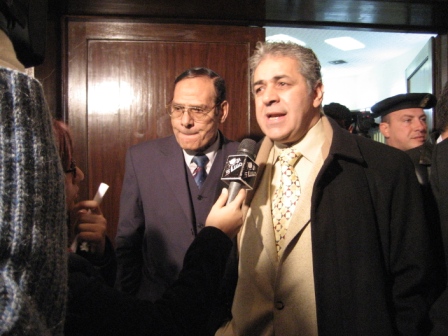
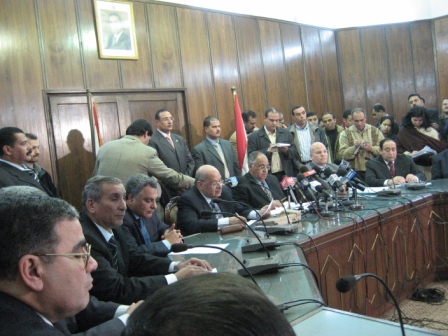
Indeed, it is no small irony that the verdict came days after Hosni Mubarak’s proposed constitutional amendments. Mubarak’s rationale for re-amending Article 76 is to “activate our political life and bolster pluralism and political party activities, leading to strong political parties capable of enriching the democratic experiment.” Apparently, the Wasat and Karama would-be parties are not deemed the right kind of parties to “enrich the democratic experiment." Just like Ayman Nour’s Ghad party, after an initial green light in October 2004, was also deemed unfit to enrich.

It’s fair to wonder why real politicians with real constituencies such as Sabahy and Mady appeal to the farcical Political Parties Committee in the first place. Why go to the government and ask: can I please oppose you?! Who in their right mind would go to the likes of Safwat al-Sherif, Kamal al-Shazli, Habib al-Adli, and other Committee members and ask them to pretty please allow some opposition?! And who in their right mind could take seriously a process that ends with Committee members handing down a report inevitably rejecting new political party applications as not “distinct” enough from existing parties?!

Would-be party leaders offer several good reasons why they engage in this bizarre charade. For a long time, the Political Parties Court proved more independent and serious than the Committee, overturning the latter’s decisions and allowing several parties to see the light of day. Thus it made sense to bank on the Court, even though it is an irregular body composed of senior administrative court judges but also “public figures” (a trusty tool to pack the court with regime loyalists and assorted nobodies). Saturday’s verdict, however, put an end to any lingering hopes that the Parties Court can carve out some autonomy and efficacy separate from the Parties Committee.

Another reason offered is that playing by the regime’s absurd rules exposes the fraudulence of its democratic claims. Following all instructions, filling out all application papers, and meeting all deadlines but still getting turned down enables opposition party leaders to call the regime’s bluff, demonstrating to domestic public opinion and influential foreign parties that the regime has made zero progress on political reform. A third reason is that going through the cumbersome legal process allows opposition parties to carve out a margin of manoeuvrability; they can profitably use the “under construction” label to begin work as a de facto political party, recruiting members, contesting elections, and developing internal party organs.

The most interesting aspect of Saturday’s verdict is not the Court’s complete rejection of 13 party projects, but what the leaders of Karama, Wasat, and other real would-be parties will do next. The rationales they have been working with so far are no longer compelling. The Political Parties Court has for some years now lost what sliver of autonomy and credibility it had accrued. Exposing the regime’s repression and political manipulation no longer carries the same rhetorical and material force that it did when Mubarak’s reform pledges were still credible. And seizing the political opportunities offered by the “under construction” status are no longer as attractive given Kifaya’s example of working openly without any government sanction.

A festive air hung over everyone arrayed on the court steps on Saturday after the court verdict. Heartfelt greetings, jokes, and congratulations were exchanged. Curious passers-by and motorists slowed down to gaze at the puzzling spectacle, only to be firmly rushed along by police and State Security officers. Courthouse secretaries giggled as they navigated around the assembled men to descend the steps and move on to more pressing domestic matters.
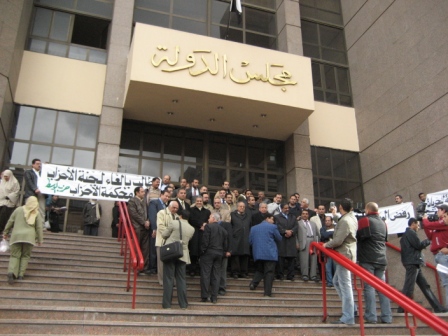
The coming months will demonstrate whether these creative, committed political activists will leave the court steps and join the public on the streets to form real, representative political parties. Perhaps like students, engineers, and workers, they will resist government repression by establishing alternative organisations legitimised by the general will of their electors. Only then will we see real opposition parties emergent from the ground up, without the Mubarak regime’s blessings, without the patronage of the Americans and Europeans, and without the geriatric leadership throttling existing opposition parties.
Tuesday, December 19, 2006

Three Elections, One Principle

I’ve been watching with intense interest and much fascination three elections that have once again pitted members of the Muslim Brothers against members of the ruling regime. These are the internal elections for parliamentary speaker and deputy speakers, the trade union elections, and the student union elections. The press and assorted commentators have rightly noted similarities with the parliamentary polls, especially widespread thuggery and intimidation of opposition forces, broad administrative interference to block opposition gains, and the utter disregard for court rulings suspending faulty elections. But the common tendency to reduce these elections to the age-old contest between Ikhwan and regime captures only half the story, and the less intriguing half at that.
(Photo courtesy of Alltalaba.com).

The other half is the struggle for undistorted, unabridged representation. The MPs who made a symbolic bid to unseat chronic parliamentary speaker Fathi Sorour, the resourceful workers who energetically exposed their institutions’ unfree elections, the brave students who organised parallel elections—all were activating the fundamental democratic principle of representation. I don’t mean some rarefied concept in political theory, but the demand to be consulted on decisions and practices that affect one’s life. I mean a mechanism to organise binding consultation, a procedure for the management of conflicting interests, and a process that holds the potential to modify existing interests. Barring direct democracy, the principle of democratic representation is the only legitimate bottom-up selection mechanism to manage the affairs of complex collectivities. It would thus be a grave misreading to reduce recent sub-national elections to nothing more than a contest between the Ikhwan and the regime. If we get past such sensationalism and unthinking parroting of the obvious, it is clear to me that the elections revolve around the struggle for adequate representation, a battle that is at the core of the drama of democracy.

Fiercely contested sub-national elections have been a consistent and lively feature of the post-1952 Egyptian political landscape. Internal elections to every sports club, faculty club, chamber of commerce, professional association, student union, actors’ union, and some public sector boards are heated affairs, much more ‘real’ than parliamentary elections and therefore of paramount importance to the regime. Far from being staged rituals orchestrated by the ruling regime as a serviceable safety valve, sub-national elections are real contests involving real issues that all Egyptian regimes have tried to control and obstruct. Recall the phalanxes of riot police and security forces during the Alexandria Chambers of Commerce elections this past May. And remember the security forces’ blockage of all Alexandria University campus entrances in April to prevent the faculty club from convening its long-suspended internal elections. Undeterred, 800 professors convened their general assembly in the open air on the corniche sidewalk and freely elected a governing board. Now this is what democracy looks like.


The Persistence of Sub-National Democracy


Egypt's contentious lawyers assemble on the High Court steps to demand new elections, January 1989.
For more perspective on the significance of the recent elections, let’s reach back even further than last spring and recall some salient facts. Nasser manipulated the internal by-laws of professional associations to pack their voter rolls with his supporters, and went further by not-so-subtly endorsing handpicked candidates. When judges defied his regime and issued their March 1968 statement, Nasser gave the green light to mobilise massive regime resources to interfere in the Club’s March 1969 elections and oust the reformists, installing a much more government-friendly board. Sadat did the same: when social protest at his domestic and foreign policies peaked, he dissolved the board of the ever-contentious bar association and handed down a draconian new law that decapitated the national student union movement, the notorious ’79 charter.

Mubarak is no different and has gone even further: he rammed through parliament an entirely new law crippling robust internal elections in the professional associations (Law 100/1993) and placing them under government receivership. A year later, he issued a law that replaced decades of bottom-up faculty election of university deans with top-down appointment by university presidents, all of whom of course are appointed by him (another law replaced election of village ‘umdas with appointment). After a protracted legal battle ably steered by the proud attorney Fatma Rabie’, lawyers successfully threw off the yoke of government receivership and resumed their suspended elections in 2001. Engineers and doctors are still battling to do the same. For those professional associations that escaped receivership (the Judges’ Club and the Press Syndicate), Mubarak was keen to see government-friendly incumbents hog all leadership positions. That old order was spectacularly overthrown when the general will of fed-up electorates ousted the rotten incumbents and voted in independent reformists in May 2002 and December 2005 (judges) and July 2003 and October 2005 (journalists).

Let’s remember that Nasser and Sadat were not battling Islamists in these institutions, but an assortment of leftists, liberals, nationalists, Islamists, and independents. That today the Islamists are at the forefront of the battle for associational autonomy should not obscure the fact that what is at stake is institutional autonomy and undistorted representation. If today the Ikhwan were replaced by leftists as the major electoral and political force, would the regime back off and let them carry on? Absolutely not. Just look at the regime’s multi-tiered involvement in the journalists’ and judges’ associations, two institutions where the Ikhwan historically have had and continue to wield very little clout. So while it’s comforting to dismiss the recent elections as yet more staging grounds for Ikhwan-regime competition, it would be entirely missing the point.

For the regime, elections in any sub-national institution pose an acute quandary. One the one hand, elections can perform useful functions. They can incubate tractable new elites, quash useless old ones, and provide a robust barometer of the moods of critical publics such as middle-class professionals, workers, and students. On the other, elections are extremely destabilising. They can incubate intransigent new elites, quash trusted old hands, and infect broader swathes of the population with dangerous new moods and demands. Above all, any elections are bound to activate demands for adequate, bottom-up representation. Whether it’s the determined voters of Damanhour and Doqqi, the enthusiastic electors in the professional unions, workers in the trade unions and businessmen in the cambers of commerce, the desire to elect representatives responsive to constituents is unwavering and arguably intensifying.

This is precisely why the ruling party dares not hold internal elections, and also why we see fierce NDP intraparty competition during the opportunity window opened up by parliamentary elections. If there were real elections within the NDP, would Gamal Mubarak and his cronies be where they are? Perhaps, perhaps not. And there’s the rub. The regime fears two things: the sheer uncertainty of the free play of interests, even if its own interests are triumphant. And the constant threat that its interests will be thwarted or challenged by rivals. Both fears fuel a multi-pronged strategy of engineering, manipulating, obstructing, rigging, and suspending sub-national elections. Such fears are also behind the decision to postpone municipal elections until 2008. More than simply fear of the Ikhwan, it’s these elections’ enormous uncertainties and real opportunities for popular mobilisation that drove the Mubarak regime’s deferral decision.


What’s New?


So if real democratic enclaves have always existed in this undemocratic regime, what’s new about the recent elections? Let’s review in ascending order of magnitude. The Ikhwan and independent parliamentarians’ symbolic bid to challenge Fathi Sorour’s endless tenure as parliamentary speaker was new, since everyone knows that all parliamentary leadership positions are jealously hogged by the very National, oh-so-Democratic Party. The attempt to reinvigorate the principle of internal parliamentary representation is significant; the closest that non-NDP MPs had come to such a manoeuvre was Ayman Nour’s running for deputy speaker after the 2000 vote (he received a surprising 169 votes). To be sure, no one expected the sticky Dr. Sorour to be dislodged from his favourite perch, and even if by some miracle he had been ejected, no one expected parliament to turn into a real creature forthwith. The democratisation of parliament and the parliamentarisation of Egyptian politics is a very long way off. But the Ikhwan’s move betokens renewed resolve to activate the principle of representation. Who’s to say that five or ten years down the line, we won’t see real, unpredictable elections for the post of parliamentary speaker? When it happens, we’ll likely look back at the maiden attempt in 2006 and ponder its long-term consequences.

Next, the trade union elections. I can’t remember the last time that these elections offered anything meaningful to write about, so why is this year different? Again, most accounts point to the Ikhwan’s new participation in what for the group so far has been mostly terra incognita. But there’s much more to it than that. Demands for real representation have long been brewing on Egyptian shop floors, fuelled by rapidly deteriorating work conditions and the dangerous erosion of the state-sponsored social safety net of yore. Over the past 15 years, the industrial labour force has been squeezed by soaring costs of living and unfair work conditions without a corresponding increase in official tolerance for worker collective action (much less collective bargaining). The rotten labour aristocracy that is the Egyptian Trade Union Federation (ETUF) has given up all pretence of worker representation and has instead embraced its role as first and foremost a state adjunct that polices workers and quashes any bottom-up attempts at independent representation.
A wave of labour protests all over the country in 2006 against declining or stagnant wages, forced early retirement packages, and other pauperisation policies set the stage for last month’s elections. Workers began mobilising to push for real representation to protect their increasingly threatened interests. Sensing this, the government took pre-emptive measures starting back in August, administratively disqualifying independent candidates and establishing a tight-knit infrastructure of procedural obstacles. Workers immediately appealed to the administrative courts and secured countless rulings verifying myriad election violations, but the regime of course ignored the rulings and elections went ahead anyway. Many pro-regime labour aristocrats were thus ‘elected’ or retained their posts uncontested. Credible, independent worker rights groups such as the Helwan-based Centre for Trade Union and Workers’ Services (CTUWS) have copiously documented election irregularities and violations.

Up to this point, the story would be a sad but familiar echo of nearly every election in Egypt. But events then took a dramatic and highly unexpected turn. Early this month, 20,000 Mahalla textile workers staged a sustained and massive work stoppage against management’s decision to renege on election-related promises to pay two months’ worth of bonuses. Workers went head to head not just with management but with Ministry of Manpower Aisha Abdel Hadi and high-ranking State Security officers. They adamantly refused several compromises brokered by Abdel Hadi and resisted State Security’s transparent divide-and-rule strategies. Above all, Mahalla’s workers (including 7,000 women) managed to valiantly weather credible threats of violence and reprisal, arming themselves with tree branches and sleeping in shifts to be able to respond to any sudden crackdown. Consciously and deliberately, Mahalla’s workers jettisoned the
politics of remonstrance and demanded full and unabridged citizenship rights. Remarkably, they won. The regime relented and management agreed to pay the full bonuses. Significantly, the strike ended with a worker petition drive that has so far collected 20,000 signatures for a vote of no-confidence in the recently “elected” company union. The struggle for real representation continues.


Egyptian Student Power, Redux


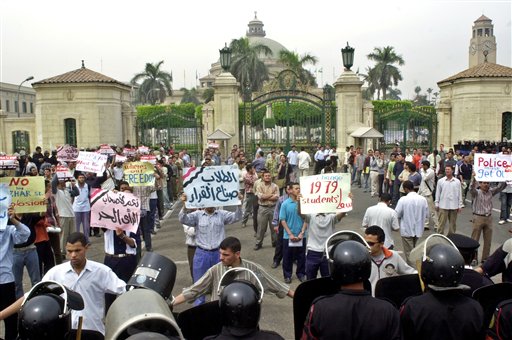
Cairo University students protest the 1979 Charter and State Security interference, April 2005 (AP Photo)
Amr Hamed is an articulate, serious, doe-eyed student in his penultimate year of medical school at Cairo University. On a blindingly sunny day, he sits on a low campus wall shaded by outstretched, leafy tree branches, fighting off an annoying cold while being greeted by friends and well-wishers. Unlike other students buried in reading for their exams, medical school students have some leeway before their brutal examinations start in the spring. So the Qasr al-Aini campus is abuzz with voluble conversation and warm sociability; students munch on biscuits and sip soda pop, chatting for hours. Medical residents walk in twos and threes in their pristine white coats and stethoscopes; haggard nurses gossip about pesky patients; professors park their spiffy cars and disappear into the Dean’s building. And Amr Hamed ponders the recent turn of events that crowned him secretary-general of Egypt’s first nationwide student federation since 1979.

The story has a long history; let’s start in the heyday of student power after the protest wave of 1968-1972. Students were arguably one of the most i
nfluential societal sectors in the mid-1970s. In February 1976, at a national student union conference in Shibin al-Kom, students demanded a new charter and gave the president a one-month ultimatum until March 22, after which they vowed to stage a nationwide general strike. On March 21, as Sadat was travelling abroad, his vice-president Mubarak signed into law a charter that contained very robust measures of financial and decisional autonomy for student unions. Cairo University students’ weekly magazine al-Tullab became a key opposition outlet, well before the ‘platforms’ and then opposition parties issued their own newspapers. But after skyrocketing domestic opposition to Sadat’s foreign and domestic policies, Sadat revoked the ’76 charter and issued a new one in 1979, which decapitated the student movement by abolishing the national student union federation. Student unions were now confined to their individual campuses, with no nationwide coordinating structure. The '79 Charter also reinstated the requirement of a faculty guardian who supervised each union and had the power to veto its decisions and withhold its funding.

Mubarak’s control of Egyptian campuses reached deeper. Not content with sundering the links between campuses, for the past ten years security forces have routinely intervened in individual campus elections. They exclude all independent, leftist, and Islamist candidates to clear the way for the pathetic candidates of the pro-regime campus union, “Horus” (even their name smacks of illegitimacy). This is in addition to the various other indignities suffered by college students, from inadequate course materials to abysmal dormitory conditions to a general and rapid decline in the quality of all campus services. This long train of abuses finally led Egyptian students to organise parallel elections in November 2005, when 15 universities held elections for a Free Student Union (FSU).

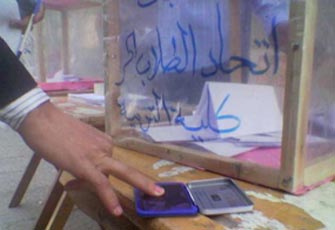
The initiative was repeated this year. Students organised a completely independent, parallel process from A to Z. They stipulated a four-day candidacy registration process, a three-day campaigning period, and a full day of balloting. They put together homemade transparent ballot boxes from plastic wrap and masking tape (I love it). They invited faculty members and human rights groups as poll watchers and ballot counters. And they invited uninterested, apolitical students to join in the ballot count.

In response, State Security hired thugs to intimidate students and faculty who participated in the FSU elections in Ain Shams, and the administration of al-Azhar University suspended students who ran and won in the FSU elections and referred them to disciplinary tribunals. Undeterred, students took matters a notch higher with the organisation of the first elections for a nationwide student union federation since 1976. Students from 12 universities participated (two elected student union leaders from each university for a total of 24 electors). The Muslim Brothers at the bar association hosted the election after the administration of Cairo University naturally refused. The Brothers of course have a vested interest since their fellow members are the overwhelming majority of elected student representatives on each campus, but as both Brothers and others emphasise, the FSU is a collective effort that includes Coptic, liberal, leftist, and Nasserist students, and several students with no set ideological commitments.

Amr Hamed from Cairo University’s faculty of medicine was elected as national secretary-general while Amr Abdel Bari from Mansoura University’s faculty of pharmacology was elected as assistant secretary-general. Asked why he thinks he got elected, Hamed is disarmingly modest, explaining that the symbolism of his university and the historic weight of his faculty within the university determined his fortunes. But watching him interact with his peers on campus tells a different story. Amr Hamed is first among equals. He does not carry himself with the arrogance of a leader or the strutting of a big man. He blends in with his constituents. He’s soft-spoken and focused, warm and congenial, and very very busy, gracefully fielding endless calls, discussions, and queries. The noon call to prayer sounds and his peers come to collect him to pray. I watch them walking off briskly and think, this is what democracy looks like. “The principle of appointment rules all across the country now,” he says, “that’s why this is significant.”


The Spectre of Democratisation


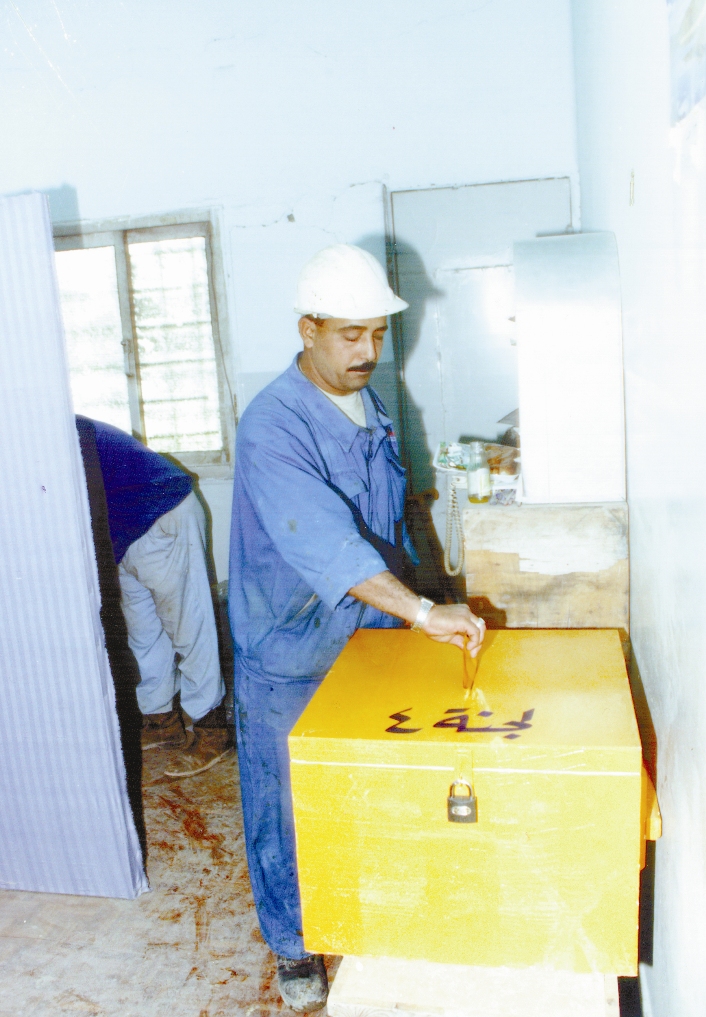
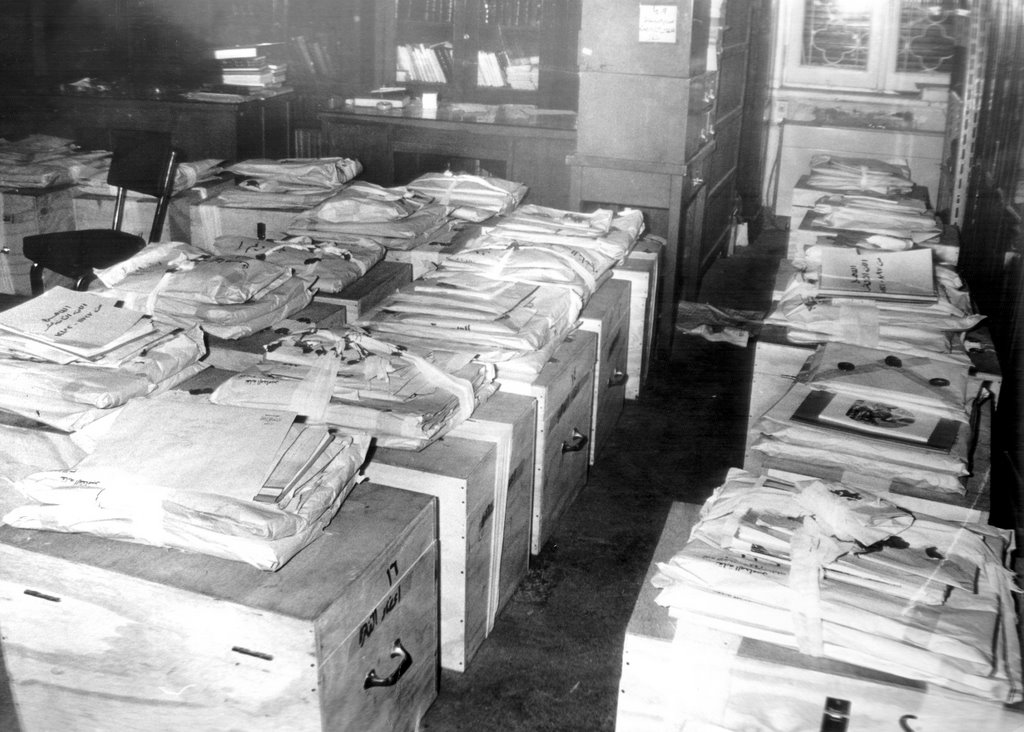
Ballot boxes in the Egyptian bar association, July 1989.

A spectre is haunting Egypt, the spectre of real representation. From 2000 to the present, parallel to the return of routinised street protest, there have been significant stirrings for genuine representation among the country’s vital sectors. Lawyers took back the bar in 2001 and 2005, judges elected a bold new leadership team in 2002 and 2005, journalists did the same in 2003 and 2005, Kifaya did serious representation work in 2004 and 2005, actors elected a more representative chairman and board in late 2005, industrial workers defied repressive rules and increasingly resorted to strikes, and university professors formed the March 9 movement for university autonomy. Egyptian physicians and
engineers are mired in a dogged struggle for the right to elect their representatives, as are independent and opposition parliamentarians. As is their wont, Egypt’s ever-resourceful students took it all a step further, not simply activating moribund institutions but setting up free, functioning, parallel institutions, and bringing back the nationwide student union federation for the first time since 1979. That’s amazing, mish keda?!

There remains the thorny question of how all this sub-national democracy interacts with the national autocracy. Seems to me that the relationship is symbiotic. The mobilisation accompanying national elections can filter down to energise sub-national polls by emboldening competing forces and raising the stakes of previously marginal contests. The outcomes of sub-national elections can percolate up to the national level by providing trained cadres and spreading a zeitgeist of participation among voters. It’s also possible though not likely that there is no diffusion either up or down, and it’s probable that autocratic practices at the national level do filter down to sub-national institutions; no clearer example of this can be found than in the Mubarak regime’s placement of professional associations under government receivership to punish their electorates for their democratic choice.

Egyptian political history contains ample evidence of cross-pollination between national and sub-national elections. There are also many many examples of cross-fertilisation between sub-national elections: journalists watch carefully how judges vote, engineers watch closely how lawyers vote, everyone watches how students vote, and the regime monitors everyone and works overtime to control the representation fever gripping the population. As elections gain currency and pull in more contestants, observers, and voters, we can expect to see more struggles for associational autonomy, more hard-fought battles for associational diversity (especially among workers), more bottom-up initiatives of genuine interest representation, and in the very very long term, the democratisation of the Egyptian polity.