Sultan al-Munshidin, Shaykh Ahmad al-Tuni
 Abida Parveen
 Yasin al-Tuhami
 Shahen-Shah-e-Qawwali, Nusrat Fateh Ali Khan (1948-1997)
 Sultan al-Munshidin, Shaykh Ahmad al-Tuni Abida Parveen
Yasin al-Tuhami
Shahen-Shah-e-Qawwali, Nusrat Fateh Ali Khan (1948-1997)

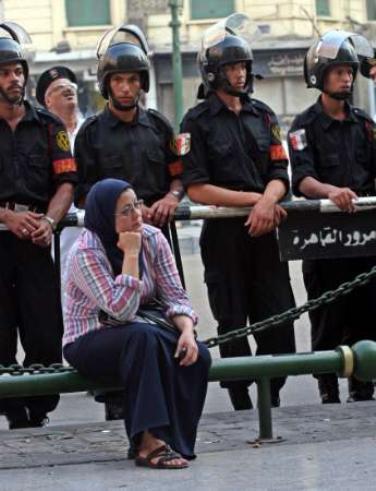
 We, the mothers, wives, and children of detainees in all of Egypt’s prisons, have the pleasure of inviting you to a group iftar on Tuesday, 22 Ramadan, 25 October 2005, in front of the Egyptian Interior Ministry. We invite you to join us in preparing for the iftar by starting our protest march at noon on that day.
 Ramadan means dusting off my antique tin fanous with the tiny candle inside and burning my fingers while lighting it. Ramadan means the return of my beloved seasonal ritual of listening to Shaykh She'esha's sublime rendering of Surat Yusuf. Ramadan means abandoning all sense of conventional time, greeting the chirping birds at daybreak and sunset and withdrawing from the world at midday. Ramadan is Shari' Gala' miraculously deserted at sunset. Watching kunafa being made in Harat al-Megharbeleen at midnight, transfixed like a child. Hearing Shaykh Yaseen fil Husayn.
 “In the name of nine million unemployed, your rule Mubarak is void!” With this and other biting slogans, the pro-democracy, anti-Mubarak movements greeted the freshly sworn-in president on September 27. Amazing how far we’ve come from just six years ago, when Mubarak’s regime was more coherent, more secure, more confident. Today, crises are a piaster a dozen, Mubarak’s regime is in the throes of a botched facelift, the economy is precarious at best, and Egypt no longer commands the regional heft its rulers have long parlayed into considerable influence. A decrepit regime faces off with a society in movement. Egyptian society is debating, organising, learning, mobilising, demanding, manoeuvring, grumbling, watching, transforming, and of course, sulking. The creativity of newly politicised young people is astonishing, like this brilliant Mostafa Hussein creation that takes a leaf from old Egyptian film posters.
 Egyptian popular forces have always been gifted at theatre. Deft symbolism, nimble humour, and an excellent sense of timing have always been their metier. All the more so when they’re contending with a regime quite unparalleled in its abominable image-making skills. On September 27, up in parliament, Mubarak’s handlers apparently thought fit to invite a fellow president-for-life to witness Mubarak’s “swearing in.” As Libya’s fantastic Mu’ammar al-Qaddhafi looked on and Suzanne gazed down lovingly from the gallery, Mr. Hosni Mubarak uttered the presidential oath to “sincerely protect the republic, respect the constitution and law, fully care for the people’s interests, and guard the homeland’s independence.” Down on the street a little later, flanked by Kamal Khalil, the outrage of ordinary Egyptians, and the literal drumbeats of protest, Kamal Abu Eita led a counter-oath, vowing to “continue the struggle for freedom and bread.”
"We Want all of Egypt to Know the Facts"

 The work of Youth for Change in particular deserves special mention, for its stunning admixture of political insight and artistic creativity. I’m completely in awe of the bravery and commitment of these young people, working on even less than a shoestring budget. Take the short film “Mubarak New Look 2,” where two young men take turns methodically puncturing prevailing political myths and Mubarak’s campaign promises. One young man is animated and impassioned, the other precise and professorial. Both are beyond eloquent, expressing in mellifluous ordinary language the duty, as they see it, of expressing reasoned opposition to the Mubarak regime.
There’s more here than mere hortatory speech. In the middle of the 28-minute film, we’re transported to a nameless “informal area,” which is in fact Kilometre 4 ½ on the Cairo-Suez highway. With the mournful tunes of a ney in the background, one resident after another recounts his/her horror stories with obtaining potable water. After 25 years of living there, residents still have no running water, and must pay £E1 per jerry can of water if they can find it. A 60 year old widow who lives alone paid £E300 for water to be delivered to her by someone who turned out to be a scam artist. She now depends on the kindness of neighbours for her drinking water.
A poor woman says, “I want to able to educate my kids like the president educates his kids.”
At the end of the film, one of the two young men says, “I won’t ask you to go to a demonstration or shout slogans. All I ask is that within your family, among your friends, say: I am opposed to this, the country has to be cleaned up. And when you take a stand, the person next to you will also take a stand, and so will your neighbour, and so will the guy sitting downstairs at the ahwa, and so will the man who lives down the street. The bounty of Egypt is for Egyptians, the bounty of Egypt is for Egyptians, not for its rulers, not for its masters, the bounty of Egypt is for Egyptians.”
As Ali al-Haggar’s soulful voice soars in the background, the other young man sagaciously points out, “We deserve better than our current condition. Regardless of who rules the country, the question is how he will rule.”
"Every Slap on Our Face Makes Us Stronger"
Other productions share the spirit of “Mubarak New Look 2” but add humour and satire. Blackk Maskk’s “Gamal, Baba, and the 40 Thieves” is a short, entertaining send-up of the Mubaraks’ posse-state, to the tunes of Dalida’s lovely “Salma ya Salama.”
Mahmoud Tawfiq’s audio collage “Batel w’Noss!” has an oddly powerful effect. A mélange of voices from street demonstrations, cabaret belly-dancing music reminiscent of 1970s B-films, and Tawfiq’s own wry commentary, the audio medium conveys the intensity of people’s convictions. Tawfiq understandably can’t resist digitally altering the voice of PEC Chairman Mamdouh Mare’i as he announces the results of the September 7 elections. My favourite is his parting salute, “Thank you to those who decided not to give up their rights.” As a demonstrator tells him, “This is a weak regime, every slap on our face makes us stronger.” For a long time now, the Internet has offered a forum for all manner of anti-Mubarak insignia, of varying levels of quality and cleverness. The Socialist Studies Centre’s publications have always been among the most daring. The American-based Egyptians without Borders maintain a collection of rather predictable emblems and photos. Prolific cartoonist Tantawy often has his moments; this spoof (right) on the wildly popular film of a few years ago Mafia makes me giggle every time I see it. Posse-state, indeed.
The Politics of Linkage
The above is only a sampling of the creative energies of Egyptians, overflowing after years of pent-up demands and execrable claims about their supposed “apathy” blah blah blah. Instead, before our very eyes, old actors are reinvented and new ones christened, old modalities are refurbished and new ones innovated. Seasoned dissidents stand shoulder to shoulder and argue with newly inducted political activists. The spirit of the 1970s is resurrected. Ahmad Fu’ad Nigm is everywhere. The palimpsest has a new layer. In my opinion, the most remarkable process in all this is the blurring of the lines between supposedly “elite” issues such as trimming presidential prerogatives and “popular” concerns about bread, prices, education, health, etcetera. Whether in protest slogans or street theatre or the proliferating samizdat, weighty political issues are twined with everyday concerns. Presidential powers are a street-level issue. Bread and freedom. Politics is life, life is politics. Don’t take it from me. Go watch “Mubarak New Look 2” and listen to these courageous, clear-thinking young people who’ve turned political profundities into the stuff of everyday life.
And happy birthday, Kifaya. ‘Uqbal meet sana.
 “Sleeplessness for me is a cherished state to be desired at almost any cost; there is nothing for me as invigorating as immediately shedding the shadowy half-consciousness of a night’s loss, than the early morning, reacquainting myself with or resuming what I might have lost completely a few hours earlier. I occasionally experience myself as a cluster of flowing currents. I prefer this to the idea of a solid self, the identity to which so many attach so much significance. These currents, like the themes of one’s life, flow along during the waking hours, and at their best, they require no reconciling, no harmonizing. They are “off” and may be out of place, but at least they are always in motion, in time, in place, in the form of all kinds of strange combinations moving about, not necessarily forward, sometimes against each other, contrapuntally yet without one central theme.”
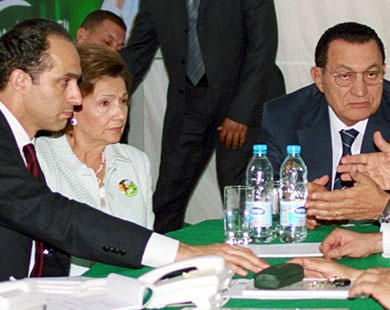 Now that Hosni Mubarak is safely installed as “the first elected president of Egypt,” we all have a right to wonder about the next steps. It’s no secret the man is ailing, weak, and no longer fully in control. And it’s old news that his son Gamal is a major powerbroker and may even be the de facto president, if word on the street and in political salons alike is to be believed. The Gamal Mubarak Project will surely rage on, perhaps with even more fervour in the coming months. But just as surely, it will continue to spawn ever bolder and more intrepid societal resistance. So it’s a wonder to me how the ruling family continues to blithely pursue this most execrable of ideas. Are they so cloistered from reality, so astonishingly oblivious? Or are they so intoxicated by their illegitimate power that anything seems possible? Perhaps, true to form, they’re just exceptionally brazen.
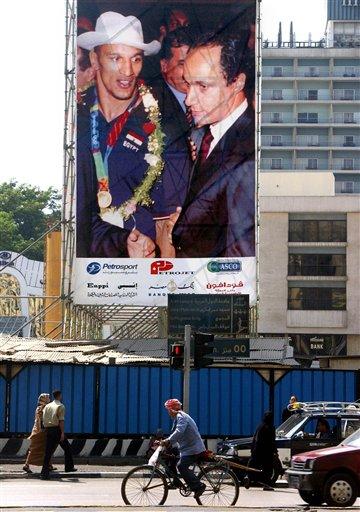 Now that parliamentary elections are upon us again, it’s no surprise that the Gamal Mubarak spectre raises its minatory head, with even more gall. It’s never receded far from view: recall this infamous Tahrir Square billboard (right) back on September 10, 2004, showing Gamal bey with Egypt's Olympic Gold Medal winner in wrestling (the billboard was swiftly taken down right after). But today the regime has to tread extra-carefully, since the make-up of the next parliament is directly entangled with the selection of presidential candidates. As per the amendment of Article 76, any presidential contender from now on will have to come from a legal political party commanding 5% of parliamentary seats. What’s more, the party has to have been in existence for at least five years. Right, currently only the NDP fits the bill, and that is the point. But, if Gamal were to run in say one or two years when his father reaches 80 and becomes completely incapacitated, it would be most propitious if not mandatory to have a few “competitors” from recognised opposition parties to run “against” him and put on a good show.
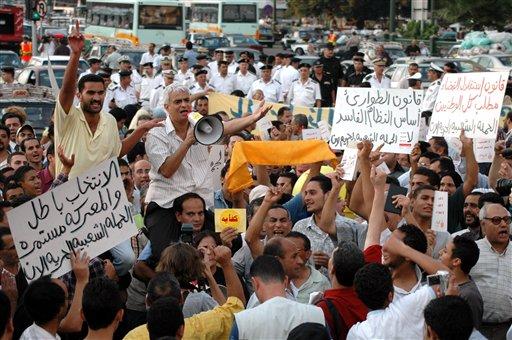 Exactly one year to the day after the above picture was taken, demonstrators took to the streets decrying Hosni Mubarak’s fake democratic legitimacy. On September 10, 2005, a motley crew made up of the Popular Campaign for Change (Freedom Now), Kifaya, Ayman Nour, Saad Eddin Ibrahim, Ahmad Fu’ad Nigm, Muhammad Abdel Quddous, Youth for Change, et al marched in downtown streets railing against the presidential selection show. The ever-noble Kamal Khalil (with megaphone) revved up the crowds, flanked by some wonderful Hamla signs: “A law for the independence of the judiciary is the demand of all patriots!”, “Emergency law is the foundation of a corrupt regime!” And the extremely pithy, “The election is invalid, and the battle continues.” This is what Gamal Mubarak and his bunch must contend with. What are their responses, I wonder?
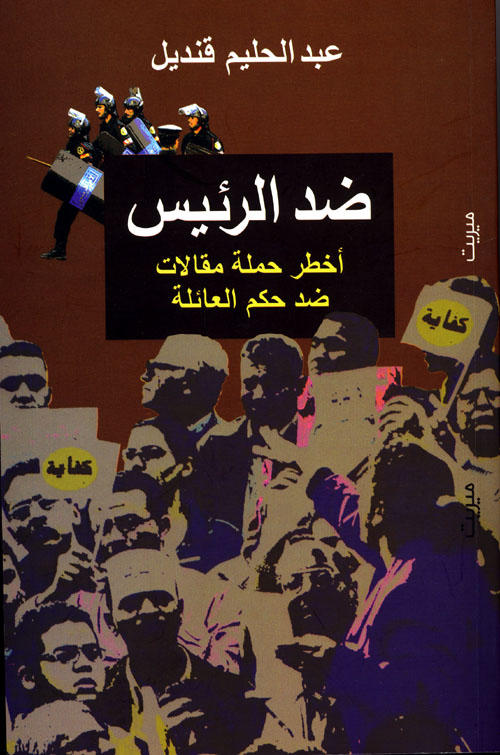 Qandil’s brand-new book Against the President is one of the most important projects taken on by Merit , thanks to the discerning and committed publisher Muhammad Hashim. The book is a no-frills compilation of Qandil’s columns (no Table of Contents, for God’s sake!), from May 2000 to July 2005. He prefaces it with a characteristically concise, uncowed challenge, “This is my crime!” Here he puts to paper what he’d previously circulated only among friends: the constant pressures from regime emissaries on Diaa Eddin Dawoud, Nasserist party head, to tone down the newspaper’s line or have it closed. The sudden cancelling of Qandil’s daily column in the Qatari al-Raya, a perch he’d uneventfully occupied for nine years. Discomfort in high places from a certain appearance by Qandil on al-Jazeera. And the desperate coup de grace: the November 2004 kidnapping of the man by burly, suited thugs who left him naked on a deserted stretch of the Cairo-Suez highway, but not before pummelling and warning him to stop talking about “the big people.” What was that again about Mubarak “allowing” bold criticism in the press??
 So now we know the predictable results: out of 32 million registered voters, a paltry 23% turned out, itself a considerably inflated figure. Hosni Mubarak received 88.571% of the vote, Ayman Nour 7.3%, and No’man Gom’a a pathetic 2.8%. The only surprise is that Nour came in second place with quite a respectable showing.
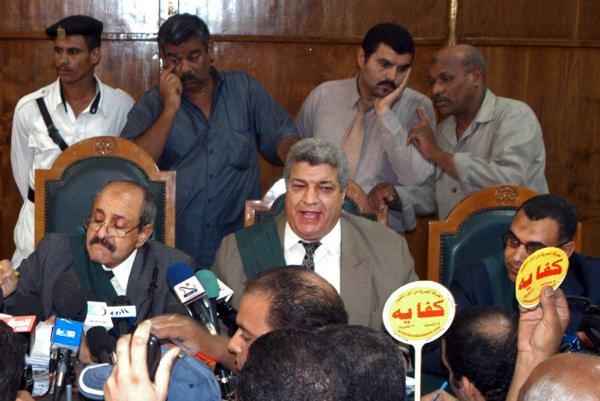 At this juncture, I can’t resist honouring a judge cut from an altogether different cloth. Farouq Ali Abdel Qader is easily the most prominent and well-known judge in Magles al-Dawla today (seated moustachioed judge, above). He handed down the rulings of September 3, followed by another ruling just days later striking down the PEC’s decision to exclude hundreds of judges from supervising elections. Abdel Qader graduated first of his law school class in 1959 and has since crafted an upstanding, illustrious judicial career. Young judges speak of him reverently as “Farouq bey,” compiling and circulating his copious rulings on compact disc to pore over the important legal principles he sets down. You wouldn’t know it from his unassuming and genuinely modest bearing, but Abdel Qader has one of the most truly indispensable and difficult jobs in Egypt today.
 Judges convened their general assembly meeting yesterday, where deliberations lasted for about six hours as demonstrators gathered in solidarity outside the Press Syndicate next door. The majority of judges resolved to monitor the presidential poll next Wednesday, on the following terms: (1) judges will permit members of civil society watchdog groups to enter polling stations and observe the vote, (2) judges will hand over copies of voting figures to candidates’ proxies, and (3) those judges who have been distanced from monitoring by fiat (approximately 1,700) will form their own fact-finding commissions and monitor the vote anyway, roving between polling stations much like the citizen watchdog groups.
 A few days from now on September 2nd, Egyptian judges will convene for another extra-ordinary general assembly in the stately precincts of the Judges Club in downtown Cairo. Kifaya and its cohorts have promised public rallies of support on that day. Egypt’s entire political class, untold numbers of ordinary people, and foreign parties invested in Egyptian affairs will be watching closely. September 2nd of course is the date set by the earlier extraordinary meeting of the judges on May 13th (photo above). On that remarkable day, judges issued a resounding ultimatum to the executive, demanding a revamped judiciary law and full supervision of elections from A-Z in exchange for their full cooperation.
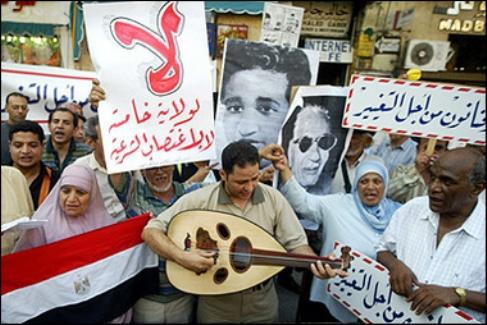 As the presidential selection spectacle rages on, Writers and Artists for Change staged their second protest in the public square yesterday. In Midan Tal’at Harb, the spirit of ’19 returned with the songs and likeness of Sayyed Darwish, looking on with his sad eyes. The sign says: “No to a fifth term, no to wresting legitimacy.” Mubarak’s electoral charade is not winning over these stubborn citizens. Like Sayyed Darwish, they like to speak the truth.
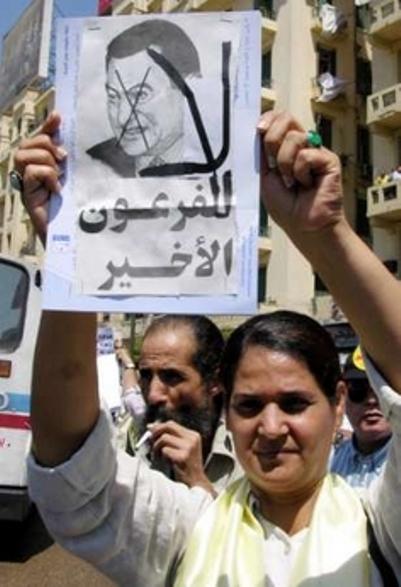
 A protestor holds up a sign that says, “Down with the dictator Mubarak.” Today’s al-Ahram says, “President Hosni Mubarak, National Democratic Party candidate in the presidential elections, delivered an address from the heart to Egypt’s workers in Mahalla al-Kubra, in which he emphasised that £E1 billion will be earmarked to provide for the needs of industry… Mubarak stressed that he will not allow the use of the wide-ranging reforms encompassed by his election program as a backdoor for circumventing the rights of workers or encroaching on their gains.”
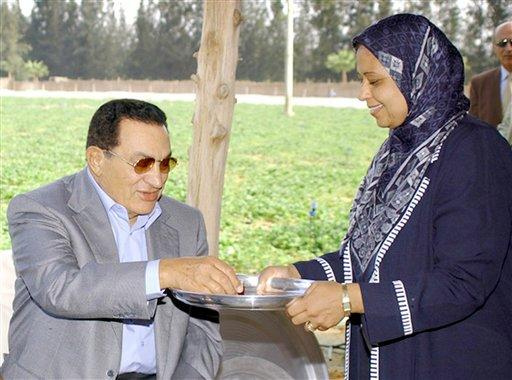 Is it just me, or is there something deeply offensive about this particular frame? I don’t know why, but out of the dozens of contrived and awkward poses released by Mubarak’s campaign, this one stands out for me as particularly galling. For its shameless exploitation of the lovely Egyptian tradition of khamseena tea in afternoon. For the cynical evocation of filial respect. For the unsightly expression on Mubarak’s face. For the ruthless use of this woman’s genuine smile and generous offering as a mere election prop. Mubarak and his handlers’ sordid efforts to negate 24 years of his well-known aloofness and indifference to ordinary Egyptians have surpassed all decency. Kifaya.
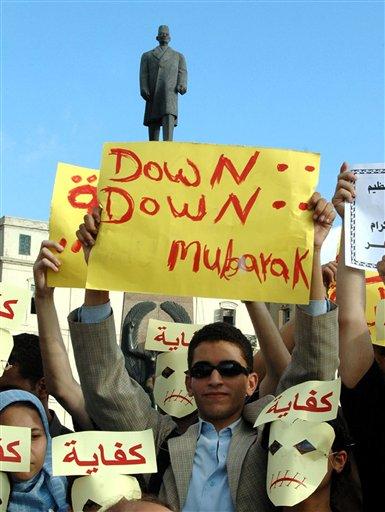 There are a lot of good reasons to be anxious and worried about what’s happening and what might happen in Egypt these days. Fearing change is not in our “national character” (whatever that is), but after 24 years of the same president and pretty much the same political system, it’s natural to cling to the status quo rather than wager on the unknown. “The one you know is better than the one you don’t know,” goes our popular adage, nicely captured by Anthony Shadid in his wonderful article summing up the Egyptian zeitgeist.
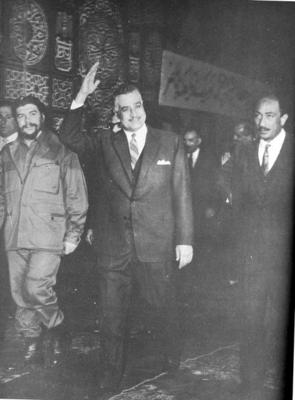 The first-ever Egyptian presidential poll set for September 7 is shaping up to be a curious exercise, a paradox where the outcome is already known but the process is full of uncertainties. In every normal election, people have their eyes trained on the result: who wins, who loses, and how things will change. In this election, however, we all know Hosni Mubarak is going to “win” (barring some miraculous deus ex machina). Yet, the process is still worth watching. Not to see the state-owned media sell the election as a token of Mubarak’s fatherly benevolence. Nor to behold Mubarak junior’s desperate attempts to sell his spent father as a real candidate with a real platform. But to follow the intense public debates on whether or not to boycott. To see the other candidates tread uncharted territory. To watch an intricate network of groups and individuals step up to monitor the poll. And to savour the ever-shifting alliances and eleventh-hour reversals within Egypt’s political class. Fifty some years ago, Gamal Abdel Nasser built the modern Egyptian hyper-presidency, dwarfing everything in sight (including the military). Anwar Sadat re-tooled it, but it took the unexceptional Mubarak to preside over its creeping diminution. Direct presidential elections are not a magnanimous nor “astute” gesture by Mubarak, but a huge, reluctant concession, one whose long-term consequences neither he nor his successors can anticipate or control. Most unwillingly, Mubarak is actually abetting the rapid deterioration of the mystique surrounding the Egyptian president. And that’s a very good thing.