Sunday, February 05, 2006

Ferry Tragedy

It is one of the worst disasters in Egyptian maritime history. At or around midnight on friday, the ferry As-Salam 98, carrying 1,414 passengers from Saudi Arabia to Safaga, sank in the Red Sea after a fire broke out on the car deck. Flooding occurred during the firefighting, causing the vessel to list and then capsize. No distress signals were sent from the ship, and search and rescue operations were launched seven hours after it sank. Reuters and AFP have compiled more details.

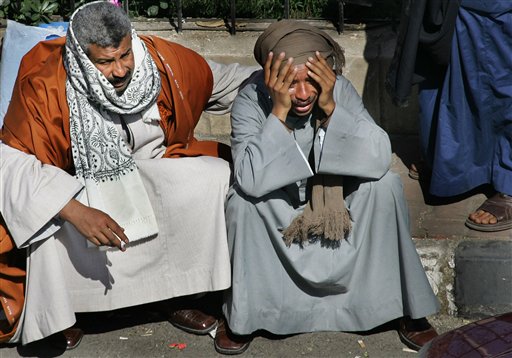
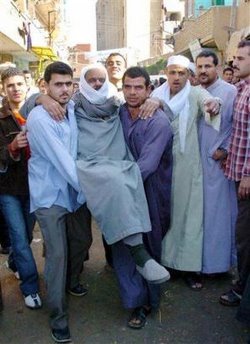
So far, 460 survivors have been brought ashore, after many hours of desperately clinging to life in the frigid waters. Around 190 bodies have been found, and 700 are still missing. The stories of the survivors are chilling. "There was a blaze down below," said survivor Nader Galal Abdel Shafi. "The crew said 'Don't worry, we will put it out.' When things got really bad the crew just went off in the lifeboats and left us on board."

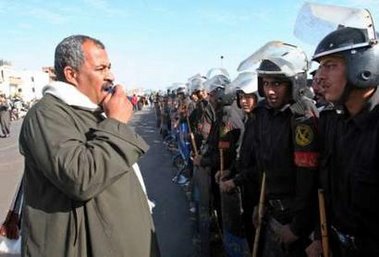
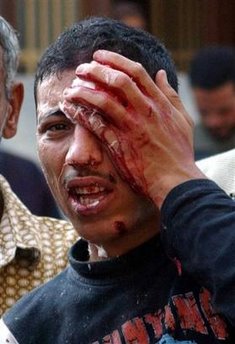
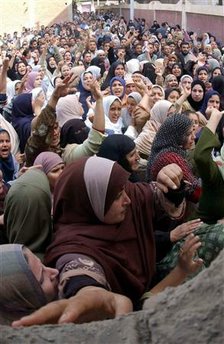
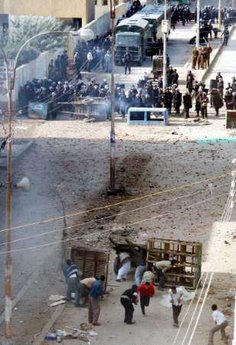
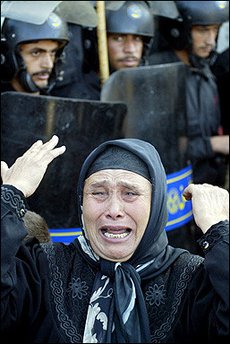
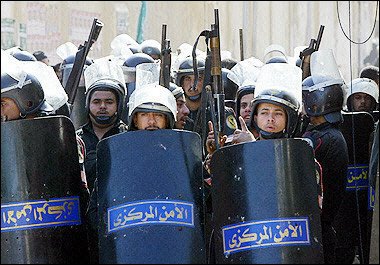
The press and rights groups are raising pertinent questions over authorities' handling of the disaster, including the deployment of Central Security Forces at Safaga. Relatives flocked to the port from all over Egypt seeking news of their loved ones, and some clashed with riot police who barred their way to the port area and hospital. "We are not afraid of the security forces," said Dahi Abdallah Ahmed, who came to Safaga to look for his missing cousin Khaled, who had found a job in Saudi Arabia. "We are a people that is used to not having any leadership in hard times. We solve problems our own way," he said.

Other distraught relatives pointed to chaotic management and lack of adequate or timely information about the rescue effort. Tareq Sharafeddin had no news of his wife and four children. “Are they among those rescued by the Saudis, are they in a hospital in Hurghada, in the morgue or dead in the sea? I don’t know.”


Like the spate of other recent transport-related disasters, almost all of the passengers were working people who made their living in Gulf countries (some were pilgrims returning from Makka). Survivors and relatives said many of them were bringing back sometimes years' worth of savings.

Monday, January 30, 2006

Persons of the Year 2005

I will always remember 2005 for its abundant surprises and endless ferment, with not a single dull moment, not even a lull. It’s a year too eventful for the inevitably boring and perfunctory exercise of the year-in-review, yet too rich to let pass without some sort of stock-taking. A year unthinkingly dismissed as a ‘disappointment’ by contrarians, cynics, and busybodies who prattle too much and think precious little.

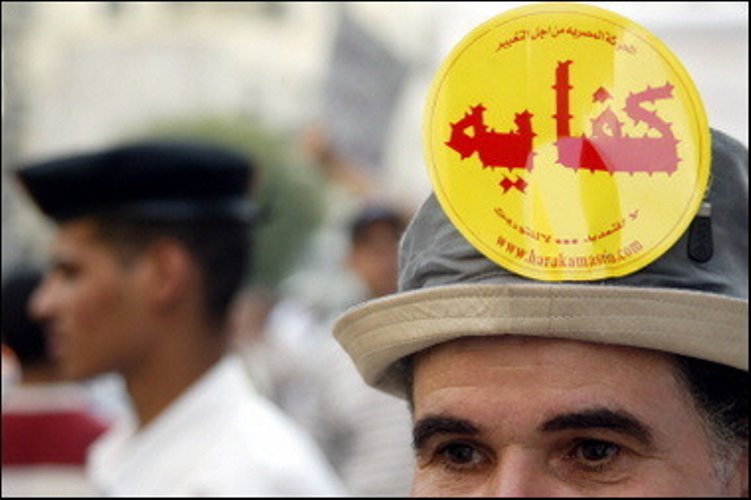
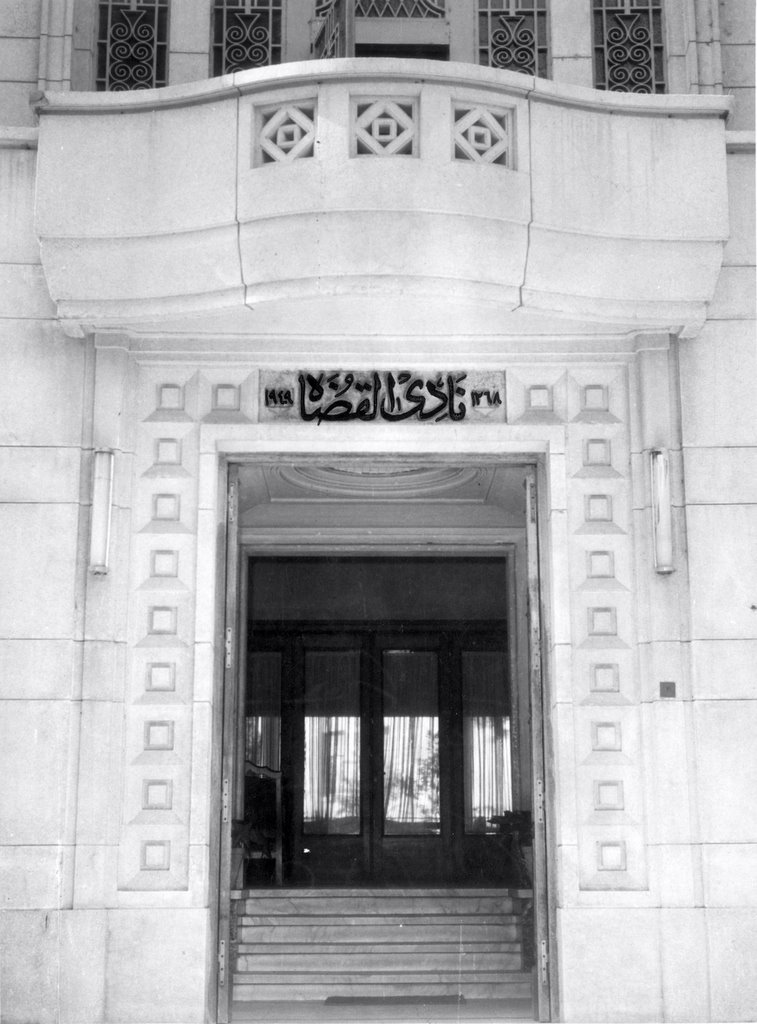
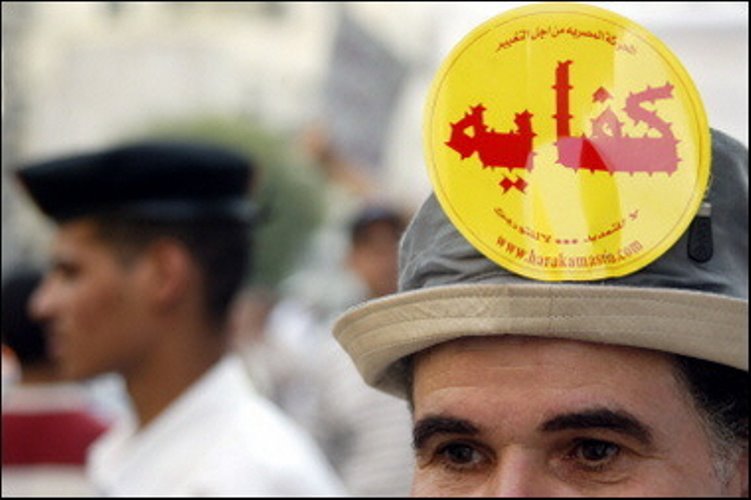
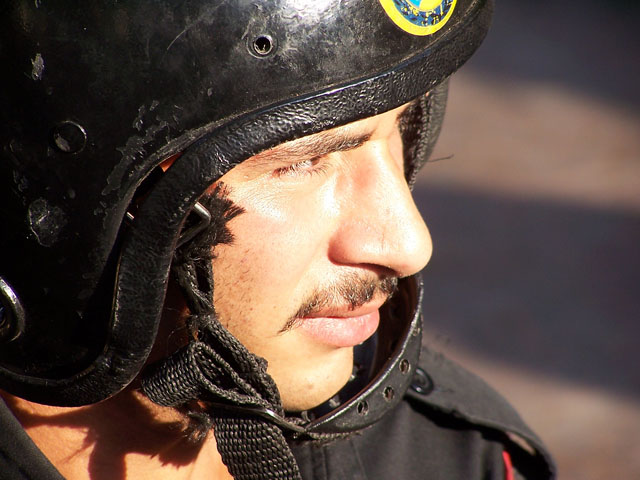
Cataloguing the many events of the year would be tedious and unimaginative, mish keda? I want to instead emphasise three “persons” who made 2005 rather exceptional. First, the Egyptian Judges Club, Nadi Qudat Misr, a wondrously unlikely space of incessant mobilisation. Second, Kifaya, a wondrously unlikely impulse of political innovation. And finally, the recruits of the Central Security Forces, those fearsomely helmeted and armed human beings omnipresent on Egyptian streets, more than ever in 2005. Judges, activists, and gendarmes. Together and separately, they shaped 2005.


1


The Egyptian Judges Club is a remarkable institution. Founded in 1939 as a collective of judges adamant about a new law for the judiciary (eventually promulgated in 1943), it continues to aggregate and organise judicial opinion, and continues to agitate for a new law guaranteeing the true independence and professionalism of the judicial branch. The Club’s pivotal role in 2005 comes as no surprise to the judges themselves, whose robust collective memory is stacked with proud moments of defiance and resolve: 1951, 1963, 1968-69, 1984, 1990-91, 2004, and 2005.

The Club’s general assemblies in 2005 were, without exaggeration, historic events, and I hope their videotaped proceedings are circulated for a much wider and fuller viewing than the snippets aired on al-Jazeera. But what on earth is a general assembly? It’s the supreme deliberative and law-making body of a particular institution, comprising all its members. Historically, the general assemblies of Egyptian professional guilds have been paradigms of direct democracy, featuring real debates, virulent disagreements, hefty doses of humour, utter chaos, ego wars, adamant majority rule, and vocal protests by the minority. Sometimes, general assemblies have seen inspiring displays of oratory and heroism. Sometimes, they were witness to startling instances of shameless quackery. Always, they were an arena for brinkmanship and the clash of competing interests. Direct democracy.

It’s no surprise then that Egypt’s rulers have always sought to control and infiltrate professional unions’ general assemblies, from King Farouq all the way down to the current embattled ruler and his entourage. The control attempts are that much more fascinating when the general assembly in question is composed of state officials, and all the more delectable when those state officials have a tradition of convening contentious general assemblies that threaten the vital interests of the power-hungry executive.

The Judges Club general assemblies in 2005 were a nightmare for Mubarak and his lieutenants. On April 18 in Alexandria and then May 13, September 2, and December 16 in Cairo, judges not only subjected the regime to measured but devastating criticism in full view of local and international media. They also threatened to complicate a very sensitive procedure that Mubarak and Co. were very nervous about: elections. Now there have always been judicial rumblings every time an election rolls around. But in 2005, the judges took everyone by surprise when they turned rumblings into concrete and effective mobilisation. Most surprised were the Mubaraks and their minions in the Supreme Judicial Council and the Ministry of Justice, who still don’t know what to do with the adamant judges.

The 2005 general assemblies were also occasions for a highly significant yet almost imperceptible process. They politicised, inspired, and perhaps even radicalised younger judicial cadres, led by a charismatic and delightfully plain-speaking contingent from Alexandria. These younger judges clinched the victory of Zakariyya Abdel Aziz as chairman on December 16 and re-elected Mahmoud al-Khodeiry to a second term in Alexandria a week later. As their long serving elders gradually retire from the scene, the younger judges will steer the battle in its next phase, armed with less patience, closer ties to the judicial rank and file, newer ideas for redrawing executive-judicial relations, clearer concepts for more effective action, and most important: less fear. “Do your utmost,” they say to the executive’s legal henchmen and inept fixers. “We are not afraid.”

Nadi al-Quda’s struggle for a new judiciary law and full supervision over the electoral process did not begin nor end in 2005. That year was merely a particularly meaty chapter, to be continued over the next several years, and still in its full throes as I write this. But the truly new element introduced in 2005, aside from the relinquishing of fear, is the new affinity between judges and activists that made itself especially clear on May 13 and September 2. When judges signalled at the beginning of the year that they would have no truck with falsifying voters’ will in elections, Kifaya and Muslim Brother activists quickly cleaved to the judges and protested more than once in solidarity with their demands.

Judges in turn relished the public support and cultivated it as a key asset in their negotiations with the executive. And so a new alliance was made, one that al-Ahali journalist Tharwat Shalabi neatly captured in December when he dubbed Nadi al-Quda the new Beit al-Umma. Presumptive veteran journalist Sana’ al-Beesy shamelessly cribbed Shalabi and pilfered the credit for the evocative metaphor, so let’s set the record straight and return the credit to its rightful bearer.


2


There’s no doubt that Kifaya was one of the main architects of heightened public consciousness of and support for judicial independence. But it did much more. A movement-idea that was subjected to incessant criticism from the day it was born, Kifaya muddled right on through, organising the summer Wednesday demonstrations that were finally capped by the “Batil!” protest of September 10, before all the relevant parties turned their attention to the battle of parliamentary elections. If wresting the right to collective street protest was all that Kifaya did, it would have been remarkable enough.

But it did more. Kifaya spurred all sorts of groups to form spin-offs (Youth, Artists, Journalists, Lawyers, and Doctors, all For Change). It jolted the Ikhwan behemoth out of its satisfied complacency as the prime opposition force. It infuriated police chiefs and their superiors and threatened the gerontocracy running the “opposition parties.” It alternately flummoxed and tempted a broad spectrum of international observers, not least the journalists and editors of the American Washington Post, who rather ingeniously found a way to credit George W. Bush for Kifaya’s existence (smashing, no?). Like the Judges Club, Kifaya confounded all its interlocutors while compelling them to radically reorder their plans.

I can’t resist mentioning those who were acutely perturbed by the movement. Gamal Hosni Mubarak and his daddy and their mercenaries first tried to dismiss Kifaya as a handful of foreign agents parachuting in on dear Egypt. Then they dispatched their house intellectuals to dub Kifaya a “TV phenomenon” with no representational clout. But then their British and American political consultants alerted Gamal and daddy that attacking Kifaya was inappropriately gauche and a tad thuggish (oh dear). The handsomely rewarded image-makers thus instructed that it was much sexier for the Gamal Mubarak product (90% foreign-made, the remainder pure local knavery) to appropriate the energy and rhetoric of the movement.

So the dutiful Mubaraks, confident that the aganeb are always right, abruptly shifted gears. They went around waxing lyrical about how the “Cairo Spring” was a marvellous thing, how dearest Egypt would never be ruled in the same bad old ways again, how the NDP had a spanking new plan to transport Egypt to blissful heights of prosperity and freedom. Gamal’s friends pitched in to help, declaring that Kifaya’s mere existence was a sure sign of the uniquely benevolent and open-minded temperament of Egypt’s current rulers. Ahhhh, the chicanery.

Outside the halls of illegitimately acquired political power but keen on remaining on its good side, a whole cottage industry sprung up to pooh-pooh the very idea of Kifaya. “They should stop cursing the president, ‘ayb” they frowned. “They’re a bunch of failures and leftist has-beens who desperately want the limelight,” they smirked. “What is their vision?” they demanded. “Can they do anything else but demonstrate?” they wondered. “They’re so disorganised.” “They’re anti-Mubarak, but what are they for?” “They’ll never be able to run the country!” “Who’s behind them? I don’t trust them.” “It’s a handful of intellectuals, they don’t have any popular support.” “What is this silly term, “Kifaya”? Shouldn’t they come up with a more respectable name?” “And those girls who go to their protests, of course they’re going to be attacked, what do they expect?”

I count myself among those who are deeply inspired by this thing called Kifaya. I respect those who have serious and insightful critiques of the movement, but I have nothing but scorn for those who cloak their hatred and fear as serious critique. As a social movement compared to others in Egyptian history and the history of other countries, Kifaya is a tiny and precarious creature, with its share of blunders and factionalism.

But I still love it. For having the courage and decency to say enough, however feebly. For weathering physical injury and abuse to make a point. For not succumbing to the pernicious myths about Egyptians’ (and Arabs’) masochism. For trying to do something constructive and noble despite the formidable odds. For reminding us of the power and value of a quixotic act. And for laying the groundwork for collective action despite intense political, tactical, and personal disagreements, all in a political environment fraught with risk and danger. Above all, I love it for working to dismantle the fear implanted in the majority of Egyptians by decades of repression, deprivation, and rotten ideas.

Believing in Kifaya may or may not be like believing in the efficacy of hurling an egg at a stone. It does mean believing in an urgent recovery of civil citizenship, what the movement articulated with its two-day conference of 3-4 January. As sectarian conflict flares up with disturbing regularity, huge class inequalities deepen by the day, the very notion of the public weal is completely eroded, the state has ceased to protect and instead attacks citizens, and a generalised malaise engulfs even the most microscopic interpersonal relations, how could it not be patently obvious that regaining our citizenship is a matter of the absolute highest urgency?

Kifaya, the Ikhwan, Ayman Nour, Freedom Now, unaffiliated leftists and Islamists: all in their own ways have chosen the path of resistance and refusal to accept our lot. So have genuine liberals, not phony government hacks and certainly not two-bit entrepreneurs who’ve found in “liberalism” a fancy cover for their achingly embarrassing scribblings (the Tarek Heggi and Mohamed Salmawy crowd). Kifaya gathers all these people under its big, rickety, but protective umbrella. I’ll cleave to it any day, warts and all.


3


Nothing symbolises the state of eroded citizenship more poignantly than the plight of the Amn al-Markazi soldier, what the late masters Atef al-Tayyeb and Ahmed Zaki presciently foretold with their unforgettable character Ahmad Sab’ al-Layl in al-Baree’ (The Innocent One). The year 2005 offered unprecedented opportunities for traffic between the Central Security Forces and activist citizens. I like to think that this was an eye-opening experience for at least some recruits, but I don’t know. What I know is that their swollen ranks and sub-human living conditions are constant reminders of the depths of exploitation and injustice in this country, one of the many tragedies created by Hosni Mubarak’s regime that will take us decades to clean up.

Though composed for an entirely different context to salute an entirely different class of soldier, Nigm and Imam’s
beautiful tune always rings in my ears when I see the CSF recruits, idling together on some residential street, waiting for their next assignment to put down noble protestors or attack unarmed refugees. Like the great Kamal Khalil, I’ll never be able to see the recruits as willing accomplices in state violence, but downtrodden and violated human beings. Their emancipation is inseparable from the struggle for effective representation and real social justice in Egypt.

*Alf Shukr to the talented Mouaten Masri for the photograph of the CSF recruit.


Friday, December 30, 2005

Total Impunity

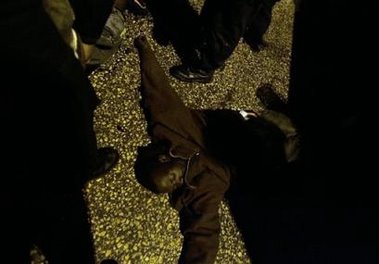
More harrowing proof, if such be needed, of an out of control police force manned by hapless recruits and vicious officers and their mercenary higher ups. In the wee hours of Friday, Hosni Mubarak’s ever-expanding police apparatus targeted Sudanese refugees holding a months-long sit-in to protest the UNHCR’s refusal to hear their cases for resettlement after the peace deal in Sudan. al-Jazeera broadcast horrifying footage of water cannons sprayed onto refugees in the frigid night air, riot police warming up as if for a decisive battle, and ruthless walkie-talkie-wielding officers beating, kicking, and slapping unarmed refugees (including women) as they dragged them to buses waiting to transport them to camps outside the city. The death toll so far: 20, including several children.

The Interior Ministry claims that refugees were drunk and hurled liquor bottles, injuring 75 officers and riot policemen. The Interior Ministry also claims that police used “restraint.” Egyptian television dutifully repeated the claims, showing footage of the injured officers in hospital, flanked by sympathetic family members. Of course, no images of injured or abused refugees were aired. The Muslim Brothers are vowing to raise the matter of police brutality in parliament. They would do well to follow through. Merely a few weeks ago, the very same police forces shot voters to prevent them from approaching polling stations. The very same, hateful “State Security” officers beat up judges, just as they pummelled unarmed refugee men and women.

Egyptian police brutality is now legendary. With alarming frequency every year, Egyptian police officers maim, kill, and otherwise abuse completely innocent citizens. The police has become a gargantuan, horrendous monster, sicced on whoever curries the displeasure of the powers that be. Controlling, disciplining, and entirely reforming this extremely abusive, corruption-laden, and entirely unaccountable apparatus is quite literally a matter of national security.

*AP Photo.

Monday, December 26, 2005

"New Thought" in Practice

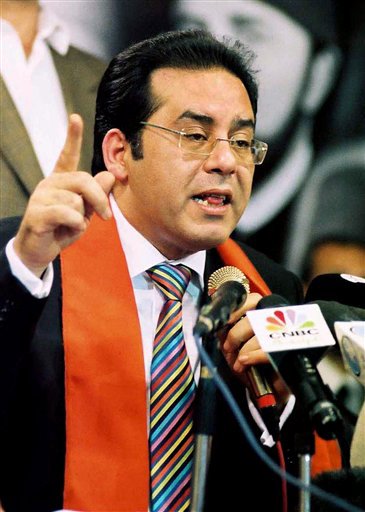
Saturday’s sentencing of Ayman Nour to five years in prison inevitably calls to mind the eerily similar tribulations of sociologist Saad Eddin Ibrahim three years ago (Ibrahim received seven years). Both were sentenced by the same, ill-reputed judge (Adel Abdel Salam Gomaa), both were officially charged with forgery (though the legal case against Nour is even more flimsy than Ibrahim’s), and both had varying degrees of complex ties to the American administration. Both were viscerally hated by the Mubaraks (for very different reasons), and both proved very adept at capitalising on their international ties. Of course, both were not above working with the regime that later hounded and harassed them.

But here’s the key difference. Whereas Ibrahim could count his domestic supporters on the fingers of one and maybe two hands, Nour has quickly amassed a sizeable following of sympathisers and supporters. Whereas Ibrahim’s trial sessions featured a who’s who of the Cairo diplomatic set, Nour’s trial had more Egyptians than foreigners, with his young partisans filling the courtroom with fiery anti-regime slogans. Whereas Ibrahim’s sentencing was met with domestic indifference and even schadenfreude in some quarters, supporters and sympathisers of Nour immediately took to the streets to condemn his phony trial and conviction.

Not because Nour is some genuinely popular national hero, but because the presidential will to extinguish him was crystal-clear from the outset. Just as voting for the Ikhwan for many people was a satisfying slap in the face to the ruling regime, so supporting Nour for many people is a token of resistance to Mubarak senior’s abuse of power and Mubarak junior’s lust for power. No doubt there are some true believers in Ayman Nour, but there are many others pulled by the enduring allure of the protest vote, made more alluring by the fact of a stalwart regime refusing to share or otherwise redistribute its power in any way. For me and I think many others, the regime’s noises about “new thought” and all that cheap blah blah are nothing more than revolting spittle, designed to grease the wheels of the creaky, shameless, bankrupt
Gamal Mubarak project.

The contrast between Ibrahim and Nour’s domestic receptions is the story of seismic shifts in Egyptian politics in the short space of just three years. Since 2002, the relationship between Egypt’s hukuma and ahali experienced an incremental loss of control by the former and new manifestations of boldness by the latter. Mubarak’s regime no longer commands the material or symbolic resources it wielded comfortably just three years ago. It is unable to innovate even its arsenal of repressive tactics. It is unable to anticipate the responses of its relevant domestic and international interlocutors and strategise accordingly. It is unable to maintain even a face-saving modicum of coherence. It’s muddling through, at best, unsure whether to crack down decisively or open up carefully. Both courses entail momentous consequences and big risks, and there’s no one in the regime who’s thinking strategically, deliberating, or planning rationally. Tsk tsk.

Mubarak’s regime never ran like a well-oiled machine, but it also never evinced the fissures and intramural wars of position currently the talk of the town. For the latest, read the
eruption of the phony liberal and incorrigible prevaricator Hala Mustafa. Apparently, Ms. Mustafa has recently and miraculously discovered that Egypt’s security services are ubiquitous, nefariously thwarting the potential of true liberals like herself. But I don’t wish to despoil this space with further discussion of the poser and small time opportunist Mustafa. Anyone who knows her background, qualifications, career path, future ambitions, and current affiliation with Gamal bey’s club (aka the “Policies Secretariat”) will decipher her true motivations.

As the curtain falls on Egypt’s eventful year, and as we debate the meaning of it all and the possible trajectories from here, I’d like to conclude with an insight passed on to me by my roster of beloved teachers and mentors over the years. When approaching social analysis, assume sparingly, observe carefully, listen intently, think clearly, write lucidly, be on the lookout for the unexpected and improbable, don’t twist the facts to suit your preferences, and always, always, ask: what would prove me wrong? It’s thrilling to be right, but you learn more when you turn out to be wrong.

Happy Christmas, Hanukkah, Kwanzaa, Eid, and any additional celebrations I’ve missed. Here’s to hoping for a new year that brings in more justice, truth, and self-determination.


*Photos from AFP.


Monday, December 19, 2005

Mandate

And so it has come to pass. The ultimate election of the year has brought in dramatic results. On Friday, judges returned the “iron slate” of incumbent Zakariyya Abdel Aziz, so-called because of its tough stance on the imperative of judicial independence (I love it). Out of 4,652 valid votes, Aziz garnered 3,680, while the pro-regime Adel al-Shorbagi came away with a non-negligible 930. Unknown last-minute entrant Ihab Abdel Muttalib secured some 89 votes.

I was blessedly wrong to think that the body of judicial electors is having second thoughts about Aziz’s activism. Instead, the results show an intensely mobilised and unwavering judicial general will, ready for a new chapter of hard bargaining with the regime. Physical attacks on judges during the parliamentary elections are still fresh in everyone's mind. But let’s not brush aside the significant minority of challengers led by Shorbagi. They’re crafty and retain close ties to the powers that be. And they’ll live to fight another day. Still, I can’t resist offering my condolences to the regime’s dejected fixers. Your job just got much harder, gentlemen. Pity.

Even more remarkable than judges’ unambiguous mandate to Aziz et al is how closely watched and then heartily celebrated these elections have been. “Mabrouk!” is the cry on everyone’s lips (many thanks for all the e-mails, I’m ecstatic too). It’s as if a significant sector of the public tethered its hopes for freedom and justice to this odd electoral exercise among this most unexpected group of electors. This no doubt is one of the most intriguing and perhaps enduring outcomes of the Judges’ Club vote. As is obvious, the pro-independence faction won more than the confidence of its peers. It has also secured the lasting interest and admiration of members of the general public, for whom the once obscure names Abdel Aziz, Hisham Geneina, Ahmad Saber, and Mahmoud Mekky now evoke honour, courage, and intrepid perseverance.

Judges in this country have long been held in high esteem, but always at a certain remove. Charisma was anathema, unseemly, and downright frowned upon. Now, judges are at the centre of public politics, and it wouldn’t be an exaggeration to claim that a handful have attained the stature of beloved public personalities, purveyors of a certain mystique. That continues to trouble many, and the concerns are legitimate. What does it mean that judges take on the public leadership roles usually assumed by politicians and charlatans? Why did none of the ‘clean’ contenders for parliament capture the public’s imagination in the same way that judges have? How will the regime respond to this latest of a string of setbacks thrown its way? How will Abdel Aziz and partisans maintain the momentum for a new judiciary law while fending off infiltration, demoralisation, or implosion from within? Judges thrive on wielding specialised legal knowledge, fairness, and guardianship of what’s left of the public interest. How the rough and tumble of politics will affect their prized social capital, painstakingly built over decades of dogged professional service and collective action, will be one key development to watch.

But let me not complicate the festivities with too many nagging questions. It’s time to celebrate. I’ll even drink sharbat!

Friday, December 16, 2005

And Then There Was One

It’s neatly fitting that the final elections capping this remarkable Egyptian electoral year will be by and for the judiciary. In a few hours, the Egyptian Judges Club will witness its most critical elections since the March 1969 poll. At stake is not simply a new Club chairman and governing board, but at least two foundational issues: the very tenor of executive-judicial relations for the next several years, and the matter of which institution will be the legitimate representative of judges, the Club or the Supreme Judicial Council. For the past several days, the Club has been awash in the electoral paraphernalia and leaflets of opposing camps, some of suspiciously high quality (glossy booklets and all). And judges are arguably more mobilised than they have ever been, even more than during the critical 1969 elections. Rather than a pro- and anti-regime bloc, however, the judicial electorate is split along much more intricate lines. The nodal concern is how to manage the now thoroughly public and even internationalised spat with executive authorities, still extremely raw after the bloody parliamentary elections. In short, a real battle, with a completely unknowable outcome of enormously high consequence. Does it get any better than this? Let the voting begin.


It’s rather foolish to say much at this point, no doubt. But I can’t resist some broad strokes. Let’s begin with the three contending blocs. It’s difficult to imagine that judges would have mobilised so spectacularly this year without the incumbent leadership team headed by Zakariyya Abdel Aziz and fellow travellers (Dirbala, Geneina, Saber, Mekky et al). The trajectory of Abdel Aziz is a story unto itself, worthy of a more careful narrative at another time. For now, be it noted that irate strongmen within the regime are especially keen on sweeping out Abdel Aziz and party and installing their own pliable supporters.

Enter Cassation Court judge Adel al-Shorbagi and posse, the regime’s new team after the jettisoning of trusty but crusty stalwart Moqbel Shaker and his goons. Old-timers will recall that Shaker started his reliable pro-regime service as a promising young buck brought in by Justice Minister Mohamed Abou Nosseir in the 1969 manoeuvre that ousted Mumtaz Nassar and Yahya al-Refai’s intrepid board. The traces of history are all over this election, another story for another time. But the last days of 2005 are fundamentally different than 1969, when even at its weakest, Nasser’s regime was more coherent, more competent, and certainly savvier than the bumbling behemoth we’re contending with today. Mish keda walla eh?!

To make matters even knottier, Abdel Aziz’s consistently high-profile activism this year has begun to alienate non-negligible segments among men of the bench. Abdel Aziz was exceptionally energetic after the second stage of voting. He was behind the controversial plea calling on the armed forces to help protect judges and voters (as per Law 73/1956). He met with Port Said judges to reassure them that they won’t be attacked in the run-offs. After Noha al-Zeiny’s
revelations, he invited other judges supervising the poll in Damanhour to offer their own testimonials, collating them in a detailed letter sent to the Minister of Justice and certified by esteemed Alexandrian magistrate Mahmoud al-Khodeiry. In short, he was acting like the president of the judges, actively negotiating with Justice Minister Mahmoud Abu al-Layl and shuttling from city to city, listening to and aggregating the concerns of colleagues. As we know, Mubarak’s regime loathes independent leadership of any sort, especially the dangerous kind of stewardship that has an effective constituent base. The task is thus clear: Abdel Aziz must go (back to Tanta would be best).

Cautious judges not necessarily on the regime’s side wonder if Abdel Aziz’s modus operandi is the best strategy to obtain their cardinal goal: a new law for the judiciary. They’re worried that brinksmanship and bold escalation not only render a new law more unlikely, but expose their profession to dangerous appropriation and even further infiltration by hostile outsiders. It’s a legitimate concern, increasingly shared by many upstanding judges. The latest reports tell of eleventh hour defections from Aziz’s coalition over precisely these issues (by Hisham Abu Alam and Farouq Darwish, specifically).

To thicken the already intricate plot, a third faction has emerged headed by relative unknown Ihab Abdel Muttalib, a Cassation Court judge. His platform is unity of the ranks and rapprochement with the Supreme Judicial Council, but without giving up on the demand for a new judicial law. The claim is appealing, but questions remain as to the real origins of this new faction. Is it a covert regime attempt to split the votes for Aziz, or a genuine coalescence of an alternative, ostensibly more productive third way?

Who wins will determine how judges will face off with a regime still intent on denying them autonomy, how the Judges Club of Egypt will continue to stake its claim to be the only truly independent representative of the judicial general will, as against nefarious government usurpers such as the Supreme Judicial Council, and indeed how other corporate sectors in Egyptian society will organise their own future collective efforts for self-governance and independence from the dictatorial grip of the executive. I know I’m not the only one watching with baited breath. Annus mirabilis.


Wednesday, December 07, 2005

Endgame


Asmany feared, the last day of voting today saw security forces intensifying their use of violence against voters to thwart any further gains by opposition candidates, especially the Muslim Brothers. Security forces did not confine themselves to blockading roads and closing off polling stations, but fired tear gas and rubber bullets into crowds of voters. In Mansoura, Kafr al-Shaykh, and Zaqaziq, voters suffered tear gas inhalation and assorted injuries. al-Jazeera
reports at least seven fatalities and 600 injuries. However, al-Jazeera also reports relatively unobstructed voting in Baltim and Hamoul, and the opposition al-Karama's Hamdeen Sabahy is quoted as saying that unlike last thursday, police today have refrained from terrorising voters in his district.


This elderly woman in the town of Kafr al-Shaykh was overtaken by tear gas before samaritans came to her aid.


Women voters barred from entry congregate outside a polling station in the town of Kafr al-Shaykh, and a wounded supporter of the Muslim Brothers in Mansoura (above).

In Mansoura (left), Central Security Forces fire at supporters of the Muslim Brothers, while the latter take shelter behind makeshift shields and throw stones at police.


This voter in Zaqaziq tries to reason with troops blocking access to a polling station (above).


What can possibly be said when ordinary people attempting to peacefully exercise their right are met with state-sponsored, lethal violence?

*Thanks to the talented photographers of Reuters, the Associated Press, and Agence France Presse.


Sunday, November 27, 2005

The Egyptian Voter, Unbowed

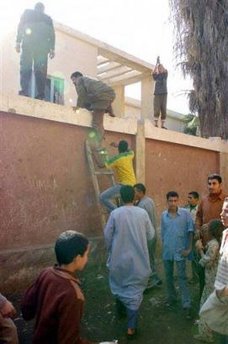
A “democracy with fangs.” Mr Anwar Sadat’s unparalleled description of 'his' no-nonsense kind of democracy immediately came to mind this week as the curtain dropped on the second Act of parliamentary elections. In some districts, thugs hired by ruling party candidates attacked voters while police looked on or looked the other way. In others, police actively blocked access to polling stations and skirmished with fearless voters. In this district in Qalyoub (left), determined voters secured a rickety ladder to scale the back wall of a polling station closed off by security forces. An Alexandria voter’s depiction is arresting: “The police are like the Israelis and we are like the Palestinians. We are oppressed.”
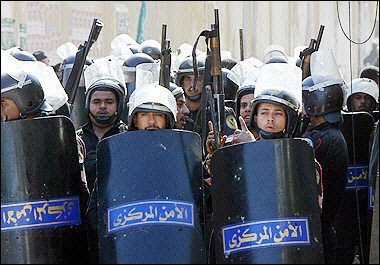


Still, the outcome has seen startling gains for the Muslim Brothers (29 seats this stage, 76 overall) and a stinging drubbing for Hosni Mubarak’s party and regime. I doubt anyone predicted the utterly astonishing events unfolding before our eyes these days, though I don’t doubt we’ll soon hear from those who’ll claim they’ve known it all along. Be that as it may, I am amazed by the element of surprise in all this. Most surprising of all is the tenacity and fearlessness of some Egyptian voters. Unfazed by knife- and stick-wielding thugs, intimidating police formations shooting rubber bullets and tear gas, and the sheer logistical hurdles and sense of doubt accompanying the act of voting, ordinary men and women have trudged to polling stations to demand their rights.
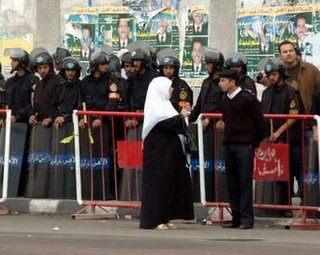
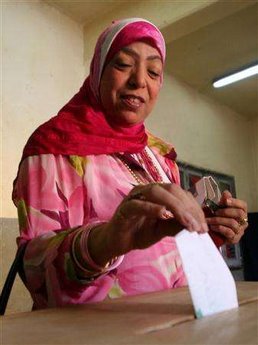
There is something deeply noble to me about this lone citizen trying to negotiate her way into this formidably fortified Alexandria polling station. Let me be clear and honest: if I were subject to the levels of intimidation and physical abuse that many voters endured, I would have paused for a very long time before venturing out of the house. Being an intellectual, I would surely overanalyse my fear and craft it into some pseudo-argument for why voting is futile in the first place. But, you see, the vast majority of Egypt’s people don’t have the luxury of overanalysing anything. Their life circumstances are much more pressing. The act of voting for them is a matter of survival and dignity. Says Alexandria voter Mustafa Rizk, “We all hate the government. They treat us like animals. It’s not Islamic the way they treat people. This is why we all want an Islamic government.”

In the same vein, I like Tom Perry’s pithy and perceptive lead, “The deep, filthy puddles in the streets leading to Belkina's polling station remind some villagers to vote against Egypt's rulers when they get there.” It is rather straightforward, is it not? Egyptian voters, forever falsely said to be apathetic, tribal, apolitical, and a thousand other derisive adjectives, are wresting their right to be heard and to demand their basic right to a human standard of living. It is they who are responsible for the Ikhwan’s success; it is they who have wrought the ruling regime’s deafening failure; it is they who constantly upend and confound the hectares of useless print purporting to “analyse” them.
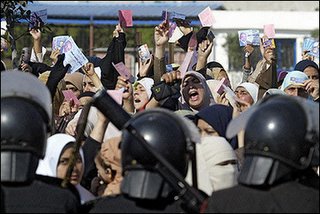
The Ikhwan have done well to take voters and their needs seriously, and voters in turn are returning the favour by braving security phalanxes and demanding their right to be heard (above). Now I am deeply ambivalent about the Ikhwan, but who cares? As my Egyptian politics guru rightly reminds (that’s right, guru), one cannot impugn their fundamental respect for the ordinary Egyptian, and their superior skills at capitalising on and augmenting seemingly puny opportunities. They are not infallible and they are not without schisms, but they are committed. And they are clean.

So before the pundits begin to produce their post-mortems, moaning and wailing about the supposedly sinister rise of the Ikhwan, let’s be honest and clear-headed here. The Egyptian public is not some drugged mass following the siren song of religion. The Egyptian public is suffering from a regime that is aloof and inept at the very best and dangerous and violent the rest of the time. It is not a mystery nor a ‘problem’ how an uncorrupt, moralising, problem-solving, and politically astute organisation has captured the provisional trust of large swathes of that public. The challenge for the Ikhwan as a political phenomenon will be to maintain and truly live up to voters’ trust. No easy task, and not a foregone conclusion.

Good dramas always feature a stirring contest between a roguish villain and a sympathetic underdog. The election’s second Act furnished us just that in the hateful presence of Mustafa al-Fiqqi and the admirable figure of Gamal Heshmat. For background, read the backstory on Fiqqi here. I’m too revolted by him at present to waste precious narrative space on his uncanny resemblance (literal and figurative) to a lowly troll. Heshmat on the other hand is the picture of a true believer. Not a zealot, but an indefatigable striver. In a democratic Egypt, he would be a very successful national politician, with a long and productive career. His secret: a keen sense of constituents’ needs in his native Damanhour. A former Nasserist, Heshmat is among the new breed of Ikhwan for whom Islamist sermonising works hand in glove with age-old constituency service. Simple as that. The man is intelligent, affable, and accessible. Having the repulsive Fiqqi “run” against Heshmat on his home turf of Damanhour must go down as one of the most colossally stupid ideas in contemporary Egyptian political history. I repeat: the author of the idea deserves special plaudits for political inanity and profoundly inept strategic planning.
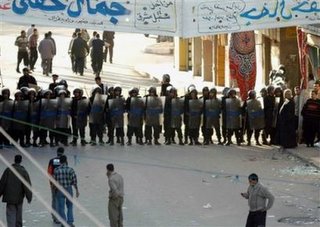

Heshmat and his supporters campaigned intensely. By contrast, the London-loving Fiqqi made a few perfunctory rounds, letting it be known that he’s the “presidency’s candidate.” As expected, on November 20, Damanhouris said Toz. They braved security forces' determined blocking of roads to polling stations (above) to return their man, buoyed by the government's unjust ousting of him from parliament in 2003. That’s the beauty of Egyptians at election time, they say Toz loud and clear to anyone who will listen. Heshmat put Fiqqi in the shade, with a staggering 24,611 votes to Fiqqi’s 8,606. In an exact replay of the Doqqi district fiasco, presiding legal officers panicked and whispered of the dire consequences of a Fiqqi defeat. Presidential representatives monitored the vote count by mobile phone, sending desperate entreaties on the importance of returning Fiqqi as chair of the Foreign Affairs committee in parliament at this “critical time for Egypt,” or some such hogwash. In a flagrant bait-and-switch, after a vote count with absolutely no traces of ambiguity, legal officers announced Fiqqi’s victory and Heshmat’s defeat.

The plot thickens when a fascinating deus ex machina swoops down on the scene, in the guise of an upstanding legal officer by the name of Noha al-Zeiny. She decides to tell the truth regardless of the consequences, and hands over her candid testimony to al-Misri al-Youm, where it’s published on Thursday (full text here). “I use this forum to bear witness to what I learned, of the falsifying of election results in the first district in Damanhour,” she writes, “And I call on those who witnessed the incident to offer up their testimony as well. One of them said to me afterwards that he could not sleep after what happened.” The irony of ironies is that al-Zeiny is not even a sitting judge but a high-ranking member of the Administrative Prosecution, legal officers the government expressly counted on to facilitate its election doctoring.
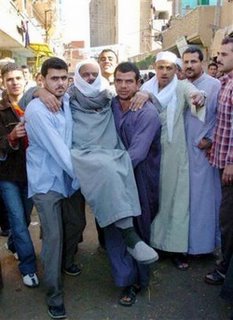
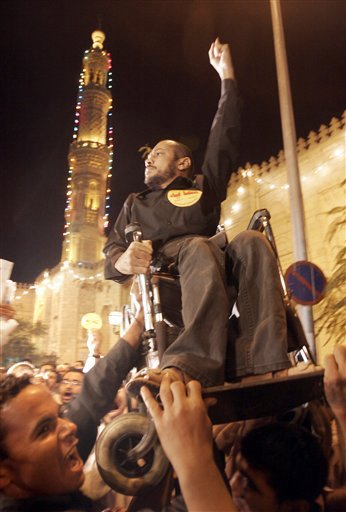
What will the third Act bring? We must wait and see. But I know one thing for certain. It will usher in more surprises, made by human beings for whom voting is an act of defiance, and perhaps even a matter of honour. This disabled Qalyoub man is being assisted to a polling station to vote on November 26. A Tanta voter’s measured expression of outrage to al-Jazeera haunts me: “Security is preventing all the citizens from entering the polling stations, as you can see. Is this right? Does the president of the republic agree to this? Let him call the supervisor of the polling station to let people in, or then let us go home!”

*Photos from AP, AFP, Reuters.

Thursday, November 10, 2005

Four Myths About Elections

Ahhhhh, election season again. Egypt’s parliamentary poll started on Wednesday, the eighth since Mr Anwar Sadat oh-so-graciously decided to return to multiparty politics back in 1976. It was a manoeuvre he would later deeply regret, especially when parliamentary opposition quickly dovetailed with paraparliamentary protest. This year’s elections are neither a historic turning point nor a meaningless routine, but an exercise festooned with uncertainties (yes, festooned). Three, to be exact. First, there’s a considerable uncertainty of outcome. I fail to see how sundry observers are arriving at their predictions of 100 opposition deputies being elected, or 50, or 75, or a middling NDP victory, or a comfortable NDP victory, or any of the other estimates circulating about with such false authority. An NDP majority is assured but beyond that, the final election results hinge on far too many shifting circumstances and naturally ephemeral alliances. Hazarding a forecast is rather foolish, methinks, mish keda walla eh?

Second, the process is even more wildly unpredictable. Here are just some of the axes of uncertainty: How much, where, when, and in what ways will the government wield its repression? What sorts of alliances will be struck, in which districts, among which candidates, and on what terms? What sorts of irregularities will prevail, how much, and where? What kinds of issues will surface in the raucous process that is Egyptian elections? Will foreign parties exert different kinds of pressure on the regime during different stages? All of these and more are key ingredients in the process, and I for one have no idea how they’ll interact or what outcomes they’ll produce. Initial reports from the first round of the first phase of voting brim with diverse irregularities that vary from district to district, with no clear trends or patterns yet emerging.

Third and most intriguing to me is one factor almost entirely absent from the presidential selection charade of September: the voting public. Constituents. Electors. Clients. The kinds of relationships forged between candidates and constituencies has always been a key motif in every Egyptian election story. Today, it seems obvious to the point of banality to note that each of the 222 districts has a different and peculiar dynamic. Voters are mobilised in some districts more than others, cleave around certain issues more than others, and engage at certain phases of the election process more than others. I find it silly and ignorant to generalise about the “tendencies” of all Egyptian voters. Like their counterparts the world over, they are a variegated, diverse lot. They can neither be dismissed nor reduced to some uniform mass.

Put the three uncertainties together, add a collection of intensely ambitious, cutthroat politicians masquerading as a coherent party (NDP), sprinkle in a disciplined and electorally astute challenger (Ikhwan) and a somewhat rejuvenated official opposition, factor in new movements spawning new candidates (Kifaya, Freedom Now), take account of an unusually charged political atmosphere with acute international interest in Egypt, remember the ever-present prospect of violence, and what do you get? Quite the mulukhiyya, with plenty of fried garlic (to make it interesting). But whereas real, delicious mulukhiyya for some reason makes me intensely sleepy, I’m having no trouble staying wide awake for this election mélange.


But alas, I can’t enjoy my election mulukhiyya in peace. There are some astonishingly bad ideas flying about, and they’re annoying me. Of course, they’re the very same myths that surface every time an election rolls around, and they will surely surface again during the next election, perhaps with some tweaking. Come to think of it, they’re all of a piece with those other myths that persist even as reality changes and history says otherwise: Egyptians are passive, apathetic, quixotic, unready for democracy, unorganised, and just an all-round sorry lot. As the elections get underway, I’m especially suspicious of the following hackneyed tropes.

The elections are meaningless carnivals that burnish the regime’s image in front of the khawagaat. This alarmingly reductive claim is routinely resuscitated to explain anything and everything about Egyptian politics, and therefore of course it explains nothing. Pick up any newspaper and you’ll see this statement somewhere on one of the pages. The obvious problem is that any feature of Egyptian politics can be explained away as designed for foreign consumption or instigated by foreign pressure. Reality, fortunately, is much more intricate. All elections since 1976 are products of intense bargaining between the regime and its various domestic contenders. The khawagaat observe, but have they ever changed the regime’s behaviour on any aspect of an election?

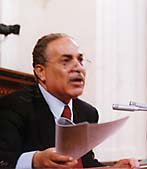
If elections are mere props, why would government legal tailors incessantly tinker with different election systems and rules to weaken and fragment the opposition? The 1976, 1979, 1984, and 1987 elections each operated according to different rules because the government of the day was always responding to immediate and real domestic challenges. Remember the 1976 elections. The 24% representation of independents and opposition proved too irksome for Sadat, who could not stand the mere handful of boisterous deputies using parliament as a platform to denounce and criticise him. Men such as Mumtaz Nassar, Adel Eid, Kamal Ahmed (above), Mahmoud al-Qadi, and Abul Ezz al-Hariri infuriated and disturbed Sadat. So he got rid of them.

After a sham plebiscite, he dissolved parliament and called new elections in 1979, and for good measure added a 30-seat quota for women to look progressive. Sure enough, representation of independents and the opposition dropped to 12.2%. Active rigging and violence prevented the return of all Sadat critics save one: the venerable ex-judge Mumtaz Nassar, whose staunch partisans in the south guarded ballot boxes by force of arms until a phone call from Sadat himself instructed security forces to back off. The khawagaat did not lift a finger. Remember, they were too busy applauding Sadat as a visionary, courageous statesman for signing Camp David. What’s a little electoral rigging and violence at home, hhmmm?

The 1984 and 1987 parliaments were similar products of intense domestic wrangles. Both were dissolved after the Supreme Constitutional Court invalidated the electoral rules on which they were elected. How did the SCC get into the act? Because energetic candidates like Kamal Khaled appealed to the courts to challenge electoral laws that discriminated against independents. When the government blatantly doctored the 1990 election law, the Egyptian opposition achieved an unprecedented amount of coordination and boycotted the vote, save for the Tagammu’ and the Nasserists.

The 1995 vote was the bloodiest in Egyptian electoral history, with 60 dead and hundreds wounded, and the lowest ever opposition and independent representation: 9.6%. Why was it so violent? Hosni Mubarak was rattled by the attempt on his life in Addis Ababa and worried by the violent Islamists in the south. He turned on the Ikhwan, trying them before military tribunals to make sure their best and brightest didn’t run in elections. So, only one Islamist made it into the 1995 parliament: Ali Fath al-Bab, independent Islamist unaffiliated with the Brothers but close to the Labour Party. Once again, was the regime responding to domestic or foreign pressure?

This story would be incomplete without mentioning a critical actor: Egyptian courts. Since 1984, disgruntled candidates have actively turned to the judiciary to invalidate election rules and results. The Supreme Constitutional Court twice declared election laws unconstitutional (in 1987 and 1990) and in 2000 mandated full election supervision, spurred each time by aggrieved independent candidates. The Court of Cassation (CC) and the Supreme Administrative Court (SAC) both have the power to invalidate election procedures and call for new elections. There are hundreds upon hundreds of CC reports and SAC rulings that do just that, but the devilish Article 93 of the Constitution renders the CC’s reports non-binding, while countless rulings of the SAC are evaded and/or selectively applied.

But the point is, elections have become quite the headache for the regime, thanks to some citizens taking them very seriously, the same process that transpired with the presidential vote. This year, in August and November, administrative courts ruled in favour of citizen election monitoring in both the presidential and the parliamentary polls. One intriguing novelty in court involvement came on November 6, when the administrative court threw out a suit challenging the Ikhwan’s use of their 1987 slogan, “Islam is the Solution.” This reflected the unexpected controversy over the slogan, with the Ikhwan aggressively (and rather defensively) defending their choice and critics complaining of cynical evocation of religion to garner votes. The Ikhwan even have a little ditty to go with the slogan, though the lyrics leave much to be desired.

Elections may also be for domestic consumption, but they don’t fundamentally alter the regime’s power. Er, no. I was dismayed to read the usually sharp Abdel Halim Qandil express this unsubtle view recently, which seems widely shared. But elections are a very dangerous exercise, not because they threaten the regime’s existence, but because they contain a nucleus of competition. No one who knows anything about elections anywhere will fail to appreciate the consequences of even a sliver of competition. Each of the 1976, 1979, 1984, 1987, 1990, 1995, and 2000 elections had wildly different implications for the regime, none of them inconsequential, some of them quite grave. Why else would both Sadat and successor invest enormous effort in micro-managing polls and deploy all the resources of the state to ensure a favourable outcome?

The competitive logic of elections induces microscopic yet significant changes in the regime’s structure on at least two levels: the state structure, and the structure of the NDP. Take the first. We all know how centralized Egypt has become under Hosni Mubarak, with a direct line running from the president to the provincial governor (muhafiz) to the district police station (nuqtat al-markaz) to the village ‘umda. All are part of a single, tight-knit chain of command that was further tightened in 1994 when ‘umdas became appointed rather than elected. Provincial and municipal councils (al-magalis al-mahaliyya) are also critical institutions of centralised state control; they enjoy absolutely no oversight powers nor any appreciable role in allocating resources at the local level. Instead, they are repositories of state control, to be drawn upon when necessary. The rest of the time, they serve as arenas for turf battles and ego wars between aspiring government hangers-on.

At election time, all these apparatuses are intensively mobilised to ensure the victory of NDP candidates. With a word from the muhafiz, answering to the Interior Minister in Cairo, all markaz police stations work round the clock, hiring local toughs to disrupt independent and opposition candidates’ campaigns, arresting supporters of opposition candidates on the eve of election day, luring, confusing or intimidating opposition voters, and spreading rumours. Provincial and municipal council members do their bit as well, campaigning aggressively for their ruling party patrons and coordinating with markaz police. Markaz police instruct the village 'umda to threaten his village folk with detention if they vote for independent/opposition candidates. The 'umda complies on pain of losing his headship.

In return for these services, the centre holds out the prospect of post-election rewards and inducements. Here is where the impact of elections on the structure of state power is blatantly obvious. It is no coincidence that muhafiz appointments and other local governmental reshuffles immediately follow parliamentary elections. Let’s take one concrete example of this dynamic from this year: Kafr al-Shaykh muhafiz Salah Salama. Salama was until recently the head of State Security Intelligence (Mabaheth Amn al-Dawla). He was removed from his post and posted to Kafr al-Shaykh due to serious animosity between him and Interior Minister Habib al-Adli. Salama is an ambitious little rogue, with designs on the ministerial portfolio. He has reportedly delighted in Adli’s misfortunes (the Sharm el-Sheikh bombings in July, the widely condemned attacks on Kifaya protestors in May and July), and will do everything in his power to help NDP candidates in his province. His strategy is to please the big bosses and deliver Kafr al-Shaykh so that they’ll reciprocate and appoint him minister.

Multiply this single dynamic a hundredfold in a hundred different state nooks, from the muhafiz all the way down to the street-level clerk and the two-bit member of the municipal council, and you begin to see just how important parliamentary elections are to the distribution and turnover of personnel within the government structure. This can affect the regime’s power in many different and often contradictory ways. But let’s not pretend that elections matter little for the regime’s power.

Let’s take the second structure: the very National, very very Democratic, very storied Party (NDP). The competitive dynamic of elections aggravates the rumblings always raging beneath the surface stolidity of the NDP. That behemoth is of course not a party at all but a vast praetorian network studded with ruthlessly ambitious mercenaries who harbour loyalty to nothing other than their own advancement. Elections are the moment when the NDP’s chaotic structure is laid bare for all to see, as politicos manoeuvre for official party candidacy and all the perks it entails. Remember that the 2000 phenomenon of momentarily defecting NDP members who re-joined the party after elections led to a sequence of events that culminated in the rise of Gamal Mubarak. Could there be any clearer proof of elections directly impinging on the power of the regime? Or this year’s successful operation to unseat the lone Ayman Nour from his perch in Bab al-Sha’riyya. Is the regime really that threatened by a lone political maverick?

As with 2000, this year the regime cherry-picked its candidates, 438 men and a whopping six women (the true face of Suzanne Mubarak’s contrived and utterly phony commitment to women’s empowerment). The government tried to appease hundreds of other equally ambitious contenders with promises of endorsement in the 2006 municipal elections and sundry state appointments. But as we know, hell hath no fury like an NDP hanger-on scorned; the rejects decided to run as independents. Already, violence has erupted between partisans of official NDP candidates and those spurned by the NDP, in Buhayra province to be exact. Boulaq has seen skirmishes of a different intra-party stripe, between NDP businessman and presidential crony Mohamed al-Mas’oud and former Amn al-Dawla officer and Interior Minister confidant Badr al-Qadi.

Election times thus brim with intense intra-party and intra-regime intrigues on a scale that would have flummoxed even the man who wrote the book on the arts of political conniver. Poor Niccolo Machiavelli seems positively angelic compared to our formidable Kamal al-Shazli, for example, the über powerbroker and no doubt Egypt’s premier political survivor. For many, al-Shazli is the emblem of political corruption in Egypt, but why bicker over details, I say? al-Shazli is a specimen to behold, especially during election time, when all his stupendous fixing skills are brought to bear. Like Machiavelli’s superior strategist, our man Shazli has never met a crisis he couldn’t surmount, seamlessly flitting between Nasser’s Arab Socialist Union to Sadat’s Egypt Arab Socialist Platform to Mubarak’s National Democratic Party, all the while graduating from cheap and positively gauche suits to impeccably tailored and exquisitely coloured outfits. I must stress that this photo (above) of him amidst the Bagour faithful fails to do justice to his considerable sartorial gifts.

But alas, chinks marred al-Shazli’s armour in 2000, when his men garnered only 38% of parliamentary seats. Suddenly, whispers about his supposedly diminished powers circulated with a vengeance within the political class. The man can no longer deliver, murmured the gossipers. He’s losing his touch, his days are numbered, yapped the tongue-waggers. The corruption is out in the open, muttered the naysayers. Again this year, the same fevered speculation is surfacing about our man’s supposedly plummeting fortunes. I for one prefer to reserve judgement until quite some time after the elections. But I can’t help wondering, quo vadis, Kimo??

What’s certain is that internal NDP intrigue has nothing to do with all that silly jabberwocky about the reformist Gamal guard and the recalcitrant old guard. What’s going on in the NDP is textbook factionalism and ruthless contests for power, I care not a whit for what the gloss de jour is. The infighting within the state patronage machine doesn’t line up on old guard-new guard lines, but instead differently constituted factions that each comprise both ostensible old guarders and members of Gamal’s group. The key propellant is individual members’ personal ambitions to work their way up the hierarchy, tether themselves to powerful patrons, outdo long time competitors, or pre-empt rising threats.

Take the case of the Qasr al-Nil district, where the runoff will see fevered competition between Gamal crony Hossam Badrawi and former Policies Secretariat (PS) hobnobber Hisham Mustafa Khalil, son of the NDP’s vice-president Mustafa Khalil. The younger Khalil was incensed that Badrawi was handpicked over him, so he dramatically resigned from the PS, shrugged off concerted pressures to withdraw from the race, and showered benefits on residents of Ma’rouf and Maspero, two very poor enclaves amidst the aristocratic and well-heeled clientele of Qasr al-Nil. To make it even more delicious, there are rumours that our man Shazli is tacitly backing Khalil. I quiver with anticipation at the outcome of these and so many other intramural battles. But I positively howled with laughter when I read Alieddine Hilal’s fantastic remarks on the NDP. The great prevaricator would have us believe that it’s a real party, with internal discipline and—hold your breath—an ethics committee! But let us not be too judgemental. Mr Hilal is simply trying to maintain his position as the head bootlicker among lesser bootlickers. Let us leave him to ply his trade in peace, shall we?

A services deputy (na’ib al-khadamat) is bad but a political deputy (na’ib al-siyasi) is good. This extremely common idea was recently expressed by another NDP toady, Abdel Moneim Said in the October 24 al-Ahram. As per usual, Said is merely packaging ambient notions; as a pen-for-hire, he is incapable of independent thought. This idea is based on the stereotype of the politically ignorant representative, shuttling from ministry to ministry to secure favours for his district. The opposite is the supposedly dignified and educated senator, participating intelligently in parliamentary discussions and commanding the intricacies of legislation. I have no idea where this dichotomy originates, perhaps in an idealisation or reflexive veneration of “first world” systems, the better to contrast them to dysfunctional and irrational mechanisms in the “third world.”

Being a “services deputy” is a curse word that everyone likes to avoid. However, let’s get off our high horses for a moment and remember an inescapable fact: to be a parliamentary deputy anywhere in the world partially means to oversee the flow of public resources into your district. Consider the magnified urgency of service delivery when the state of public services is abysmal and the only way citizens can secure public goods is to petition their deputies. This is the case in Egypt, when basic survival for the majority of residents is a project fraught with daily battles. Since, as we’ve seen, local representative assemblies are completely beholden to top-down commands and have no control over distributing resources, the only marginally credible potential problem-solvers are deputies in parliament.

As every Egyptian MP will confirm, the two largest needs of any district are petitions for state-funded medical care and job requests. Ordinary Egyptians cannot afford the skyrocketing cost of even basic surgeries and operations. They appeal to their deputy for help because there is no one else to turn to. He makes his way to the Health Ministry and negotiates with the Minister for X number of government-funded operations per month for district residents. He then makes the rounds of other ministries, negotiating to secure job opportunities for his constituents. This is how the typical Egyptian deputy spends his day; a conscientious one who serves his district, that is. When and why did this become a flaw? It baffles me that we can continue to pretend that service delivery is a loathsome activity when we know full well that the state has completely given up on providing basic services.

More serious is the supposed dichotomy between a politically unsophisticated benefit-deliverer and some brilliant legislator. To be sure, the NDP is full of both ignoramuses and ruthless politicos who’ve never done a thing for their constituents except buy their vote on election day. But many successful opposition and independent MPs combine both political acumen and loyal service delivery to districts. The Ikhwan MPs are especially interesting and significant in this regard. They are committed local problem-solvers: arranging for potable water, edible bread, functioning sewage systems, regular sanitation removal, and other human basics that most of Egypt’s denizens lack entirely. They do this by shuttling from ministry to ministry and municipal hall to municipal hall, negotiating incessantly. But they are also active and involved in reviewing and proposing legislation. Other independents and opposition deputies do the same. Think of al-Badri Farghali, Kamal Ahmed, Akram al-Shaer, Hamdeen Sabahy, to name but a few. Even the NDP does not lack for an occasional conscientious deputy who possesses both a constituent support base and political acumen: think of al-Nuzha’s longtime incumbent and NDP stalwart Hamdi al-Sayed.

Egyptians are apathetic and don’t care to vote. This is the mother of all myths, unthinkingly parroted so many times by so many people that it’s sickening. Apathy is an atrocious little weasel word, invoked by the lazy and ignorant to “explain” that which they do not understand, and in the process feel all superior about themselves. Please pause for a second and think this one through. To judge “apathy,” one would have to clamber into people’s brains and look inside, now wouldn't one? Short of that, how do we really gauge whether someone is apathetic or not? I’d love to know. That Egyptians don’t care to vote is as clear as day, but whence comes the notion that this is due to “apathy”?

How can we really know what Egyptians are thinking or feeling about politics? I don’t trust any polling outfit in this country, such as they are, so even if pollsters went around door to door asking people how they feel about politics, that would never capture Egyptians’ complex mixture of extreme astuteness about and extreme distrust of politics. Again, why on earth would anyone package this under the simpleton rubric of ‘apathy’? That Egyptians distrust or even hate their politicians is one thing, that they are apathetic is to claim something else entirely. The interesting facts to learn are not why Egyptians don’t vote in an often violent and rigged process, but what they do to evade, surmount, or work with this distorted reality.

One highly underappreciated way to gauge this is to observe the details of candidate-constituent links in different constituencies at different stages of the vote. Such linkages can be clientelistic, charismatic, or programmatic. They can be all three at the same time. If they’re purely clientelistic, then we shouldn’t moan and wail about it but try to understand the nature of the relationship. Far from evincing apathy, many Egyptians seem exceptionally mobilised during election time, even if in purely clientelistic terms. One of my favourite examples of crafty clientelism comes from the January 3, 1950 general elections, when fellahin openly auctioned their votes to the highest bidder! Today, the Hawamdiyya district in Giza is renowned as the home of the one-term candidate, since crafty citizen-clients promptly vote out all candidates who fail to deliver basic services, robbing them of coveted incumbency. Can ‘apathy’ even begin to explain the local intricacies of Hawamdiyya and its cognates across Egypt?

Election time offers opportunities for candidates to interact with and woo district residents. Vote-buying surely occurs, as preliminary accounts of the first round of voting are already making clear. But other ties are also possible. Residents may identify with an underdog or someone who stands up to rotten local bosses. Residents may be attracted by the appeal of a particular idea, e.g. “Islam is the Solution.” Residents may simply vote for one candidate to spite or protest against another. Even if candidates run entirely quixotic campaigns, they help ordinary Egyptians lay some claim to public politics, even if only fleetingly.

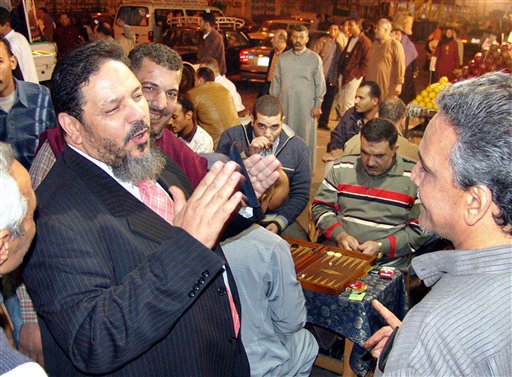
This is why the campaigns of organic intellectuals such as Dr. Ahmad Abdalla (Ayn al-Sira), Kamal Abu Eita (Boulaq), Kamal Khalil (Imbaba), Mona Makram Ebeid (Shubra), Magdi Hussein (Manyal), and Muhammad al-Ashqar (Giza) are so important, despite the fact they all lost. The same for savvy politico Montasser al-Zayat (Boulaq, left), who’s adept at pressing the flesh and appealing to the downtrodden. The short-lived yet significant campaigns of all of these people offer meaningful, dignified interactions for both candidates and constituents, something that we see precious little of in Egypt today. At the very least, such interactions allow ordinary people a chance to air their grievances. At most, they build relationships that are then reactivated at the next round of elections five years down the line. Unless of course you’re the repulsive Mustafa Bakri, who’s failed repeatedly to capture the confidence of voters, and who I wholeheartedly hope fails again in the run-off.


Bird's Eye


When we leave behind the fascinating details and try to grasp broader patterns, I like to think that the elections are one instalment in a very long epic, the drama of ordinary Egyptians’ struggle to gain control over the conditions of their own existence. Meaning: having a say in how their lives are governed. Gaining a foothold in the power structure. Most of the time, the great majority of Egyptians are subject to forces beyond their control. They accommodate and adjust, but they rarely initiate.

Elections are episodes when the tables are turned, if only for a spell. Even the most stalwart government kingpin relies on humble commoners to return him to the ranks of the plumed and powerful. In that exchange, so fraught with unexpected possibilities, commoners get a taste of their own importance. They have sometimes made choices between bad and less bad bosses, sometimes taken heroic stances in support of quixotic challengers, and sometimes aligned themselves with powerful incumbents. If this happens at least some of the time in some election districts every five years, then I cannot for the life of me understand why anyone would describe this as “apathy.”


Elections are those fleeting moments when power needs to certify itself again by popular mandate. The rich and powerful, outfitted awkwardly in their ridiculous regalia and outlandish symbols, must out of necessity seek the endorsement of those who possess nothing. I would not dare forecast the outcome of this paradoxical process. I prefer to observe, and to listen to the blind sage as he sings, “Ya Masr ‘oomi w’sheddi al-hayl” (Get up, Egypt, show your mettle).

*All photos from AP, Reuters, al-Ahram Weekly.

Wednesday, November 02, 2005

Detention

On Wednesday October 26, Alexandrian blogger Abdel Karim Nabil Suleiman was taken from his home and detained by State Security agents (Amn al-Dawla). Bloggers who visited his family report that the family believes Abdel Karim's political opinions and writings for several outlets, including Copts United, are behind the arrest. Suleiman is a 21-year-old law student at al-Azhar University (Damanhour campus). He lives in the Muharram Bek neighborhood that witnessed rioting by 5,000 Muslims outside the Mar Girgis Church on Oct. 21, resulting in three deaths and more than 100 wounded. Security forces detained 100-some rioters but recently released many of them.

As is now well known, the crowds were protesting a play performed at the church two years ago that allegedly insults Islam. The play was recently circulated via CD/DVD by unknown parties, though theories abound as to who could be behind it. Stories point the finger at the Ikhwan, competition between rival NDP candidates, and long-festering social tensions. Observers disagree on whether the violence was election-related, but all agree that the government's purely security-centric approach to sectarian relations is blatantly inadequate.

Abdel Karim maintains a blog, but his family could not say whether this is relevant to the arrest. Abdel Karim's brother speculated that his arrest may be instigated by local "fundamentalists" with whom Abdel Karim apparently has tense relations. It remains to be seen whether he has been "preventively detained" for the usual 15-day chunks and whether he will be formally charged by State Security Prosecution. The first few days (sometimes weeks) of a detention are always the murkiest, with Amn al-Dawla deliberately keeping everyone in the dark to instill fear and confusion. The causes of Karim's detention thus remain entirely unclear. Did neighborhood toughs instigate the police to arrest him? Are security agents punishing Abdel Karim for his writings? Why did his family appear to be unconcerned with locating his whereabouts?


Given these and many more questions, it seems to me counterproductive to traffic in unsubstantiated theories and rumours, or to reflexively sensationalise this as an Iranian-style 'crackdown on bloggers,' or to bicker about whether Abdel Karim's views are "representative" or worth defending. This is basic: a person's views are never the issue when it comes to arbitrary and unlawful detention. The issue is security agents' behaviour, plain and simple. Therefore, I will not comment here on what I think of Abdel Karim's writings; what I or anyone else thinks is not relevant, with due respect. It is much more important now to monitor the situation closely and work to obtain concrete information from State Security, as Egypt's human rights groups have always done in these situations.