Saturday, September 17, 2005

Of Ruses and Resistance

Now that Hosni Mubarak is safely installed as “the first elected president of Egypt,” we all have a right to wonder about the next steps. It’s no secret the man is ailing, weak, and no longer fully in control. And it’s old news that his son Gamal is a major powerbroker and may even be the de facto president, if word on the street and in political salons alike is to be believed. The Gamal Mubarak Project will surely rage on, perhaps with even more fervour in the coming months. But just as surely, it will continue to spawn ever bolder and more intrepid societal resistance. So it’s a wonder to me how the ruling family continues to blithely pursue this most execrable of ideas. Are they so cloistered from reality, so astonishingly oblivious? Or are they so intoxicated by their illegitimate power that anything seems possible? Perhaps, true to form, they’re just exceptionally brazen.


Whatever the cause, the project is already a failure. Not only has it not succeeded in normalising the outrageous and assimilating the indigestible. It has vastly augmented the public’s antipathy to the Mubaraks, though no doubt there are those who benefit from and thus look with favour upon a father-son presidency. It has subjected the president to heavy doses of societal scorn and derision, besting even the illustrious Sadat in a job at which he excelled. And it has crystallised powerful calls for trimming the president’s powers, limiting his terms to no more than two, and electing him by direct popular vote. If there’s one thing all of Egypt’s political class agree on today, it’s that the presidency must be disciplined and cut down to size. So, once again, it’s all about grandiose plans undone and base schemes uncovered. Call it the triumph of plebeian sense over patrician designs.


Plotting and Scheming


The Gamal Mubarak project has of course been with us since at least 2000, that is, since the ruling party’s resounding failure at the parliamentary polls. The much-hyped ostensible party housecleaning was the perfect political cover for Gamal’s mercurial rise. To add colour, Gamal and his people spun a neat little story about an entrenched “old guard” resisting an intrepid, reformist “new guard.” Credulous foreign audiences lapped it up, thanks in part to the loyal services of Nabil Fahmy, Egypt’s ambassador to the U.S. and an exquisitely serviceable little toady. In reality, there is no ideological, Soviet-style struggle between two camps. “Old guard” stalwarts no longer useful to the regime have been shunted aside without so much as a whimper. Think of Yusuf Wali and his retinue, long thought to be an untouchable kingmaker. The old guard-new guard story fails to mask the obvious: a mere changing of the guard substituting crusty old bosses in ill-fitting suits with relatively young faces in more correct raiment…and marginally better English pronunciation.
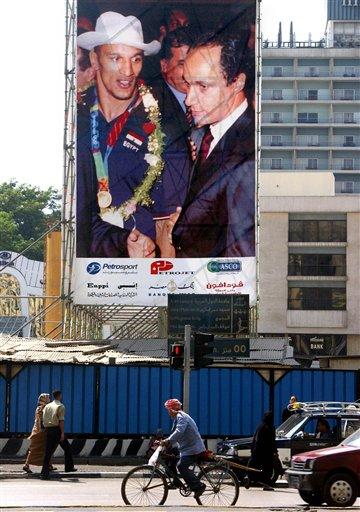
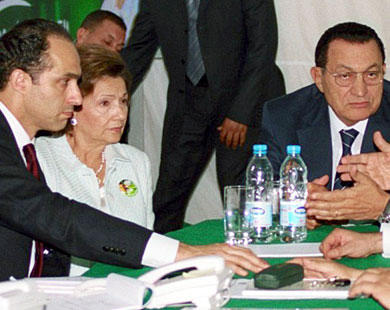
Now that parliamentary elections are upon us again, it’s no surprise that the Gamal Mubarak spectre raises its minatory head, with even more gall. It’s never receded far from view: recall this infamous Tahrir Square billboard (right) back on September 10, 2004, showing Gamal bey with Egypt's Olympic Gold Medal winner in wrestling (the billboard was swiftly taken down right after). But today the regime has to tread extra-carefully, since the make-up of the next parliament is directly entangled with the selection of presidential candidates. As per the amendment of Article 76, any presidential contender from now on will have to come from a legal political party commanding 5% of parliamentary seats. What’s more, the party has to have been in existence for at least five years. Right, currently only the NDP fits the bill, and that is the point. But, if Gamal were to run in say one or two years when his father reaches 80 and becomes completely incapacitated, it would be most propitious if not mandatory to have a few “competitors” from recognised opposition parties to run “against” him and put on a good show.

So the ruling regime is now weighing the option of a mixed electoral law, combining individual candidacies with party slates, hoping that the latter will give opposition parties a boost to meet the 5% threshold. As for Gamal, there are several guises under which he could run. To learn these, we have to await the ruling party’s Congress later this month, to which it makes sure to invite foreign dignitaries and foreign media and to feed them some fine-sounding ideas. There we will see whether Gamal bey will be promoted, how, and to which position. Note that the Gamal Mubarak project does not hinge on the dauphin necessarily becoming president. The only requirement is that he remain at the commanding heights; under what cover is the question.

But let me not get lost in the details and neglect the obvious. The Gamal Mubarak project has never been anything more than a lustful bid to protect ill-gotten gains. The Mubarak family wants to ensure a successor loyal to it, one who will safeguard its secrets, nourish its primacy, and extend its ruinous control over the country. All that drivel about “New Thought” blah blah blah is just noise. And all those academic sycophants pretending that they believe in a new “reformist” project are so many rank prevaricators. I have no interest in entertaining their sputtering excuses and mealy-mouthed disquisitions. It goes against every precept of logic, to say nothing of veracity and decency, to sit around debating whether Gamal bey’s ideas are good or bad, or earnestly affirming that he really “cares” about “reform,” as his posse likes to circulate. Toz. How he parachuted down on our heads in the first place is the fundamental issue.


Praxis
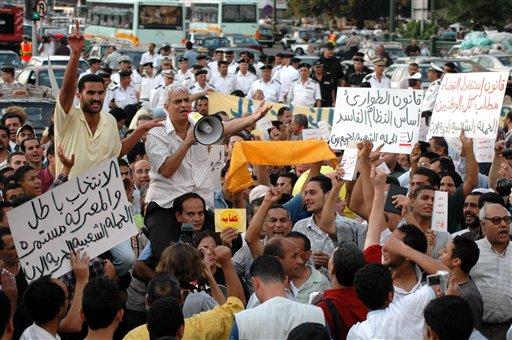

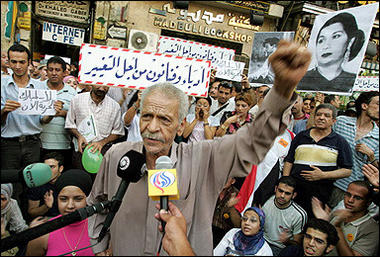
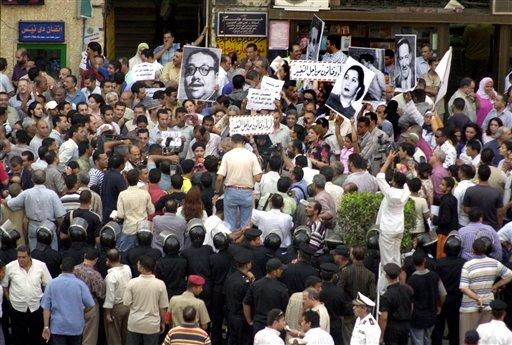
Exactly one year to the day after the above picture was taken, demonstrators took to the streets decrying Hosni Mubarak’s fake democratic legitimacy. On September 10, 2005, a motley crew made up of the Popular Campaign for Change (Freedom Now), Kifaya, Ayman Nour, Saad Eddin Ibrahim, Ahmad Fu’ad Nigm, Muhammad Abdel Quddous, Youth for Change, et al marched in downtown streets railing against the presidential selection show. The ever-noble Kamal Khalil (with megaphone) revved up the crowds, flanked by some wonderful Hamla signs: “A law for the independence of the judiciary is the demand of all patriots!”, “Emergency law is the foundation of a corrupt regime!” And the extremely pithy, “The election is invalid, and the battle continues.” This is what Gamal Mubarak and his bunch must contend with. What are their responses, I wonder?

Resistance against tawrith (inheritance of power) fed and bled into resistance against tamdid (extending Mubarak’s tenure). An intense, bespectacled man deserves much of the credit for this linkage; on one occasion he nearly paid for it with his life. I confess that before 2002, I didn’t think much of Abdel Halim Qandil, classifying him as a rather defensive and shrill Nasserist. But exigent circumstances spawn unexpected metamorphoses. Between 2002 and 2005, Abdel Halim Qandil came into his own as Egypt’s most articulate, most clear-headed, and certainly most effective critic of the Gamal scheme. I don’t remember precisely when his Sunday columns became much-anticipated events, when friends asked, “Did you read Qandil today?!” and marvelled, “This man is committing suicide!” I do remember erupting in little temper tantrums when al-Araby was sold out by noon on Sunday. I can’t imagine what the week would be like now without Qandil’s electrifying intervention. By what strange turn of events does a slight, lapsed physician with a gifted, intrepid pen morph into one of the most formidable threats to la famiglia Mubarak?
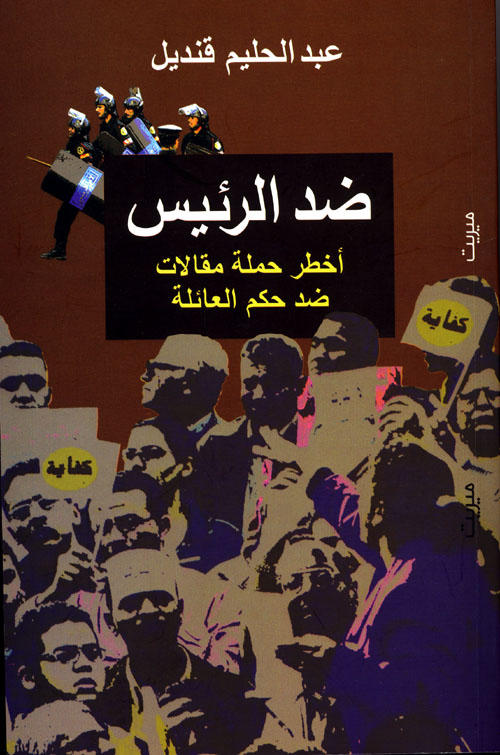
Qandil’s brand-new book Against the President is one of the most important projects taken on by Merit , thanks to the discerning and committed publisher Muhammad Hashim. The book is a no-frills compilation of Qandil’s columns (no Table of Contents, for God’s sake!), from May 2000 to July 2005. He prefaces it with a characteristically concise, uncowed challenge, “This is my crime!” Here he puts to paper what he’d previously circulated only among friends: the constant pressures from regime emissaries on Diaa Eddin Dawoud, Nasserist party head, to tone down the newspaper’s line or have it closed. The sudden cancelling of Qandil’s daily column in the Qatari al-Raya, a perch he’d uneventfully occupied for nine years. Discomfort in high places from a certain appearance by Qandil on al-Jazeera. And the desperate coup de grace: the November 2004 kidnapping of the man by burly, suited thugs who left him naked on a deserted stretch of the Cairo-Suez highway, but not before pummelling and warning him to stop talking about “the big people.” What was that again about Mubarak “allowing” bold criticism in the press??

Reading Qandil’s columns in chronological order opens an extremely instructive window onto to the development of some pivotal ideas. And sets the record straight. Anyone who seriously claims that Mubarak called for amending Article 76 only in response to American pressure needs to reconcile that with some inconvenient facts. On May 4, 2003, at the height of anti-regime ferment on the streets in the wake of the American invasion of Iraq, Qandil wrote, “We want an elected president.” In his usual taut, crisp prose, he concluded, “We want an elected president for Egypt. The reason: Egypt is in danger, and change—now and not tomorrow—is the greatest wall of defence.” On July 6, 2003, he began his column, “Let’s be clear: al-Araby’s campaign against the passing of the presidency to Gamal Mubarak will not stop until an official, decisive refutation is announced.” When Hosni Mubarak proffered that refutation on New Year’s Day, 2004, Qandil shifted to the next pressing topic: “President Mubarak is capable of making history if he decides not to nominate himself to a fifth term,” (January 18, 2004). And so on in relentless fashion, along the way reviving a venerable Egyptian journalistic tradition of reasoned opposition to the powers that be, ever since the days of Ahmad Hilmi. Finally, not to be missed is Qandil's dedication to his mother, an extremely moving, even haunting piece that juxtaposes the reticent decency that she and and other ordinary citizens represent against the obscene schemes and abusive ploys of the powers that be.

Years from now, when we think back and remember the travesty that is the Gamal Mubarak project, we’ll surely and rightly count it among the biggest scams ever pulled on the Egyptian public. But we shouldn’t forget what it helped midwife: A feisty popular campaign against tawrith, some choice jokes at the expense of an underwhelming, ignorant, and exceptionally uninteresting little parvenu, and a remarkable consensus that hyper-presidentialism is a profound danger that must be rigorously checked and leashed, beginning with direct popular election. With their limitless faith in public relations and spin, what the Gamal people would like us to do is change the topic, focus on peripherals instead of fundamentals, get lost in the details and bicker over inanities. What history will record is their well-deserved comeuppance, at the hands of a sagacious and vigilant public standing up for some basic values: decency, truth, and the republic.

*Photos from AP and AFP. Book published by Dar Merit (2005).


Friday, September 09, 2005

Pessimism of the Intellect, Optimism of the Will

So now we know the predictable results: out of 32 million registered voters, a paltry 23% turned out, itself a considerably inflated figure. Hosni Mubarak received 88.571% of the vote, Ayman Nour 7.3%, and No’man Gom’a a pathetic 2.8%. The only surprise is that Nour came in second place with quite a respectable showing.

The fascinating thing about the presidential selection spectacle is certainly not that it constitutes a “huge step” on some hypothetical road to democracy, or that it “opens the door” to democracy, or that it’s a “historic turning point,” or any of the other unbelievably pat metaphors mechanically repeated ad nauseam these days. To me, the really noteworthy fact is how an evident farce was turned into a real process by those who refused to be sidelined and deceived. Consider: On February 26, Mubarak made his “historic announcement” to permit direct presidential elections, which he surely thought was a brilliant manoeuvre to extend his tenure in democratic garb. Six months later, there’s utterly unprecedented societal mobilisation against rigged elections, judges and courts have joined the battle on the side of citizens, the regime’s cronies and their fake institutions are severely discredited and embattled, and on election day activists marched through downtown streets filling the air with cries of “Batil! Batil!” (Void! Void!). Seems like even the best-laid plans are bound to unravel. Pity.


It all reminds me of Antonio Gramsci’s lovely, paradoxical phrase: pessimism of the intellect, optimism of the will. The Italian communist activist and
thinker believed that one could be simultaneously gloomy about the prospects of change yet retain the vision and stamina to actually effect such change. Gramsci’s aphorism is a paradox, one that perfectly captures the ethos of Egypt’s democracy activists. Realising full well the vast power disparities between them and the Egyptian regime, and the real likelihood that they’ll never see meaningful change in their own lifetimes, activists still insist on turning regime stratagems into dead-serious affairs. Optimism of the will beckons the muse of history, Clio. And Clio loves to usher in unintended consequences. This isn’t unprecedented in Egyptian chronicles. As hoary history-lover Muhammad ‘Awda told al-Jazeera, “This is not a unique moment, but a new moment within a continuous frame.”


The Best Laid Plans...


A week before the election on September 7, everything was going swimmingly for the Mubarak regime. All the requisite ingredients were in place. A very correct Presidential Elections Commission (PEC) headed by the Supreme Constitutional Court chief was conjured up to lend an air of gravitas. The president’s handlers arranged for the best makeover money can buy, featuring a new and improved Mubarak with a studied populist touch, though no one missed the visible fatigue of the star “candidate.” Suzanne Mubarak was trotted out to recall her girlish crush on her future husband, sharing with the nation her feelings of immediate attraction to the handsome young man in uniform (shudder). No’man Gom’a was prevailed upon to lend his services, with promises of handsome rewards. And clueless American senators blessed the whole process as historic bla bla bla, and bla.

Foreign-trained Egyptian
image-makers were flown in to choreograph the president’s make-believe campaign. It was deemed fitting to surround Mubarak with model citizens outfitted in model garb. There was the token muhaggaba, the token peasant in gallabiyya, the token clean-cut professional in sharp suit, a veritable panorama of the nation’s sartorial diversity. All were instructed to paint solicitous expressions on their faces and muster those plastic smiles. Mubarak was also positioned in down-home settings flanked by idyllic vistas, bantering with ordinary Egyptians and partaking of their afternoon tea. No surprise that we all saw this for what it was: a fake exercise dripping with the Mubaraks’ notorious contempt and disregard for hardworking, ordinary Egyptians.

Aside from the inconvenient little fact that nobody bought it, the Mubaraks’ plan seemed impeccable: the president would “win” by a respectable margin, go through the pomp of swearing the oath before parliament, and then deliver an address calling on the nation to come together in magical consensus to confront the challenges ahead and continue Egypt’s march to democracy. Voilà! Mubarak’s ugly autocracy would be outfitted in the beautiful new robes of democracy, carping domestic critics would fall silent, restive foreign patrons would be satisfied, and the Gamal Mubarak project would be handled by stealthier means. What could possibly go wrong?


Crimps


Some Egyptians taking it all seriously, that’s what. As with so many moments in Egyptian history, a silly farce suddenly turned serious, completely overturning all expectations and radically altering the calculations and strategies of all relevant parties. I refer to seemingly quixotic gestures such as suing the PEC suddenly leading to momentous consequences; relentless judges refusing to abdicate their hard won power of certifying the people’s representatives; ordinary citizens taking it upon themselves to act as election monitors; election extras such as Ayman Nour shrewdly capitalising on regional grievances to extend his name recognition outside of Cairo, particularly in Port Said and Sinai; and demonstrators roaming downtown streets on election day, vilifying Mubarak. Much as they trip over themselves to appropriate societal energies, I have a hard time believing Mubarak’s people foresaw any of this.

One of the most fascinating lessons to be distilled from the whole elections exercise is the contest between real and fake judicial structures in Egypt. This subterranean struggle has been ongoing for two decades, of concern only to judges and lawyers anxious to uphold professional standards and self-governance. Completely unbeknownst to Mubarak and his henchmen, the elections have exponentially increased the audience interested in this previously obscure affair, exposing the regime’s tactics of infiltration, co-optation, and corruption of the judicial community.

Nowhere is this more evident than in the delicious comeuppance of the Presidential Elections Commission (PEC). The PEC is of course the regime’s signature showpiece in the election ruse, set up by Presidential Elections Law 174/2005. Designed to mimic the cachet of the venerable Election Commission of India but with none of the content, the PEC was soon exposed for the fraud that it is. Everyone castigated its “mythical” and “dictatorial” powers and took to task its bumbling chairman, Supreme Constitutional Court chief Mamdouh Mare’i, who’s always been held in maximum contempt by the very legal community to which he nominally belongs. Law 174/2005 is blatantly unconstitutional, exempting the PEC’s actions from any appeal before any body, violating Article 68 of the constitution and absurdly setting the PEC’s writs above even the president’s, whose decrees aren’t immune from judicial oversight.

In an evidently fanciful move, human rights groups decided to challenge the PEC’s immunity. They contested its decision to exclude them from monitoring polling stations before the first-instance Court of the Administrative Judiciary (Mahkamat al-Qada’ al-Idari). On September 3, the court handed down a package of election-related rulings whose significance shouldn’t be forgotten as we enter the parliamentary elections hoopla. First, the court ruled that the PEC has no jurisdiction over the issue of NGO monitoring, and that civil society groups should certainly be allowed to enter polling stations and observe voting procedures. Second, the court contradicted the PEC’s judgment and surmised that presidential candidate Wahid al-Uxori (head of one of the cardboard opposition parties) cannot enter the race due to the disputed status of his party leadership.

Third, the court referred the suit by Kifaya to the State Commissioner’s Authority (SCA), an important court advisory body that prepares legal opinions which are then often adopted by the court. Recall that Kifaya contested the Interior Minister’s decree announcing the results of the May 25 referendum on the amendment of Article 76 of the constitution, buttressed by the Judges’ Club report indicating that average turnout did not exceed 3-5%. The referral to the SCA means that the court sees merit in Kifaya’s suit and doesn’t deem it frivolous. Fourth and in many ways most remarkably, the court agreed to refer specific articles of Law 174/2005 to the SCC, arguing that the fact the law was vetted by the SCC before passage by parliament (already an irregular and unprecedented occurrence) does not rule out further judicial review.

The rulings are not only significant for bolstering activists’ demands. Taken together, they completely shatter the PEC’s immunity, question its judgment, and by referring Law 174 to the SCC again, implicitly challenge Mamdouh Mare’i’s competence as both SCC chief and PEC chairman!


Quagmire


Mare’i’s response to the verdicts was outrageous, sending ripples of shock through Egypt’s political class. He said the PEC would not abide by the court’s rulings. The prospect of an SCC chief flagrantly ignoring a court ruling was remarkable indeed. As all first-year law students know, failing to implement a court ruling is a crime punishable by imprisonment, as per Article 123 of the Penal Code. Prime Minister Ahmed Nazif convinced no one when he dutifully chimed in, “The election commission is headed by the head of the supreme court in Egypt, which is much higher ranking than the administrative court.”

Experts pored over the legal morass, pitting a pillar of Egypt’s judicial structure (administrative courts) against a newfangled institution of dubious constitutionality (the PEC) headed by a presumptive legal maven who in reality is a loyal regime apparatchik. The regime moved to quickly contain the looming crisis. Under pressure from his bosses, Mare’i quickly retracted his disastrous statement and dispatched government lawyers to appeal the court’s rulings, thus effectively admitting the PEC’s status as nothing but an administrative organ. On September 6, the Supreme Administrative Court (SAC) issued a ruling that was widely interpreted as a hasty political compromise intended to salvage the elections scheme from grave constitutional crisis.

The ruling was a perfect instance of doublespeak, a delicate dance around the luculent unconstitutionality of the PEC. On one hand it upheld the PEC’s immunity from judicial review. On the other, it urged reconsideration of the provisions of Article 76 exempting the PEC from judicial oversight! The SAC’s deliberations stretched into the evening and were led by the head of Magles al-Dawla, Justice Abdel Rahman Azouz. Moreover, the ruling went against the report of the State Commissioner’s Authority, a rare occurrence. It’s certainly not the first time the government prevailed upon the SAC to override a perturbing ruling of a lower court; the administrative court’s history is replete with additional examples. Suffice it to note that the SAC was established in 1955 for precisely this function, to contain and control the spate of rulings against the government by independent-minded courts of first instance.


A Tale of Two Judges


I’ve already discussed who Mare’i is and his underwhelming judicial credentials. His mettle as a judge has been irrevocably dented over the past month, and one can only wonder what that will mean for the status and reputation of the Supreme Constitutional Court once Mare’i returns to it after this annus horribilis, especially since the SCC has already weathered significant infiltration after its July 2000 ruling on judicial supervision of elections.

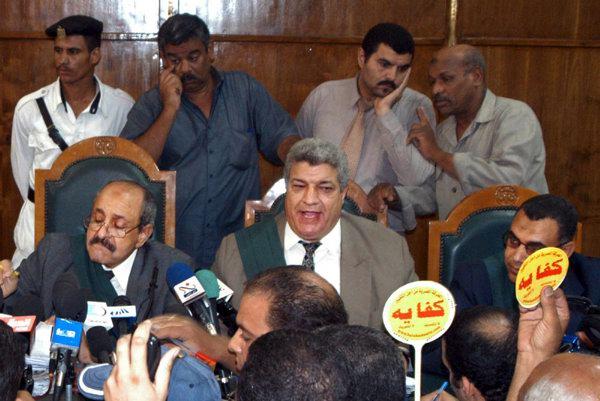
At this juncture, I can’t resist honouring a judge cut from an altogether different cloth. Farouq Ali Abdel Qader is easily the most prominent and well-known judge in Magles al-Dawla today (seated moustachioed judge, above). He handed down the rulings of September 3, followed by another ruling just days later striking down the PEC’s decision to exclude hundreds of judges from supervising elections. Abdel Qader graduated first of his law school class in 1959 and has since crafted an upstanding, illustrious judicial career. Young judges speak of him reverently as “Farouq bey,” compiling and circulating his copious rulings on compact disc to pore over the important legal principles he sets down. You wouldn’t know it from his unassuming and genuinely modest bearing, but Abdel Qader has one of the most truly indispensable and difficult jobs in Egypt today.

As President of the Courts of the Administrative Judiciary (34 circuits), Abdel Qader literally sits at the interface between citizens and state. Administrative courts are the arenas where citizens contest any and all acts of the administration. As head of the crucial first circuit (da’irat al-afrad), Abdel Qader determines the fate of citizen petitions against the government. As he sees it, he is constantly mediating between citizen freedoms and state power. From that vantage, he’s handed down some remarkable rulings in defence of citizen rights.

Just a handful of examples: the ruling authorising marches and demonstrations to protest the American war on Iraq; the ruling allowing the newspaper al-Shaab to resume publication; the ruling that deemed unconstitutional the controversial tagging of garbage collection fees onto electricity bills, and the ruling ordering that Tareq al-Zomor be released from prison. al-Zomor has served his 22 year sentence in connection with his role in the Sadat assassination. Unlike most administrative court verdicts, this last was not reported in the state-owned press.

Whether these rulings were implemented or not is another matter entirely (the last certainly wasn’t), and whether one agrees or not with Abdel Qader’s verdicts is immaterial. The point is that for decades now, he has been a quiet, diligent, and upstanding defender of an inadequate but still decent constitution. I can scarcely imagine what it is like to be deluged with the thousands of petitions that he contends with, at a time when acts of the government grow more arbitrary and legislation more repressive and unjust. His sense of responsibility must be crushing, for every administrative court judge is keenly aware of how his verdicts shape future cases. So when Abdel Qader rules in favour of civil society groups monitoring elections, or in favour of reopening opposition newspapers, or in favour of peaceful demonstrations, he is aware that he is sending potent signals and setting subtle precedents that get at the core of the regime’s legitimacy and power.

I know I am not the only one who scoffed when I read al-Gomhuriyya editor-in-chief’s veiled attack against Abdel Qader on September 5. Or when I learned that Mamdouh Mare’i had decided to ignore Abdel Qader’s verdicts. There are judges and then there are judges. Maximum respect and admiration are owed to Abdel Qader and his colleagues.


Looking Ahead


As the regime sells Mubarak as “the first elected president,” let’s pay attention to the details of the voting process and its rampant abuses, amply documented here by the intricate network of citizen groups, with more sure to surface in the coming days. Let’s remember those righteous judges who refused to let the NDP’s voters enter polling stations en masse, earning an angry rebuke from Gamal Mubarak’s errand boy Mohamed Kamal. In a pre-emptive bid to blame the pathetic turnout on judges, Kamal complained on al-Jazeera of judges’ “rigidity” which turned voters away, he suggested. Gamal Mubarak pal Ahmed Ezz was reportedly also furious with stringent judges on election day, instructing NDP proxies to file police reports on those judges who refused to allow more than one person at a time into polling stations. And let’s await the post-mortems of judges themselves, which will determine their stance on the upcoming November parliamentary elections. The Judges Club will begin hearing sessions on Monday to collate judges' experiences supervising the poll and prepare its report.

The presidential elections ploy is over, Mubarak is still president, the regime’s stability is untouched. But I’m not concerned here with regime stability. I’ll leave that sordid topic to those who call themselves “risk analysts,” to foreign embassy types, and to those quaking at the very mention of the word change. A step to democracy hasn’t been taken, because democracy doesn’t proceed in neat little graduated steps that we can tick off and list. What strikes me is how government ploys have this pesky habit of going awry, thanks to the actions of citizens and judges with other ideas. For the pessimism of their intellect and the optimism of their will, I bow to them in awe and respect.

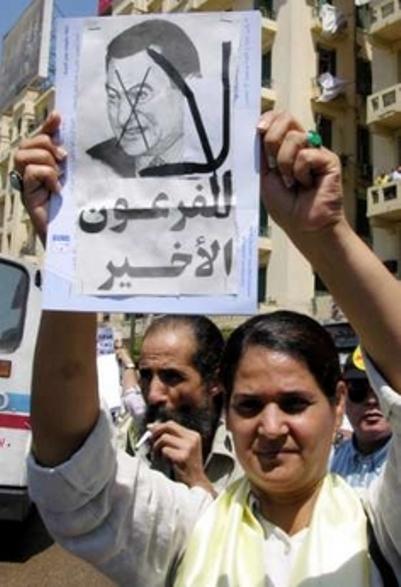
*Reuters photo, September 7, 2005. In Tahrir Square, a Kifaya demonstrator holds a sign saying, “No to the last pharaoh.”

*Courtroom photo from al-Ahram Weekly.

Friday, September 02, 2005

Be It Resolved

Judges convened their general assembly meeting yesterday, where deliberations lasted for about six hours as demonstrators gathered in solidarity outside the Press Syndicate next door. The majority of judges resolved to monitor the presidential poll next Wednesday, on the following terms: (1) judges will permit members of civil society watchdog groups to enter polling stations and observe the vote, (2) judges will hand over copies of voting figures to candidates’ proxies, and (3) those judges who have been distanced from monitoring by fiat (approximately 1,700) will form their own fact-finding commissions and monitor the vote anyway, roving between polling stations much like the citizen watchdog groups.

Far from a capitulation, the judges’ decision is an exquisite example of calibration and measured defiance. All three of their conditions are in explicit contravention of the Presidential Elections Commission (PEC) and its imperious chairman, chief of the Supreme Constitutional Court Mamdouh Mare’i. Because they have decided not to give up on the cause of clean elections by boycotting monitoring, judges have now put themselves on a clear collision course with the PEC. Independent judges have essentially resolved to take matters into their own hands, bypassing Mare’i’s obstructionism and thus thoroughly puncturing his already threadbare legitimacy. So now we’re faced with a delectable but by no means unprecedented irony. The battle for Egyptian judicial autonomy and clean elections hinges more than ever on intra-judicial dynamics. But we’ve always known this, mish kida? In Egypt, there are judges, and then there are judges.


Activism


Judges’ collective resolve this year is in no small measure due to the leadership of several remarkable men of the Egyptian bench who are risking a great deal for the causes of professional autonomy and continued public confidence in the judiciary. To name just a few: Alexandrians Hossam al-Ghiryani, Ahmed Mekki, [Alexandria Judges Club president] Mahmoud al-Khodeiri, and Ashraf al-Baroudi, all inspired by the example of honorary Judges Club president (and wry Alexandrian) Yahya al-Refai. In Cairo, the outspoken Hisham al-Bastawisi and Judges Club board member Ahmed Saber are noteworthy, as are Hisham Geneina, Muhammad Nagi Dirbala, and Tal’at Abdalla.

Judges Club President Zakariya Ahmed Abdel Aziz deserves special mention, for he was not suddenly catapulted into the limelight this year but has had a track record of independence and relative outspokenness. In June 2001, Abdel Aziz beat long time regime loyalist Moqbel Shaker to the presidency of the Judges Club by a narrow margin of 200 votes. Shaker is the quintessential pro-regime judge, first coming onto the scene back in March 1969 in the Judges Club election that Nasser’s legal henchmen tried but failed to rig. But Abdel Aziz’s first year as president was marked by ever-escalating tensions with Shaker’s men, who had secured the board. Early elections were called a year later in June 2002 to resolve the crisis, with turnout approaching 50%. This time, Abdel Aziz triumphed over Shaker by 732 votes, ending up with a like-minded board. His election slogan: “Change and Renewal” (al-Taghyeer wa-l-Tajdeed).

Sure enough, his leadership has meant an amplified political profile for the Judges Club and more insistent demands for a new judiciary law. In June 2003, the Judges Club general assembly refused to comply with NGO law 84/2002. It is an enduring irony of Egyptian politics that the Judges Club is governed by the NGO law, i.e. it answers to the Ministry of Social Affairs! Clearly, judges are having none of it. Then in March 2003, in an unusually bold move, the Judges Club issued a high-profile statement against the Iraq war. Then, on March 12, 2004, 3,000 judges convened for another extraordinary General Assembly to protest warnings issued by the Supreme Judicial Council against judges Hossam al-Ghiryani (see more on him here) and Ahmed Mekki, the two Alexandrian judges spearheading the campaign for clean elections this year.


Containment


Rumours are now circulating that Moqbel Shaker has resurfaced at the Judges Club and is starting to drum up support for unseating Abdel Aziz during the next elections. He will surely gain the support of those still undecided judges ill at ease with Abdel Aziz and his board’s activism this year, as well as the backing of staunchly and openly pro-regime judges. Take PEC chairman Mamdouh Mare’i. When Fathi Naguib died suddenly in August 2003 while serving as president of the Supreme Constitutional Court (SCC), the regime scrambled to find another pliable judge from outside the court’s own ranks to continue trimming the SCC’s claws, especially after its July 2000 ruling requiring total judicial supervision of elections. It brought in Mare’i, an obscure head of the Cairo Court of Appeals and certainly no luminary in judicial circles, neither as a practitioner nor as a constitutional jurist.

Mare’i returned the favour swiftly. In March 2004, he clamped a lid on a raging debate exactly as the regime wanted it to be sealed. The debate centred on who gets to be defined as a judge and what organs are included in the vague moniker “judicial organs” (hay’at qada’iyya). The overwhelming consensus within the legal community is that only “sitting judges” adjudicating cases are to be counted as judges. And judicial organs are only those institutions that issue verdicts, such as the Administrative, Supreme, and Cassation Courts (and their lower rungs). In March 2004, Hosni Mubarak requested a binding interpretation from the SCC (one of its tripartite functions), and Mare’i decided to fly in the face of all expert consensus and adopt the broad interpretation of “judicial organ” to include the State Cases Authority and the Administrative Prosecution, both legal servants of the executive branch.

The coveted outcome? At sensitive moments such as elections, the regime can now use a seemingly legitimate SCC certification and mobilise its legal staff to man polling stations, thereby claiming that elections took place under full judicial supervision. Shoehorning the executive’s legal staff into judicial structures also helps undermine the latter’s coherence and dilutes their intractable esprit de corps.

As head of the PEC, Mare’i has managed to alienate ever-increasing numbers of people. Saad Eddin Ibrahim castigated the Commission for its vast powers and lack of any mechanisms to appeal its decisions (al-Raya, August 29). And this week, the Egyptian Organisation for Human Rights issued a very valuable report carefully detailing the PEC’s unconstitutional powers and the serious gaffes of its objectionable chairman.

It doesn’t end there. Further stoking festering tensions with the judiciary, Mare’i has enraged judges by ignoring the Judges’ Club repeated proposals, entreaties, and appeals on the proper conduct of judicial supervision. Insult was added to injury when the list of judges Mare’i drew up to monitor the polls excluded the names of 1,700 judges active in the call for judicial autonomy and supervision (al-Ahali, August 31, 2005). Finally, in a clumsy and transparent move, Mare’i ordered that the 329 main polling stations be supervised by heads of primary courts (easily amenable to executive influence), while more senior judges are relegated to the 9,737 auxiliary polling stations. Presidential Elections Law 174/2005 of course grants a preponderance of power to the heads of the primary stations.


Warning


The judges are proving to be shrewd and clear-eyed negotiators, with a keen sense of timing and studied escalation of their demands. Yesterday, they vowed to hold a sit-in at the Judges Club in October if the Supreme Judicial Council maintains its intransigent silence on the proposed new bill for the judiciary. Then they went for the jugular. Zakariya Abdel Aziz warned Mare’i, “The judges’ and Egypt’s reputation as well as the country’s future are in your hands. If this election takes place the same way the referendum did, the highest office, that of the president, will be under threat.” Note well. This is not just an upstanding judge berating an inferior colleague, but a pregnant reminder to Mare’i’s bosses in the regime. The message: judges are fully aware of the strategic resource they now control, namely the power of certifying the process of presidential election. In refreshingly blunt terms, Abdel Aziz is reminding Mubarak that presidential legitimacy is now in judges’ hands, and they are more than capable of effecting a constitutional crisis. Behold the devilishly unintended consequences unleashed by fake regime reform.


Legacies, again


As we know, judges are drawing on a vivid collective memory of past struggles to animate their mobilisation this year. And they have their eyes firmly trained on the next battle: parliamentary elections in November. It seems clear that the boycotting trend has waned among judges, giving rise to perhaps a more effective strategy of participating on their own terms. I confess that I was very taken with the boycott option, but if upstanding Egyptian judges have decided to pursue another tack, the least we can do is wait, watch, and lend them our support.

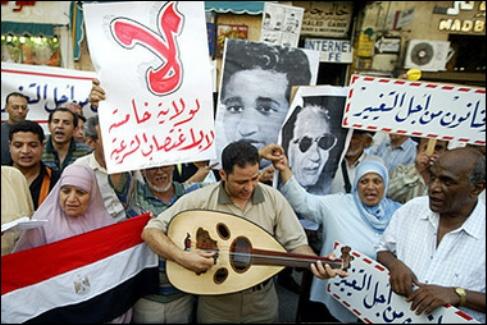
More so than at any other moment in modern Egyptian history, the judges in 2005 have lent their esteemed imprint to the society-wide ferment for democracy and justice. It’s a remarkable symbiosis: judges use their hard won clout to push for truly free elections that represent the citizens’ will, and citizens’ groups reciprocate by expanding the popular support base for judicial independence. Each buttresses the other’s quest for self-governance and autonomy. Each sees the other’s struggle as inseparable from its own. I love the ubiquitous protest sign held aloft at nearly every demonstration this year (see photo above): “O judges, O judges, free us from the tyrants!” (Ya quda, Ya quda, khallasoona min al-tugha!).

This judicial-societal alliance is bound to have a profound effect on the future of Egyptian politics. Of course, the regime and its judicial minions will work diligently to restore the familiar ways of doing things. But rolling back such innovation will be a difficult task, especially if this year’s political energy spills over into next year, and the one after that (foisting Gamal Mubarak on us in a year or two is a foolproof recipe for continued agitation). As in 1968, judges this year have had an intoxicating taste of their own collective capabilities, plus a robust test of their moral support base in society. Does this raise the spectre of an imperial judiciary? Methinks that’s highly unlikely. More likely is a judicial-societal alliance struggling for rights, sparring with a defensive imperial presidency ever so gradually being trimmed down to size.

*AP Photo, September 2, 2005.


Sunday, August 28, 2005

All Eyes on the Judges

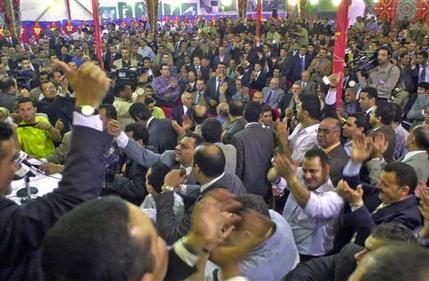
A few days from now on September 2nd, Egyptian judges will convene for another extra-ordinary general assembly in the stately precincts of the Judges Club in downtown Cairo. Kifaya and its cohorts have promised public rallies of support on that day. Egypt’s entire political class, untold numbers of ordinary people, and foreign parties invested in Egyptian affairs will be watching closely. September 2nd of course is the date set by the earlier extraordinary meeting of the judges on May 13th (photo above). On that remarkable day, judges issued a resounding ultimatum to the executive, demanding a revamped judiciary law and full supervision of elections from A-Z in exchange for their full cooperation.

Unlike the current presidential circus whose outcome we already know, the September 2nd meeting will be a true deliberative exercise whose results no one can foretell. Judges are not of one mind, surprising new developments are transpiring literally by the hour, and the stakes simply couldn’t be higher. This time, both the process of deliberation and its outcome are shrouded in mystery. When was the last time we’ve seen such genuine suspense in Egyptian politics?! I’m giddy with anticipation.

The Regime

Since May 13th, judicial-executive relations have been characterised by maximum fluidity, tension, and fevered negotiations at all times. Oscillating between tenuous truces and measured escalation, negotiations have broken down more than once as each camp (and factions therein) angle for advantage and try to anticipate and manipulate their interlocutors’ responses. Rather than rehearse the extremely long list of rumours flying about, let’s quickly review what we know.

For the past four months since the judges’ first meeting in Alexandria back in April, the executive has done its utmost to sway and fragment the judges. Sundry regime emissaries have used all the means at their disposal, from dangling lucrative material incentives before judges to pursuing strategies of divide and conquer to appealing to judges’ natural instincts for order and a smooth functioning of the state. Extremely skittish at the prospect that judges will actually refrain from election oversight, the regime has pursued at least three tacks. First, it has mobilised its vast army of legal functionaries to stand in for real men of the bench should the latter boycott. Such legal apparatchiks consist of state attorneys and those in the administrative and general prosecution.

Second, the regime has made some concessionary gestures. It’s trumpeted “the largest package of promotions in the history of the judiciary” by promising the advancement of 1,742 judges (see al-Ahram of August 18). It’s said that the 54,000 polling stations will be reduced to 9,000 to enable near-complete supervision by Egypt’s 8,000 men of the bench and additional assistance by the legal functionaries. This news was broken by Judge Ahmed Mekky in his al-Jazeera interview here. Mekky also indicated that the government agreed that each judge will also have purview over what goes on outside polling stations to ensure that no voters are intimidated or barred from entering altogether, the main problem in the 2000 elections. And that voters will dip their fingers in indelible phosphoric ink to prevent them from voting more than once.

Finally, and in many ways most significantly, the regime has maintained a halo of ambiguity around its position on a new law for the judiciary, the judges’ signal demand. The executive has made vague promises but no concrete commitments, least of all on the pivotal issue of budgetary autonomy for the judicial branch and an end to the corrosive practice of appointing sitting judges as “consultants” to various ministries and executive agencies, a transparent means of bribery. By keeping the door half-ajar on the much coveted new law, the government can nourish indecision and factionalism among judges and thus cloud their decison-making processes.


The Judges


Recall that immediately after the May 13th general assembly, the executive moved to challenge the status of the historic Judges Club as a legitimate representative body bringing together all of Egypt’s judges spread out among the country’s sprawling and labyrinthine judicial structures. Despite this, judges held fast to the leadership of Judges Club president Zakariyya Abdel Aziz and members of the board. In a remarkable move, in early July the Judges Club issued a damning report on the abuses and irregularities besetting the May 25th referendum, a clear signal to the regime that they mean business when they demand real judicial supervision. The report was entitled “Egypt’s Conscience.”

The judges’ next move was equally feisty. In a memorandum detailing their demands to the Presidential Elections Commission (PEC), judges stipulated that civil society monitoring groups must be allowed into polling stations to assist with supervision (al-Quds al-Arabi, August 18). This reveals that judges do not perceive citizen monitoring as encroaching on but rather supplementing their own efforts, a truly remarkable example of civil societal-judicial synergy on the cause of clean elections. This manoeuvre prompted an angry response from Mamdouh Mare’i, chief of the Supreme Constitutional Court and head of the PEC. Mare’i, by the way, has had rocky relations with judges ever since assuming headship of the PEC. The very latest reports indicate even more escalating tension between him and the Judges Club in the coming days.

It’s important to emphasise that a considerable number of judges are truly undecided and unsure of how to proceed on September 2nd. Many judges, conservative by nature, are genuinely reluctant to engage in such a high-level, risky tug-of-war with the regime, and many are extremely leery of being associated with international pressures on the regime. Yet, they are also frustrated by the regime’s constant obstructionism and its total unwillingness to concede any steps that might mean a more equitable distribution of power between state branches. Let’s not underestimate the predicament of Egyptian judges at this historic juncture.


The Future


Will judges maintain the remarkable esprit de corps that united them on May 13th, driving the hardest bargain the Mubarak regime has ever faced in its 24-year tenure? Or will they settle for some sort of a compromise formula and live to bargain again another day? Or will judges end up ranged among two or more recalcitrant factions? Whatever the outcome, a couple of points are worth underlining. Egyptian judges now know the power of making collective, public demands, buoyed by the admiration and support of pro-democracy forces and the glare of the international and domestic media. I wager that this is one genie not likely to disappear back into the bottle. Judges’ contemporary mobilisation has sown seeds sure to be reaped by them in future iterations of struggle, perhaps as early as the next round of elections to the Judges Club, and definitely during the parliamentary poll in November.

Most fortuitous in my view is one unexpected process of linkage that’s not likely to be sundered any time soon. The demand for judicial independence is no longer just a quaint slogan or narrow sectional interest, if it ever was. It has come to stand in for nothing less than the thirst for democracy and justice among Egypt’s society in movement. Fair elections mean total judicial supervision which means real judicial independence. From where I stand, that’s a wondrous chain.
*AP Photo.

Wednesday, August 24, 2005

Truth and Consequences

As the presidential selection spectacle rages on, Writers and Artists for Change staged their second protest in the public square yesterday. In Midan Tal’at Harb, the spirit of ’19 returned with the songs and likeness of Sayyed Darwish, looking on with his sad eyes. The sign says: “No to a fifth term, no to wresting legitimacy.” Mubarak’s electoral charade is not winning over these stubborn citizens. Like Sayyed Darwish, they like to speak the truth.
AFP Photo.
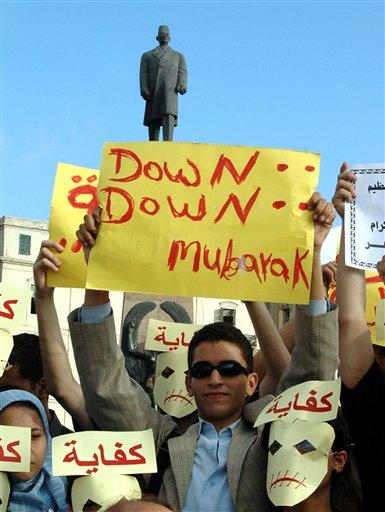
A protestor holds up a sign that says, “Down with the dictator Mubarak.” Today’s al-Ahram says, “President Hosni Mubarak, National Democratic Party candidate in the presidential elections, delivered an address from the heart to Egypt’s workers in Mahalla al-Kubra, in which he emphasised that £E1 billion will be earmarked to provide for the needs of industry… Mubarak stressed that he will not allow the use of the wide-ranging reforms encompassed by his election program as a backdoor for circumventing the rights of workers or encroaching on their gains.”
Reuters Photo.
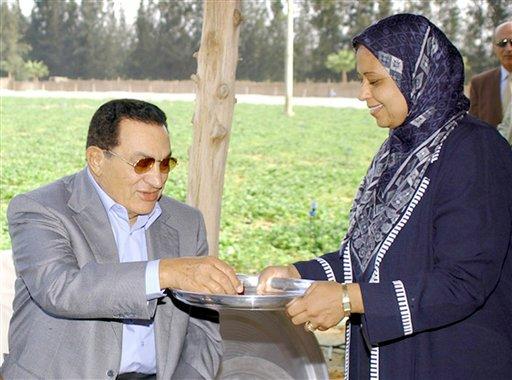
Is it just me, or is there something deeply offensive about this particular frame? I don’t know why, but out of the dozens of contrived and awkward poses released by Mubarak’s campaign, this one stands out for me as particularly galling. For its shameless exploitation of the lovely Egyptian tradition of khamseena tea in afternoon. For the cynical evocation of filial respect. For the unsightly expression on Mubarak’s face. For the ruthless use of this woman’s genuine smile and generous offering as a mere election prop. Mubarak and his handlers’ sordid efforts to negate 24 years of his well-known aloofness and indifference to ordinary Egyptians have surpassed all decency. Kifaya.
AP Photo.
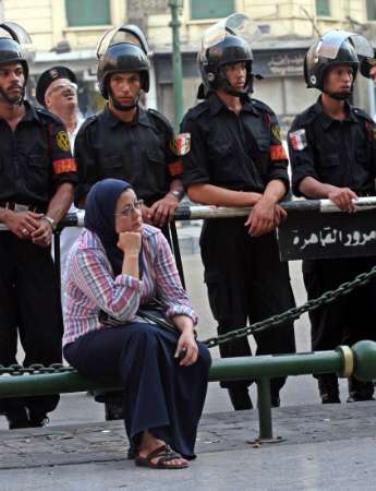
The kind Egyptian people will not be distorted. Outfit them in strange attire, barricade them from each other. They’ll always cleave to what’s noble and true.
Reuters Photo.

Friday, August 19, 2005

Who's Afraid of Change?

There are a lot of good reasons to be anxious and worried about what’s happening and what might happen in Egypt these days. Fearing change is not in our “national character” (whatever that is), but after 24 years of the same president and pretty much the same political system, it’s natural to cling to the status quo rather than wager on the unknown. “The one you know is better than the one you don’t know,” goes our popular adage, nicely captured by Anthony Shadid in his wonderful article summing up the Egyptian zeitgeist.

But there’s a world of difference between sincere fear of the unknown and intentional hatred of change. For the past two months, there’s been a rising tide of tendentious criticism of the Egyptian reform movements. Sometimes it assumes a tone of blasé dismissal, other times outright belittlement. Whether at family gatherings or on the pages of newspapers, there’s bound to be some holier-than-thou sage pontificating about why all of this means nothing and things will go back to “normal” after the elections. Finding fault with and second-guessing Kifaya, the Ikhwan, Youth for Change, Hizb al-Wasat, judges, and all the other movements daring to call for change has become something of a trendy pastime, an emblem of political sophistication, if you will.

Now, I’ve made my preferences clear. I’m thrilled by the pro-democracy ferment. I see in it such strong echoes of pivotal moments in our political history: the 1930s movement to restore the 1923 constitution, the intense mobilisation of the 1940s, the student, worker, and judges’ activism of February 1968-January 1972, and the society-wide dissidence of January 1977-September 1981. I’m happy I’m alive in these times, fleeting and reversible as they may be, and I know many Egyptians who feel the same. Even if everything ends tomorrow, Egypt’s society in movement has already made a huge imprint on the palimpsest of democratic struggle in this country.

But there are others who are scared and threatened by the spirit of the times, not simply concerned or contributing to the public debate. Ragab al-Banna’s rant against street protests in last Sunday’s al-Ahram is but one example. Ruz al-Yusuf and Akhbar al-Yom’s recent attacks against Kifaya are others. My favourite is the claim that Kifaya is “a TV phenomenon,” circulated by Mr. Abdel Moneim Said of the Ahram Strategic Studies Centre (strategic, indeed) and parroted dutifully by Banna and other fifth-rate scribblers. And let’s not forget Hosni Mubarak’s brilliant contention that Kifaya is nothing but a bunch of foreign agents.

When run-of-the-mill slurs fall flat, other tacks are tried. Ahmad Kamal Abul Magd styles himself an “enlightened Islamist” and leading public intellectual. But reading his extremely long intervention in al-Ahram of August 4th, one gets a sense of a confused mind unable to string together a coherent claim. Abul Magd, it appears, is peeved that certain ceilings have been shattered in Egyptian public debate. He’s offended that decorum hasn’t been preserved. He’s upset at “a general wave of criticism and opposition,” proceeds to school us on several abstruse points of law, and then calls for “unity of the ranks to face the future.”

‘Unity of the ranks’ or shutting down vibrant public debate? How sad to see a constitutional law expert make the most disingenuous use of words to mystify and mislead. Abul Magd would do well to abandon his intellectual pretensions and focus on his day job: vice-president of the governmental National Council on Human Rights and loyal servant of successive Egyptian regimes, from his short stint as a minister in the 1970s to his various tours of duty as one-size-fits-all adviser to the Mubarak family.

It’s elementary: real intellectuals don’t lecture the public as if they’re a bunch of sophomoric twits. Real intellectuals don’t seek to shut down the most intense public debate Egypt has seen in years. Real intellectuals don’t cramp our horizons but push them to areas we scarcely thought possible. Real intellectuals don’t tell us what’s “proper” or not, but nudge us to probe deeper and to ask the right questions. Abul Magd and his ilk are no intellectuals.

Besides those who dearly want to shut down debate and like to attack Kifaya and vilify the Ikhwan and curse Ayman Nour and have us continue to live a life of tutelage, there are those who are, frankly, clueless. Take this recent editorial in the Daily Star, which advised, “But if regime change is to be achieved, Kefaya will need to offer an alternative to Egyptians other than anarchy.” That’s rich. Whence comes the notion that anything other than Mubarak is “anarchy”? Who said that Kifaya hasn’t offered detailed alternative visions and proposals, easily accessed through its website or any of its articulate representatives or myriad policy papers? Indeed, every Egyptian group has a blueprint for the good society available through a website and ample documents, from Ayman Nour to Hizb al-Wasat to Hizb al-Karama to the Ikhwan to the Socialists. (Let me not forget the spanking new ideas of candidate Mubarak, post-facelift). The notion that “there’s no alternative” is utterly false, at best. Parroting it 50 times won’t make it true.

There’s a deeper problem. The idea that any or all of the current democratic forces are aiming to either take over or undermine state power is ludicrous. The Egyptian groupings for change want an end to Mubarak’s tenure, an end to many of his policies, and new rules of the political game to allow for maximum participation and the rule of law. All want a new constitution. What precisely is “anarchic” about any of this? Once again, an elementary point: social movements don’t aim to take over the state. Granted, powerful currents within the Ikhwan might see themselves as a regime-in-waiting, but there are equally powerful currents in that divided organisation that simply want more political participation. So when did this become a crime?

There are some serious critics, of course. The sharp Wahid Abdel Meguid takes to task Egypt’s “new opposition” for failing to dialogue with the regime over what he calls “a program for democratic transformation.” But it seems to me rather obvious that it’s not the reform groups who have refused dialogue, but the regime. Need this really be rehearsed? I respect Abdel Meguid but disagree with him entirely. He seems to pine for the days when the regime called all the shots and everyone adjusted accordingly. I’m afraid we’re well past that now, as many now realise the regime’s insoluble credibility problems.

To read the papers these days, you’d think social movements just can’t do anything right. Déjà vu. A couple of years ago, a commentator first branded Arabs as cowardly “mice” for not protesting the Iraq war to his liking. Then, when protests did break out, pundits waved them off for allegedly steering clear of Arab regimes (utterly false, but never mind). Now, when “Down with Mubarak” is a weekly slogan shouted in public on Egyptian streets, the reform movement is shrugged off as either lacking an “alternative vision,” or my favourite, really “tolerated” by Mubarak. What’s going on here? Is it reflexive contrarianism, sheer ignorance, laziness, or something more sinister?

Who cares? Let the regime hacks bark all they want and the uninformed pundits blather on. I think their motives are transparent enough. It’s ordinary people with their legitimate fears and doubts who really matter. They have every right to wonder what comes next. From experience, they know that even if there is regime change, their quality of life stays the same. Or gets worse. Will regime change mean decent schools, adequate and affordable public services, and a dignified life? Ordinary Egyptians have every right to invoke these bottom lines. And to hold fast to bits of homespun wisdom whose logic is impeccable. A man who works in the Ministry of Manpower and moonlights as a taxi driver said to me, “I don’t want Hosni Mubarak, but who knows what comes after him? At least he’s eaten and had his fill, a new one will start robbing us all over again.”

There’s a big difference between these sincere fears, and the efforts of mediocre wordsmiths who belittle and malign the extremely brave and noble actions of Egypt’s activists. So let’s separate the wheat from the chaff. It’s clear that many interests are threatened and bad old ways challenged by the current crest of activism. But this cannot be conflated with the wary sentiments of the public. And these sentiments in turn cannot be marshalled as “reasons” to impugn Egyptian democracy activists. Trepidation toward wholesale change is common even among publics in strong democracies. How much more so for a public suffering from two decades of political repression and economic dysfunction.

I can think of no better response to knee-jerk critics than Czech activist and (later president) Václav Havel’s calm retort to similar carping about his movement. In the The Power of the Powerless, Havel wrote: “Our concern is whether we can live with dignity in such a system, whether it serves people rather than people serving it. We are struggling to achieve this with the means available to us, and the means it makes sense to employ. Western journalists, submerged in the political banalities in which they live, may label our approach as overly legalistic, as too risky, revisionist, counter-revolutionary, bourgeois, communist, or as too right-wing or left-wing. But this is the very last thing that interests us.”


*AP Photo, Kifaya demonstration in Alexandria, August 10, 2005.

Wednesday, August 10, 2005

Chinks in the Imperial Presidency

The first-ever Egyptian presidential poll set for September 7 is shaping up to be a curious exercise, a paradox where the outcome is already known but the process is full of uncertainties. In every normal election, people have their eyes trained on the result: who wins, who loses, and how things will change. In this election, however, we all know Hosni Mubarak is going to “win” (barring some miraculous deus ex machina). Yet, the process is still worth watching. Not to see the state-owned media sell the election as a token of Mubarak’s fatherly benevolence. Nor to behold Mubarak junior’s desperate attempts to sell his spent father as a real candidate with a real platform. But to follow the intense public debates on whether or not to boycott. To see the other candidates tread uncharted territory. To watch an intricate network of groups and individuals step up to monitor the poll. And to savour the ever-shifting alliances and eleventh-hour reversals within Egypt’s political class. Fifty some years ago, Gamal Abdel Nasser built the modern Egyptian hyper-presidency, dwarfing everything in sight (including the military). Anwar Sadat re-tooled it, but it took the unexceptional Mubarak to preside over its creeping diminution. Direct presidential elections are not a magnanimous nor “astute” gesture by Mubarak, but a huge, reluctant concession, one whose long-term consequences neither he nor his successors can anticipate or control. Most unwillingly, Mubarak is actually abetting the rapid deterioration of the mystique surrounding the Egyptian president. And that’s a very good thing.

The Candidates


The obliging No’man Gom’a. Wafd party head No’man Gom’a’s last-minute announcement that he’s entering the presidential race set pundits and politicos aflutter and was a heaven-sent gift to Mubarak. He and his regime were highly perturbed by the prospect of a showdown with Ayman Nour, but not because Nour has any real chance of winning. Nour has other obvious advantages: he’s media-savvy, young, and possesses a certain vitality that’s only been amplified by his trial fiasco. Not to mention the matter of his tacit backing by the Americans. It doesn’t really matter that he has a shady past and no name recognition outside of Cairo; he has support from all the places Mubarak cares about. As we know, Mubarak is famously averse to any hint of a competitor, and to rub salt in the wound, Nour eclipses that other fortyish pro-American secular politician: Gamal Mubarak. So when Gom’a announced his candidacy (as much to spite Nour as to assert the centrality of the Wafd), I imagine that a huge sigh of relief wafted through the presidential quarters.

Gom’a is Mubarak’s dream candidate, as much a man of the regime as an Egyptian “opposition party” chief can be. The 70-year-old Goma’ is also from Menoufiyya and went to Mubarak’s same high school. While dean of the Cairo University Faculty of Law, Gom’a was a very cooperative administrator, handing over to State Security the names of Islamist students so they could be nabbed from their homes. He was the attorney of former NDP stalwart and Agriculture Minister Youssef Wali (remember him?) in Wali’s libel battle against Magdi Hussein’s al-Shaab, helping to land Hussein and his colleagues in jail. After the death of Fuad Serageddin, Gom’a ran the Wafd like his own personal empire, alienating both lifelong members such as erudite law professor Atef al-Banna and maverick members such as Ayman Nour (kicked out of the Wafd by Gom’a in 2001). For his latest cooperative gesture, Gom’a reportedly awaits a handsome reward in the form of a “respectable” percentage of the popular vote for president, plus enough seats in parliament to ensure the Wafd become the leader of parliamentary, ehem, “opposition.”

The slick Ayman Nour. Nour’s meteoric political rise over the past nine months is in no small measure propelled by the Bush administration’s sudden interest in his profile. The American government knows that Nour’s presidential chances are nil, but that’s not the point. The point is a long-term project of cultivating a cadre of cooperative, secular pro-free market Egyptian politicians to counter the refractory Islamists and nationalists the Americans just “can’t do business with.” I’m still amazed at Nour’s transformation from a slightly sleazy, wily politico not above cutting deals with the regime to a courageous young buck ready to take on the rotten establishment, photogenic wife in tow. To read the American press, you’d think Nour was Egypt’s best and only hope for democracy. Think again. Nour is a smart and ambitious creature, indeed, but he is and has always been a one-man show.

His Ghad (Tomorrow) party, legalised last October, had the potential to be a fresh new experiment in political party-building by relatively young politicians. Instead, it’s just as personalised and leader-centred as the other cardboard parties on the scene. Who’s in al-Ghad besides Nour and his orange-bedecked and surely loyal coterie of die-hard supporters? Former MP Mona Makram Ebeid cited the same issue as her reason for leaving al-Ghad a few short months after its birth. Al-Ghad is Nour and Nour is al-Ghad; he doesn’t even pretend to delegate authority or build grassroots support. Now, I’m glad Nour is out there unsettling Mubarak and turning Gamal’s face all green, but I’m under no illusions that he has a real constituency or that he cares about much other than his own political advancement, even if it means sidling up to the Americans. The obscene anti-Nour chants of the NDP’s rented mobs and the shooting of a 19-year-old Ghad supporter in the foot are just two disturbing instances of the degree to which the regime’s people detest Nour. But let’s be clear, personalised contests between Mubarak and nemesis de jour do not a democracy make.


The Debates


To Boycott or not to Boycott. Gom’a’s announcement accelerated a fascinating debate about the relative merits of boycotting the presidential (not parliamentary) election versus standing behind a consensus opposition candidate. Both sides make highly cogent arguments. Kifaya and the other myriad pro-democracy groups are pushing the boycott option as the most effective method to delegitimise Mubarak’s farcical election ploy. By refusing to help Mubarak repair his shattered legitimacy, the opposition can expose just how desperate and weak he is and further impugn his claim to rule. This would be fully in line with the pro-democracy momentum building up since last fall, based on withdrawal of consent to be governed and vocal demand for reform. I find this a particularly apposite response to what is clearly a cynical bid to extend Mubarak’s rule in democratic garb.

Yet, the other side invokes an equally compelling logic. As Salah Eissa wrote in last Saturday’s al-Wafd, the opposition should back one candidate against Mubarak as an alternative, proactive method to register opposition to the president. But I couldn’t believe my eyes when I read further down that Eissa supports Gom’a as the purported candidate and disagree with him entirely, but the basic idea is sound. Kifaya floated around this idea some months ago, and approached respected ex-judge Tariq al-Bishri as the desired candidate. If he hadn’t turned them down, we would have been faced with a truly original and exciting prospect: the unpopular Mubarak backed by the state, business, and NDP crooks, facing off with the unimpeachable Bishri backed by the Ikhwan, Kifaya, some opposition parties, and a wide swath of public opinion. Now this would have been a contest to savour: Mubarak “winning” over probably the single most esteemed intellectual and judge in Egyptian public life.

The Ikhwan’s choice. The big question now is what the Ikhwan will do. Deputy General Guide Muhammad Habib said they’re debating the issue in the group’s ranks across the provinces to decide which posture to take. The Ikhwan’s choice will be critical, and they basically have three options. Back Mubarak, and in return perhaps achieve legality, the release of jailed cadres, and a good chunk of parliamentary seats. Back Gom’a and continue the cooperation into the November parliamentary elections, especially if the government returns to the party slate electoral law. This will compel Ikhwan candidates to run on a party’s slate, and the Wafd is the only option available after the freezing of Labour (the Ikhwan allied with the Wafd before in the 1984 elections). Finally, maintain the boycott, nourish the tense cooperation with Kifaya, and focus on strategy for the parliamentary elections. Backing Nour is a remote possibility, despite news that he’s requested a meeting with General Guide Mahdi Akef. An unusual interview of Habib in the rabidly pro-Mubarak al-Gumhuriyya on Tuesday complicates any predictions of the Ikhwan’s strategy.

The Copts and politics. Another fascinating debate has erupted over controversial remarks made by Pope Shenouda III. In an interview in al-Ahram of August 1st, the Pope expressed unqualified support for Mubarak and had this to say about Kifaya, “These people would never have been so bold in previous eras, neither in Nasser’s nor Sadat’s time. So is this what this noble man deserves, he who hasn’t used his power against them?!” Pope Shenouda also dismissed out of hand the idea of a Coptic candidate for president. “The president should be of the majority religion,” he asserted. Angry reactions to Pope Shenouda’s remarks among Copts and Muslims alike have revisited the vexed question of Copts and citizenship. Most commentators are outraged at how religious figures are actively promoting Mubarak (a habit that also dogs Shaykh al-Azhar and the Mufti of the republic), belying any claims of fair coverage of all candidates. George Ishaq of Kifaya has said that the Pope’s remarks should never be binding on all Copts since he is a spiritual and not political leader, while bloggers Ramy and Africano have their own very worthwhile takes on Pope Shenouda’s incendiary stance.


Monitoring


The grassroots. In the past few weeks, several societal initiatives have sprung up to monitor the polls, mobilised by pure citizen outrage at security forces’ violence against protestors, especially on referendum day, May 25th. Most notable is Shayfeen.com (We see you), a true grassroots initiative spurred by English teacher Ghada Shahbandar, the woman who distributed the white ribbons on the June 1st Day in Black demonstration. Shahbandar and her fellow travellers are a wonderful and novel attempt at citizen vigilance; they’re purely self-funded and position themselves in support of the judges’ role. Another notable grassroots initiative is the Civil Society Coalition for Election Monitoring, coordinated by secretary-general of the Egyptian Organisation for Human Rights Hafez Abu Sa’da and bringing together eminent political scientists and writers Mohamed el-Sayed Saïd, Mustafa Kamel al-Sayyid, Hani Shukralla, Amr al-Choubaky, Nabil Abdel Fattah, and Hasan Abu Taleb. The Coalition is gearing up to monitor elections from A to Z, from training poll observers to tracking media coverage and campaign financing to compiling election-related grievances.

The Americans (and Brits?). International scrutiny of the elections is already visible and only bound to intensify. I was amused to see the British ambassador pay a visit to al-Ahram last week, inquiring of its sordid new editor-in-chief Osama Saraya how he plans to give equal time to all candidates. Please see Monday’s al-Ahram for Saraya’s incredible response. As is well known, the government is extremely leery of any monitoring efforts and has still not given a straight answer to the Americans’ injunctions to have international monitors. Perhaps in an attempt to achieve a compromise, the governmental National Council on Human Rights has announced that it is setting up an “operations room” to monitor the elections. But the United States government is not really waiting for permission. In an aggressive new policy announced by USAID director Andrew Natsios some weeks ago, money is now to go directly to NGOs without first being vetted by the Egyptian government. Sure enough, several Egyptian NGOs announced that they have received $250,000 from USAID to monitor the polls.

Additional American State Department funds are also being earmarked for a “Women’s Political Participation in Egypt” project ($350,000) and “Establishing a Network of Democrats in the Middle East and North Africa” ($750,00). The latter seeks to establish “a formal network of democrats.” What’s that, I wonder? The announcement says “training sessions” will be organised and “moral support” proffered. Capital, where can I sign up? There’s nothing I’d love more than to spend my time being recruited and educated by the American government about democracy. I say, it’s so radically thoughtful of the Americans to offer us wretched natives some training in democracy.


The Regime


Coordination woes. Managing such an election under intense domestic and international scrutiny is clearly a challenge for the regime, if only at the level of coordination. The last few months have laid bare an unprecedented degree of irresolution, backtracking, and conflicting signals coming from the powers that be, as if a window has been opened onto all their byzantine intrigues and wars of position in these exceptionally uncertain climes. Take the security response to the protests, oscillating between savage violence as on May 25 and July 30 and dovish tolerance as during the August 3 Kifaya anti-corruption protest in Opera Square, or the June 22 Youth for Change Shubra demonstration, where security forces didn’t show up at all! Is this a deliberate strategy to keep protestors off-balance or a function of lack of coordination and mutual mistrust between the Interior Ministry and the NDP’s Policies Secretariat? I’m convinced it’s the latter, fed by the Interior Minister and his underlings’ anxieties about being booted, as rumours have been percolating for weeks. The Sharm el-Sheikh attacks have further disoriented al-Adli and his henchmen and cast doubt on their basic competence.

Spin. One area where coordination seems to be marginally smoother is in media strategy. Gamal has apparently been working very hard to apply the very latest American marketing prescriptions that he worships. He’s assigned his lieutenant Mohamed Kamal to be communications chief of his father’s presidential “campaign.” Besides being Gamal bey’s dutiful errand boy, Kamal of course is the NDP’s emissary of choice to sell its “New Thought” to foreign audiences and the Arab public on al-Jazeera. Like his boss, he’s enamoured of all things American, especially the superficial variety. Kamal thinks that if he spouts politically correct terms and repeats them enough times, people will eventually believe him (and even quote him). So the point is to stay “on message,” even if the message is meaningless. Recall the pomp and circumstance surrounding talk of NDP “primaries” to select the party’s presidential candidate. Whatever happened to that? Gamal and crew’s motto is simple: talk like an American, do as you wish. The true mark of modernity, à la Gamal bey.


Rumour & Rumblings. But Gamal and Co. need a lot more than spin to get them through the next few months. All does not appear well in the corridors of power. Fresh on the heels of the Ibrahim Se’da and Osama Harb defections, rumours flew about last week regarding eternal presidential adviser Osama al-Baz. Apparently, he tendered his “resignation” but Mubarak refused to accept it, goes the story. Could the barnacle Baz be defecting? Or was he booted out? Similar stories tailed gynaecologist Hossam Badrawi, member of a purported “liberal” wing in Gamal’s Policy Secretariat who’s seen his fortunes fall precipitously over the past few months. As the ruling party crafts its strategy for the upcoming parliamentary elections, rumours are also brewing that parliament speaker Fathi Sorour (the longest-serving speaker in Egyptian history) will be shoved aside and NDP legal henchman Mufid Shehab to be put in his place. Pre-election violence in Sorour’s Sayyida Zeinab district has apparently dimmed the speaker’s chances, and his days of loyal parliamentary service are said to be numbered. Finally, the grapevine has been weighed down for weeks with talk of businessmen dispatching their capital out of the country and liquidating their assets, with certain regime stalwarts doing the same. Quite the nice little mess, eh?


Cookery. The biggest headache for the regime just now is how to engineer the outcome of the presidential vote. By how much should Hosni Mubarak “win”? Anything less than 60% would cast serious doubt on his legitimacy and offer a solid rationale for undermining his authority. Yet anything above 80% would surely strain credibility, so the magic number would seem to hover in the 70s. The trick now is how to smuggle this past the thicket of independent or American-financed monitors and intrepid judges. A subsidiary concern is how to cook up the results such that No’man Gom’a come in second and Ayman Nour dead last. In the event of a run-off after September 7, this too has to be handled delicately, and eleventh-hour surprises must be avoided at all costs. Goodness, this election business is not as easy as one would have thought. My heart truly goes out to regime strategists as they work round the clock to navigate these mines. Godspeed, gentlemen.


Legacies


Every Egyptian election year features some interesting debates, but this year is clearly different. Not because the presidency is at stake, but because for the first time the post of president is now subject to the deal-making and pitch-selling of politics, not the false veneration and above-the-fray stature of kingship. Imagine the legacies of this for the next election, and the one after that. As expressed by the most insightful observer of the Egyptian scene I know (you know who you are), something irrevocable has been set in motion, a process whose consequences we cannot fully fathom now, but a clear long-term victory for Egyptian democratic development. Mubarak and crew will no doubt make a cruel mockery of the meaning of elections this September, but the same cannot be said for 2011, or 2017. No matter who’ll be vying for the post by then, electing the president will bring him down to earth and start a process where he will have to bargain with (and be checked by) parliament, the judiciary, and societal organizations.

Manoeuvring for parliamentary elections will now be forever complicated by contention over presidential candidates, and can spill over into debate about the powers and prerogatives of the presidency itself. Already, Hosni Mubarak is adopting the constitutionalist language of the opposition, vowing to trim down and limit the powers of the president and amplify the purview of parliament in his new term. He has absolutely no intention of doing so, of course, but the fact that he feels compelled to utter such words is a startling and utterly unexpected coda to his tenure.

The true import of this election is best expressed by another sagacious observer, political scientist Mohamed el-Sayed Saïd in his al-Ahram column last Monday. Saïd wrote that the elections are an opportunity for candidates to answer the Big Questions in Egyptian public life: corruption, poverty, freedom, dignity, and a new constitution. “We await ambitious answers, answers that raise the ceiling of national ambition and inspire the people.” We don’t await them from any particular candidate, but from the debates, arguments, and repercussions the process has unleashed.

Saturday, August 06, 2005

My Madeleine

The bewitching scent of the yellow freesias struck some long submerged chord. A sharp, fleeting image of the tubular, red-orange flower returned with momentary clarity. I remember walking over a wooden bridge, greenery, a gazebo perched high, the texture of the velvety flower with the amazing, pungent, complex scent. Like a lily, it had strong, rubbery petals and I think pistils too, but it was much smaller than a lily and had a much sweeter scent. The walk over the bridge was a daily routine to a mundane destination, but in the corners of my memory it has taken on an ethereal, magical cast. Chronology gets all mixed up, facts are blurred, places are confused; only moods, moments, scents, and sounds remain. In a reminiscing mood, I dig up a trusty “literary” companion of my childhood: Megallet Meeky (Mickey Magazine). I riffle through its delicate, ultra-thin pages, its impossibly colourful cartoon stories, the bantering dialogue in pitch-perfect Egyptian ‘amiyya, the pictures of “Meeky’s friends” at the bottom of the pages, and the addresses of children seeking pen pals. They were from Syria, Iraq, Egypt. I always read their names and the names of the streets they lived on, but I never thought to write them letters. I am eternally grateful that I grew up with Meeky before its new look and patronage by the president’s wife. Even this cherished memento of childhood has not escaped corruption.

“Plants are a joy in every house!” is the title of this story from the issue I found. Meeky is a no-nonsense boss who runs a plant store. “We all have to work with lots of diligence and energy!” he says, and Bondoq and Kooka nod, “Of course ya Meeky!” (Much later I learned that their English names are Goofy and Clarabelle Cow). Kooka says, “I love plants very very much…how lovely they smell!” Later on in the story, she chides the hapless Bondoq for not understanding that plants are sentient creatures: “Plants breathe, they eat and feel happiness and sadness!”

Only now do I notice that every expression ends in dramatic exclamation marks. Back then, I was too absorbed in the tribulations of Bondoq as he tried to deliver the plants to customers and fell prey to the dastardly deeds of the plant thief Dongol (Peg-Leg Pete). But Dongol doesn’t know what he’s up against. A very sentient, huge plant comes to the aid of Bondoq and clobbers Dongol (“Boom!”) As he lies on his back fending off the plant’s blows, Dongol screams, “Kifaya! Haram!” The story ends with Kooka reporting back to Meeky how proud she is, and Meeky exclaims, “Our project was a 100% success!”

Meeky came out at the end of the week on Thursdays. ‘Am Mukhtar, the newspaperman, would pull it out from in between the pile of fresh newspapers he carried under his arm. It was a blaze of color amidst the grey newsprint. In my memory, ‘Am Mukhtar stands at the door in a pool of sunlight coming through the manwar window; the outside light contrasts with the dark interior of our apartment. ‘Am Mukhtar wore a galabiyya with an overcoat and had a meek bearing. Being a bookish child, I was always thrilled to hear his rap on the door, it meant hours of solitary reading fun, and the supplementary “gifts” that sometimes came with the magazine: stickers, colouring books, puzzles. When ‘Am Mukhtar came without Meeky on some weeks, I was so disappointed I wanted to cry, and pestered my father to remind ‘Am Mukhtar to bring it next time. Years later, I vaguely remember hearing that ‘Am Mukhtar had died. I felt a pang of intense sadness. The thrilling scent of fresh newsprint will always remind me of him. His name means “Chosen.”

I fell in love with the haunting sound of cooing pigeons in my childhood. My sister and I woke up early in the morning, put on our maryalas, and walked together to school with our red, box-shaped book bags that looked like miniature suitcases. They were lined with pale-yellow, soft cotton cloth and held our cahiers, crayons, and les gommes, the transparent pink and blue ones with the intoxicating bubble gum smell that we bought from the stationer’s near our grandfather’s house. My book bag always smelled of pencil shavings and bread; we carried our sandwiches of ‘esh feeno in there with our notebooks.

I remember standing in the balacona on a frosty grey morning waiting for my sister to get ready. I felt the intense alertness that comes on early mornings, and watched a cat delicately pick through debris on the rooftop across the way. Pigeons’ plaintive, insistent cooing hung over me like a gauzy canopy. Now, on the rare days when I hear cooing pigeons early in the morning, I stay silent and listen, but they stop after barely a minute. I wonder if they fly away or stand on the sill, silent.

At school, we would stand in our class queues and sing the national anthem, biladi biladi, and then a French song; the only lyrics I remember are “Une fleure pour maman, une fleur pour papa.” We had to turn to our right and left with hand outstretched as if proffering the fleure to each of our parents. I never understood what it means to feel mortified more than I understood it then. My parents insisted that we wear pants under our maryalas, to keep us warm in the winter. So there we stood in our class queues, with flaring bell-bottom pants under our maryalas, while all the other girls looked normal and happy in their sleek stockings. We looked like two clueless frumps desperately trying to pretend that it was completely normal to wear toasty pants in Egypt’s mild winter.

My parents also refused to give us pocket money to buy ‘asaliyya at school like all the other girls. ‘Asaliyya is a delectable stick of hard brown candy wrapped in plastic and made from molasses. Our parents thought that our constitutions were too delicate for the street sweet, which they damned as mish nedeefa (unclean). They tried to console us: I remember my mother standing in the kitchen with her arms elbow-deep in a bowl of thick molasses trying to churn out homemade ‘asaliyya so we wouldn’t feel deprived. Of course, she didn’t know what she was doing, and the final product was a colossal disappointment to both of us, bearing absolutely no resemblance to the coveted ‘asaliyya.


My manipulative younger sister would stop at nothing to get her fix. She actually browbeat me into going around asking random girls in our schoolyard, "ma’aki ersh? ma’aki ersh?" (Do you have a piastre? Do you have a piastre?) I will never understand how she reduced me to begging so we could buy ‘asaliyya. Now, I am attracted as if by a magnet to street hawkers selling odds and ends and the magic, uncouth ‘asaliyya. I buy five at a time and happily crush my teeth on the atrocious candy. It tastes more watered down than I remember, but everything pales in comparison to the happiness I feel at the taste of hardened, cheap molasses.

When school let out, my grandfather waited for us at the entrance, his hands atop his heavy, smooth, onyx-like cane. The distance from school to his house is extremely short, I discovered as an adult, yet he insisted on picking us up anyway. We walked past a store selling faded and chipped China teacups and saucer. I always turned to look as we walked by; they looked like toy tea sets and I wanted one badly. The store is still there today, as faded as ever, but it turns out the teacups are not for sale but rental, for large parties and weddings.

My grandfather had a commanding, purposive gait and walked briskly. We always had to be super-alert and not daydream while we trotted along beside him. He always nodded at and salaamed storeowners and passers-by, and they called out to him with affection and respect. Once, to my utter embarrassment, he sternly chided a complete stranger for dragging her toddler by his overextended arm instead of holding him firmly by the hand. To my shock, she accepted his instructions with deference and said, “hader ya ‘ammi” (yes, uncle).

When we got home, my grandparents’ small apartment would be filled with the smell of my grandmother cooking lunch, on the generic locally made two-burner stove in every Egyptian household before the advent of European imports. Half an hour later, my aunt would come home from work and we would all sit down and eat. Except for my grandfather. He never sat, he hovered.

As we dug into my grandmother’s delicious macarona with chicken or garlic-laced mulukhiyya, he would be wiping down the kitchen counter, getting the ice-cold watermelon ready for dessert, or putting out on the table his perfectly pickled cucumbers, which he kept in old sharbat bottles in the refrigerator. I’ve never tasted pickles like my grandfather’s, always green and crispy, with just the right hint of vinegar. He also made the most perfect karkadeh.

When we got up to wash our hands, he started the sacred daily ritual. He would pile up all the leftover bones and meat scraps, add rice and bits of bread, and put the mixture out in two bowls for the stray cats on the landing. They would already be rubbing up against the apartment door as we ate. When he opened the door, a litter of 10-20 famished felines would surround him as he set down their daily meal, then devour it in silence and quiet cooperation.

My grandfather finally ate his lunch standing up in the kitchen, after all God’s creatures under his care had eaten, had dessert, and settled down to nap or read. After eating quickly, he allowed himself to sit down and doze off, listening to the afternoon tamthiliyya on his antique Philips radio. In the summers, when we would stay with them all day, he would rise with the sun to buy fresh bread and feteer, the thick, buttery, crêpe-like Egyptian pancakes we loved to have for breakfast. The feteer would always be warm and flaky; we’d tear off pieces with our hands and dip them in rich molasses, leaving behind beige flakes of pastry floating in the dark puddle of syrup. I can never eat this, my favourite dessert, without remembering and missing my grandfather.

But the feteer is now greasy and heavy, and the molasses are thin and cloying. The cats are all gone, though one or two still linger in the corners of the landing, emaciated and drawn. Every time I visit my aunt, as I go up the steps and walk down the hallway to my grandfather’s apartment, with the round black plaque on the door bearing his name and profession, the cats follow me shyly, hoping for a glimpse of their beloved keeper.

*Inspired by Proust’s passage on the madeleine in his À la recherche du temps perdu.

Wednesday, August 03, 2005

Freedom Now

The people's bard reclaims his role as the gravelly-voiced chronicler of the struggle for freedom. Aged, hoary, and feisty as ever, the beloved Ahmad Fu'ad Nigm joined yesterday's gathering, "For Egypt...Baheyya," organised by Writers and Artists for Change. Joining him were actor Abdel Aziz Makhyun and writer Abdel Wahhab al-Messiri and a crew of Kifaya and Youth for Change folks. Writers and Artists for Change issued a statement saying in part, "Egypt is experiencing a historic predicament, and the prime responsibility lies with an autocratic, corrupt regime that does not represent the people. Exiting this condition requires effecting a bundle of real changes that have been agreed upon, in preparation for a transition to a pluralist, democratic society. A society that achieves the rotation of power, the meaning of participation, and the values of transparency and the safeguarding of citizens' dignity."

When Nigm leaves his perch up in Moqattam in the Rooftop Command Center (Magles Qiyadat al-Sutuh) and takes up his post among the people in the streets, I know all is well. "Girl, are you daft?" he berated me once when I doubted the capacity of Egyptians for action. He recited a rapid-fire series of proverbs about government and people, cracked some hilarious jokes, chased some of his stray chickens back into their coop, and tore off a velvety, fragrant leaf from one of the plants he was gently tending and told me to keep it. AFP Photo.

The spirit of Egypt's cultural virtuosos graced yesterday's gathering. Poet Salah Jahin, diva Um Kulthum, thespian Naguib al-Rihani, and nationalist songster Sayyid Darwish made an appearance, as did Islamist reformer Muhammad Abdu' and litterateur Taha Hussein. Drawing on Egypt's cultural past for sustenance to face the present is a newfangled, creative tack of the ever resourceful reform movement, akin to invoking our popular spiritual heritage at the Sayyida Zeinab protest. The struggle for self-rule, the quest for representation, the search for dignity and justice, and the recovery of aesthetic beauty--all are twined in the current upheaval. Lest we forget that art and culture, too, are casualties of the current regime.
AP Photo.