Tuesday, June 20, 2006

Requiem

The certainty of death is no preparation for the actual arrival of the Reaper. In the early hours of 18 June, the honourable Ahmed Nabil al-Hilali succumbed to renal failure and passed away in hospital. Thus ends a truly remarkable and exceptionally productive life, a life devoted to the rule of law, the rights of the dispossessed, and the quest for real democracy and political representation for all Egyptians. Ahmed Nabil al-Hilali was not just the most prominent and principled member of the Egyptian bar, a first-rate lawyer who knew the nooks and crannies of every courtroom and the whys and wherefores of every legal clause. He would wince in genuine embarrassment at this description, but Hilali was quite literally a living legend, someone who inspired unanimous awe, respect, and admiration.

In his lifetime, he was christened “the saint of the national movement,” the “liberties lawyer,” and “the Egyptian people’s advocate,” since he spent nearly all of his waking hours defending those accused of engaging in free expression, association, and assembly. And so at his funeral, “all of Egypt was there, from the Communist factions to Judges Club board members to Islamists, and everyone in between,” says a well-known rights lawyer. Though much loved and respected, Hilali was far from being some bland “consensus figure” with no clear commitments. He was an ardent, lifelong Communist, one for whom Communist values were spurs to action, not theoretical props or abstruse arguments. He was a Communist who constantly warned against the chronic fractiousness of the Egyptian left, a Communist who respected and defended Islamists of various hues, a Communist who believed in the deliberative capacities of ordinary people, and a Communist who was fiercely loyal to his chosen ideology yet understood and appreciated other projects of emancipation. Quite simply, Nabil al-Hilali was a true democrat, and a sweet, retiring, extremely kind man to boot. Words fail to capture the immensity of this latest loss.


The Romance of the Pasha’s Son


Ahmed Nabil al-Hilali was born in August 1928 to a family of landed notables. As is well known, he was the son of Naguib Pasha al-Hilali, minister of education, trade and industry, and Prime Minister in the final months of the monarchy before the Free Officers’ coup. As part of the culture’s abiding titillation by the mixing and mingling of classes, Hilali’s chosen riches-to-rags trajectory has been turned into something of a mystique surrounding the man, though he himself never fed this and if anything seemed hobbled and embarrassed by his lineage. But leftist hagiography emphasized and magnified the romanticised narrative of elite Egyptians turned Communists, finding in the likes of Hilali, the late Mohamed Sid Ahmed, Injy Aflaton, and Ismail Sabri Abdalla the perfect fodder. It’s as if a leftist ideological commitment is somehow more authentic if it’s professed by a member of the upper crust.

No surprise then that each of Hilali’s attempts to chart his own, disciplined path have been folded into the narrative. There’s the well-known story of how he gave up his family’s landed assets in Upper Egypt to the poor peasants who tilled them. And his spurning of his father’s elite law firm in Mostafa Kamel Square for a modest practice in Bab al-Luq that he established with fellow law school graduate and comrade Paulos Lotfallah. And of course his marriage to firebrand and fellow traveller Fatma Zaki, one of the founding members of the 1946 Students and Workers Committee and a key figure in the history and development of Egyptian communism.

Hilali met Zaki when they were both still university students and members of the very short-lived, underground Egyptian Communist Organisation (al-Munazzama al-Shu’uiyya al-Misriyya), founded in December 1948. Zaki was one of its four elected leaders and Hilali was the head of the oversight committee (lajnat al-riqaba), the organisation’s internal disciplinary body tasked with rigorous Marxist training and evaluation of all members. In addition to spawning their lifelong union from 1949 until Zaki’s death in 2004, the ECO had another profound effect on the young Hilali. He experienced first-hand the problems of organisational decay, dictatorial leadership, and police crackdowns that have long bedevilled Egyptian opposition groups of all stripes. Under the weight of internal disintegration and police repression, the ECO ceased to exist by 1950, only one year after its founding.

In one of the very rare interviews that he granted, Hilali told Rif’at al-Said in 1975 that the ECO and its autocratic leader Odette Hazan caused such high levels of mistrust between organisation members that when he and Lotfallah opened their law firm in 1954, they agreed never to talk politics with one another for fear of their views getting back to a potentially reconstituted ECO, even as Hazan had renounced her Egyptian citizenship and left the country for good. The ECO experience forever sensitised Hilali to the classic problems of organisation: recruitment, retention, trust, durability, and innovation, challenges that he spent his activist life trying to overcome in the inauspicious environment of republican Egypt.


Nasser’s Prisons


After he resumed membership in other underground Marxist organisations but before he could launch his legal career, Hilali was snatched up in the notorious New Year’s day raids of 1959, when more than 200 socialists and Communists were rounded up following a similar crackdown on Syrian leftists. The roster of the accused reads like a who’s who of the Egyptian activist intelligentsia, past and present: Fu’ad Mursi, Ismail Sabri Abdalla, Mohamed Sid Ahmed, Mahmoud Amin al-Alem, Abdel Azim Anis, Adli Barsoum, Lotfi al-Kholi, Yusuf Darwish, Sherif Hetata, Son’allah Ibrahim, Adil Hussein, Fu’ad Haddad, Mohsena Tawfiq, Rif’at al-Said, Salah Hafez, Fatma Zaki, Eryan Nasif, Nabil Zaki.

Perhaps the most well-known name in the 1959 group was English teacher Shuhdi Atteya al-Shafi’, an articulate writer and pamphleteer who would become the leading martyr of the Egyptian left. He died in 1960 after a brutal assault by prison guards, and his life and death are still studied and commemorated by Egyptian leftists.

Before and after the 1950s, defendants in Egyptian political trials have availed themselves of the courtroom as a platform to air their ideas to the public, and the Communists were no exception. They were concerned less with constructing careful legal arguments than with spreading their ideological message and exposing the political motivations of the kangaroo trials. So they were not shocked by their sentencing, and immediately set about constructing a remarkable, alternative world in their confinement based on mutual solidarity and organised cooperation.

In addition to various schemes of edification and self-improvement (poetry recital competitions, lessons on specialised topics, translation projects), prisoners of conscience engaged in a rich array of cultural activities, often with the cooperation of prison authorities. They staged plays and skits in makeshift Roman theatres in prison yards that were often attended and much enjoyed by prison officials, they put out “magazines” and news bulletins that they read out loud to the assembled prisoners, held song recitals, and beautified their grim spaces by planting herbs and plants and painting their cells. Nabil al-Hilali was the editor of the popular, satirical magazine “Doktor Shooma,” and he surprised everyone by showing real acting talent when he played the lead role in Jean-Paul Sartre’s underappreciated sleeper Nekrassov.


The Value of Quixotic Acts
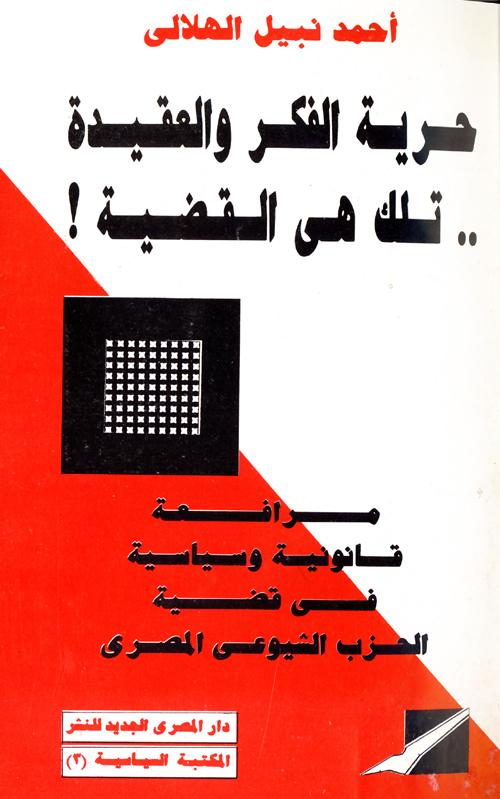

Hilali emerged from prison in 1964 as one of the few who opposed the disbanding of the Egyptian Communist Party and co-optation of its members into the state’s well-funded cultural organs. He then embarked on the career for which he would become a legend, defending all prisoners of conscience regardless of political commitment, often pro bono publico. He defended Communists in 1977, poet Ahmad Fu’ad Nigm in 1978 (tried by a military tribunal for mocking president Sadat), the Nasserist organisation “Thawrat Misr” in 1986, striking railway workers in 1987, Islamist radicals throughout the 1980s and 1990s, and freedom of expression cases such as Shohdy Naguib Sorour’s and the Revolutionary Socialists. He was a fixture of bar association politics, from the 1970s when he was elected to the board to the ideologically polarised 1980s, government receivership in the 1990s, and return to elections in 2001 and 2005.

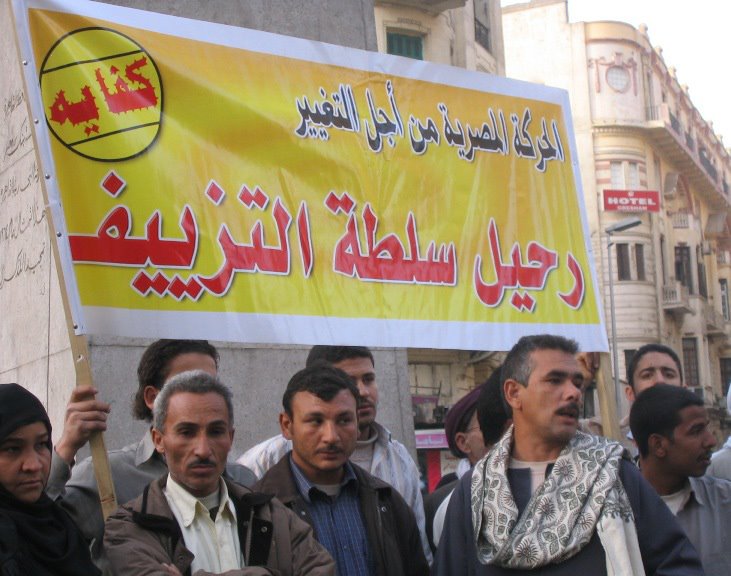
He crossed paths with student leader Ahmed Abdalla many times, first as an attorney for the students in 1972 (he was briefly detained and charged with inciting them to subversion), then during the growth of the human rights movement in the 1980s and early 1990s (Hilali received the Egyptian Organisation for Human Rights’ award in 1991), then the formation of Kifaya in July-August 2004, then during Abdalla’s bid for parliamentary elections in autumn 2005, where Hilali was one of the featured speakers at a campaign event. To me, both men embodied an exceedingly rare and even maligned trait in these times of “pragmatism”: they were faithful, stubborn believers in the consequences of seemingly quixotic acts. They had a remarkable patience and long term vision, and I doubt they even understood (much less cared about) the word “setback.” They knew that the struggle for a democratic Egypt began before their lifetimes and would continue long after they exited from the scene.

I want to emphasize two of Hilali’s most quixotic endeavours, which in my mind are also his most significant legacies for the Egyptian struggle for democracy. He was a staunch believer in the possibility and efficacy of opposition coordination, and he had a visionary sense of the politically creative impact of law. Both may seem very quaint but ineffectual tools with which to resist an overwhelming police state. Here’s why they’re not.

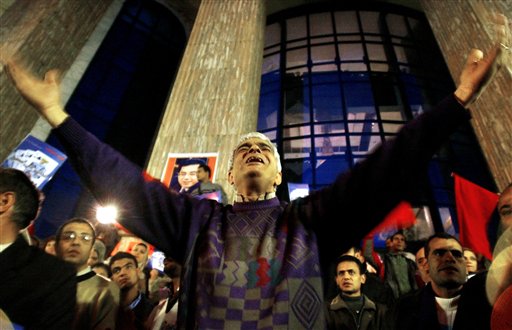
Hilali was an extremely persistent and lucid exponent of a coordinated opposition front to advance democratic gains. He was neither the first nor the only propagator of such an idea, but I daresay he was its most sincere, articulate, and credible defender on the left. In 1992, he wrote a series of elegant pieces elaborating on the necessity of strategic, not merely tactical, coordination between Islamist factions and leftist factions, each holding fast to their ideological non-negotiables, yet making room for concerted action to challenge the Mubarak regime. It matters little that such mobilisation has rarely materialised, or that when it has it was unable to reach large swaths of the public. Given how brutally and swiftly Mubarak’s regime has repressed members of nearly every opposition sector, during electoral and non-electoral junctures, it is not difficult to imagine the magnitude of the threat posed by a coordinated opposition effort. Nabil al-Hilali knew that and harped on this same point year after year, not least this ringing
democratic manifesto and anti-tawrith declaration in 2003.

Similarly, Hilali’s deep knowledge of the law enabled him to see opportunities where others saw nothing. His courtroom work was not simply a principled stand for rights, but an appeal to one of the few viable public institutions left in Egypt. Hilali understood that the judiciary had the capacity and will to produce autonomous rulings, that even if unimplemented, such rulings constituted a potent weapon in the struggle for rights, and that the majority of judges relished a masterful oral argument. His closely argued briefs were thus models of erudition, combining dense facts on the suspect sources of Egyptian penal provisions, quotations from parliamentary proceedings, comparative insights drawn from American and French jurisprudence, and evocative trimmings such as quotes from Turkish poet Nizam Hikmet.
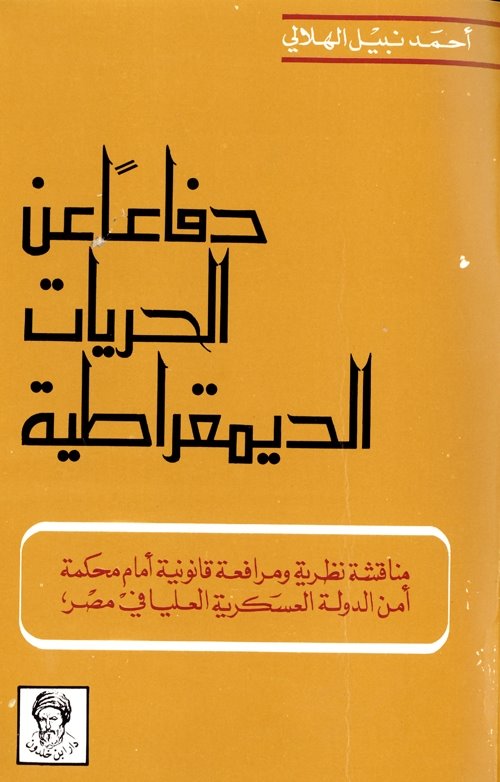
Hilali was known to go on at considerable length in his oral arguments, only to be invited to continue by the bench. By banking on the partial autonomy of the Egyptian judiciary and the professional spirit of individual judges, Hilali helped to wrest many small legal victories that are more than the sum of their parts. Well before domestic and international pundits
discovered Egyptian judges, Nabil al-Hilali knew that they were an effective crutch in the struggle for rights, and perhaps even envisioned that they would be at the frontlines as they are today.


Coda


Nabil al-Hilali always politely but firmly refused to let me profile him, partly as a matter of principle and partly because he never sat still, moving from one courtroom and niyaba office to another by day, then attending political meetings and salons in the evenings. Once, when I failed to get a hold of him after seven straight days of persistence, a member of his office staff advised me, “Look, the best way is to come here and wait at the office and then ambush the adversary the minute he walks in! But don’t you dare tell him I told you that!”

I didn’t give up on trying to interview al-Hilali, and began composing an oral argument in my head that I planned to deliver to him on why he should give me the time of day. But he passed before I could execute my brilliant plan. Now I will never get to ask him about this or that law, opaque clause, mystifying procedure, or specific case. I’ll never have the privilege of listening to him reflect on the unexpected power of law in a repressive, undemocratic state. I won’t have the chance to goad him to share some of his rich memories, or elaborate on his vision of a united front for democracy. Most of all, I won’t be able to simply be in the presence of his boundless energy and love for his metier, and his endearing and disarmingly genuine modesty.

Once, walking down the sooty, congested Sharia al-Gala’ on an early afternoon, I ran into Nabil al-Hilali on his way to the courthouse. He shook my hand firmly and gave me a courtly bow and a wide smile, then continued walking purposively and in big strides, large legal briefcase in hand. I stood watching his determined frame recede into the crowds. And that is how I shall always remember him.


Thursday, June 08, 2006

A Man Apart

I can’t believe that the extraordinarily sprightly and kindhearted Ahmed Abdalla is no longer with us on this earth. He passed away earlier this week, and his funeral procession from Sayyeda Nafisa mosque took place yesterday afternoon. Thus departs a great Egyptian patriot, citizen-scholar, and man of commitment, leaving behind much grief and a yawning sense of loss.

Ahmed Abdalla Rozza was born on 15 January, 1950 to a working class family in Ain al-Sira, the Masr al-Qadeema neighbourhood to which he remained wedded throughout his life, save for the decade of 1974-1984 when he was working on his doctoral thesis in England. He was the most prominent leader of the student activist wave of 1972-1973, and went on to forge a productive career as both an astute political analyst and an uncompromising independent activist. He had a mirthful, loquacious manner and spoke Arabic, English, and French beautifully. Above all, he was that exceedingly rare specimen of intellectual who neither disdains nor romanticises ordinary people. Instead, he lived among them, understood them, loved them, shared their burdens, and did his utmost to alleviate them.


“A Dynamic Element”


Ahmed Abdalla attained national prominence when he was only 22 years old, in his final year at the Cairo University Faculty of Economics and Political Science. On 13 January, 1972, Anwar Sadat delivered what soon became a notorious address in which he claimed that the outbreak of the Indo-Pakistan war prevented him from delivering on his promise that 1971 would be a “decisive year,” meaning the year when troops would liberate Egyptian territory seized by Israel in the 1967 war. Memorably, Sadat attributed his inaction to “the fog” created by the South Asian war.

The speech outraged college students and spurred them to action. They joined several existing groups into the umbrella Higher National Committee for Cairo University Students (HNCCUS), and Ahmed Abdalla was elected president. For one year, HNCCUS became easily the most vital popular organisation in Egypt, a vehicle through which students negotiated directly not simply with top university administrators but the highest officials of state, from ministers to parliamentarians to the president himself via a slew of emissaries. Buoyed by the first, intense wave of student and labour activism of February 1968, and a new regime still finding its bearings, students literally became a vanguard social movement, exerting real pressure on the regime to act on the two cardinal issues of occupied territory and democratisation.

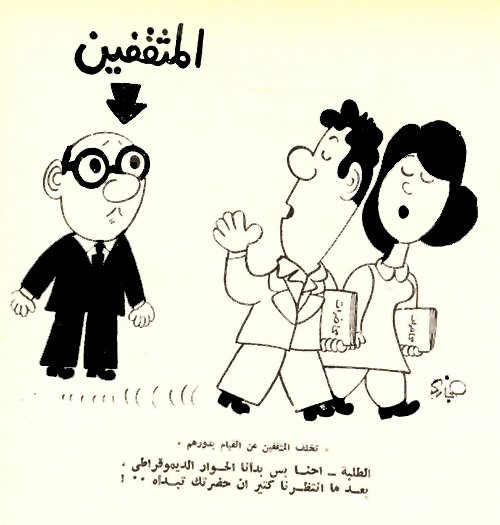
These extraordinarily young and extraordinarily articulate students went head to head with very powerful people, upstaging intellectual elites with pretensions to societal leadership (see Higazy cartoon, top, Rose al-Yusuf, 21 February 1972). For a little over a week, students and state elites engaged in intricate bargaining sessions, including a heated debate between parliamentary deputies and a 200-strong student delegation inside the parliament building. Students escalated their activism, inaugurating a sit-in at Cairo and Ain Shams universities. The state then took off the velvet gloves. At dawn on 24 January, the Interior Minister gave the order for security forces to storm the university and arrest students sitting in Nasser Hall. Hearing of the capture of their colleagues, the thousands of college students coming for classes that morning flocked to Tahrir Square and staged a sit-in there, where they were well-supplied with food and blankets by sympathetic onlookers and citizens. Recalling these events, I can’t resist noting the parallel with the outpouring of popular support for today’s vanguard social sector.

Abdalla was arrested and appeared before a university disciplinary board, which released him with a warning. He responded by intensifying his activism for the rest of 1972-1973. At that moment in Egyptian history, university campuses were humming dens of collective action and consciousness-raising, featuring creative and feisty wall magazines (the grandparents of the contemporary political blog), endless debates and meetings, a steady stream of pamphlets and communiqués, and the formation of bonds with social institutions beyond the university gates.

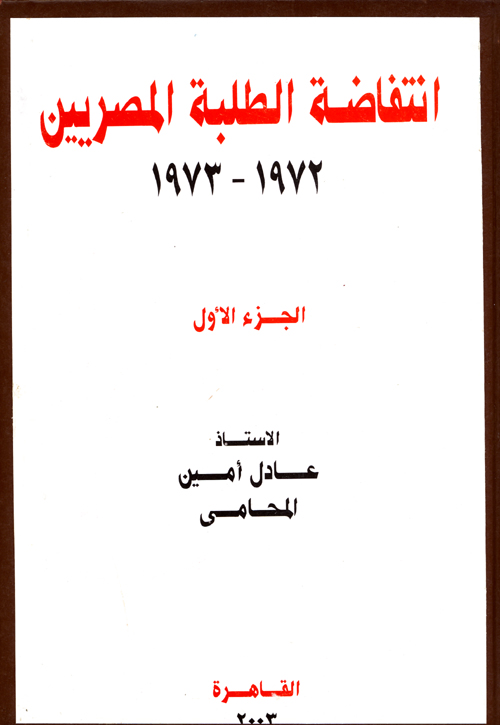
Authorities studiously recorded and pored over the contents of Abdalla’s personal wall magazine, The Rough Copy (al-Muswadda), as is evident by lawyer Adel Amin’s valuable compilation of State Security documents on student activism during 1972-73 in his book, The Egyptian Students' Intifada (2003, right). Here is a December 1972 assessment by State Security Intelligence of the intrepid, outspoken, and dangerous Ahmed Abdalla:

“This student was one of the leaders of the January 1972 movement...and led the call for sit-ins, strikes, and demonstrations. He was arrested with the students occupying Nasser Hall, interrogated by the prosecution, and then released. He remains at the peak of activism, a dynamic element around whom revolves the majority of resistant elements in universities. He continues to carry out his activism, establishing numerous links with these elements and writing wall magazines that attack the state and political leadership and some Arab states and their regimes. The aforementioned and his supporters also seek to unify the student movement in the different universities and to extend its activism to other mass sectors, especially the professional unions. He is also active in the conferences convened at the Economics faculties and other university faculties and had the leading role in designing and steering these conferences. He and his group focus on recruiting first-year students in the Economics faculty, considering them a new asset that must be won over to their side.”

The final crackdown on the student movement came in June 1973, when the chief State Security Prosecutor placed Abdalla first on a list of 56 defendants referred to trial, charged with a slew of the familiar crimes that have long ensnared Egypt’s past and present honourable activists: spreading rumours and false information, repeating seditious slogans, engaging in criminal conspiracy, and inciting assembly, demonstrations, and (my favourite) resisting the authorities. The list included luminaries such as Kifaya leader Ahmed Bahaeddin Sha’ban, rights lawyer Ahmed Seif al-Islam Abdel Fattah, writer and critic Safinaz Kazem, the people’s bard Ahmad Fu’ad Nigm, journalist Hani Shukrallah, and the late Arwa Saleh.

But then the judiciary stepped in. In the summer of 1973, judges ordered many defendants released on bail while awaiting trial, and upheld those decisions despite the president’s angry appeals. As Abdalla recounts in his doctoral dissertation-turned-book, The Student Movement and National Politics in Egypt, 1923-1973 (London: al-Saqi, 1985), “when the core of student activists was finally brought to trial, the chief justice who was to try the first group of defendants opened the proceedings with a speech assuring his defendants of the court’s impartiality and even of its patriotism.” In the lead-up to the October 1973 war, Sadat ordered a halt to all student trials and released all detainees.


Scholarship, Activism, Advocacy


Ahmed Abdalla opted to write his doctoral thesis at Cambridge on students and politics in Egypt, and its book form remains the single most valuable English-language contribution to the topic, second to none. It is a scholarly, historical oeuvre written in a staid, analytical style, with significant bits of auto-critique and reflection, scrupulous documentation, and many gems buried in the footnotes. There is no awkward tension between the scholar and the activist, no grand unsubstantiated claims, no self-exoneration, and—-just as important-—no irritating and pointless second-guessing or hand wringing.

Throughout his life, Abdalla miraculously and effortlessly merged analytical scepticism with ideological commitment. For me, he is a model of a thinker who had no truck with the fiction of objectivity, yet never allowed his political passions to blunt his analytical judgement. His example even suggests that—gasp!—each faculty can actually enrich the other. After his return to Egypt in 1984, he joined his erstwhile comrades in the burgeoning human rights movement, not because he harboured any illusions about the transformative potential of such an undertaking, but rather because he viewed it as a promising vehicle to forward democratic demand-making.

For Abdalla, human rights activism was not an ethical project devoid of politics (à la the professional human rights salariat), nor a lucrative cottage industry driven by personal entrepreneurship (à la perpetual cynics), nor a sinister foreign design (à la nationalists), but a deeply political undertaking that would further a modest yet highly significant goal. “The human rights movement is a political movement par excellence, and it should courageously present itself as such,” he wrote. “It should advertise itself as the largest reservoir of consensus politics.”

The language of human rights would be creatively deployed to transcend the historical animosities bedevilling Egypt’s opposition groups, perhaps even pave the way for some form of collective action between them. Though he retained the Egyptian left’s signature suspicion of Islamists, Abdalla thankfully steered clear from the vile stance of individuals like Rif’at al-Said, a putative leftist who takes great pleasure in collaborating with the authoritarian regime to repress and do violence to Islamists. However, by the mid-1990s, Abdalla’s take on human rights activism grew
dimmer, after the groups’ decision to accept foreign funding brought in powerful international institutions with their own agendas, agendas that were far removed from helping Egypt’s opposition groups overcome their collective action problems.

If activism and analysis coexisted in Ahmed Abdalla, so did advocacy and analysis. One of his most abiding concerns was the respectful, dignified depiction and treatment of ordinary people too marginalised to represent themselves, and too powerless to “talk back” to those who represent them. His first book is memorably dedicated to the denizens of his native Ain al-Sira: “To the People of Masr al-Qadeema, the illiterate who gave me knowledge; the poor who enriched my conscience.” He was a truly great and noble advocate for poor Egyptians, whose stock he shared, yet he never abandoned the critical stance necessary to dissect their life conditions and give them the tools to carve out a foothold in a power structure built on their exclusion.

Advocacy mixed with analysis was the driving force behind Abdalla’s energetic bid for parliament in the
2005 elections, and his years long focus on the vexing condition of child labour. Eschewing both the easy, moralising condemnation of the practice and indifference to it as yet another “social problem,” Ahmed Abdalla made the difficult choice of actually doing something about it. He established the Jeel Centre for Youth and Social Studies, both a research and information centre and an actual space where working children convened each week to, simply, live their childhood. They drew artwork, made puppets, played music, had a meal, and subjected their bodies to physical activity of a different order than the gruelling labour that marked the rest of their week. It was a place unlike any that I’ve ever been in, where the concrete reality of child exploitation coexisted with an utterly charmed environment full of laughter, love, and an aura of being blessed.


A Personal Note


I don’t remember the first time I met Dr. Ahmed, but I always remember his uproarious laugh and his moments of quiet, conversational reflection. He had a charming ability to be both hilariously funny and dead serious in one breath, and a devilish knack for teasing that apparently found in me an irresistible target! I do remember the last time I saw him; it was at the Shaykh Yassin concert in Ramadan outside Bayt al-Harrawi in 2000. It felt like spotting a loveable celebrity. We waved and smiled across the giddy crowd, in the moments of anticipation right before Yassin began to chant.

When I remember Dr. Ahmed, I always see him sitting in animated, relaxed conversation around a table on the scraggly lawn outside Markaz al-Jeel one friday, as the children played all around us and the setting sun turned a fiery orange. Dr. Ahmed’s maternal older sister was busy making sure that every child had eaten his koshari and cucumber; she was a woman of few words and enormous kindness whose death took a serious emotional toll on her younger brother. The day that I visited the Centre, I met a boy named Gharib, who worked in the tanneries. He held on to my hand tightly for the whole five hours I was there, leaving me only to take part in the karate lesson, but not before making me promise to sit and watch him kick. Dr. Ahmed kept playfully chiding him to leave me alone for a while and go eat his koshari, but Gharib only lowered his huge eyes bashfully and smiled.

Under a drooping tree branch we all sat, savouring the final hours of a purgative day.


Friday, May 26, 2006

Prisoners of Conscience

Thursday’s marking of referendum day 2005 unfolded as planned, with relatively less state violence directed at peaceful protestors, compared to the past month of brutal repression. Judges were able to stage their silent stand on the High Court steps after all, when court custodians relented and security forces backed off from occupying the building.

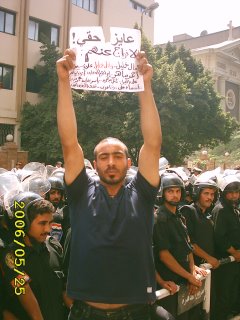
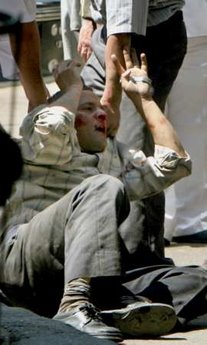
A solid month of solidarity demonstrations with judges has left hundreds of peaceful activists detained, in conditions that are a clear violation of international standards of pre-trial detention. Almost all of them have experienced mistreatment, and some of them such as Muhammad al-Sharqawi (right) have been subjected to torture and sexual abuse (read his testimony here).

The focus now is on releasing all detainees, regardless of their political beliefs. Naturally, Kifaya, the socialists, and the Ikhwan emphasise the plight of their own. But we should remember that all of them are paying an equally steep price. All of them are fighting for our citizenship rights. And all of them are worthy of maximum respect, admiration, and gratitude.

Their political beliefs are immaterial. Their immediate release is imperative.


*Photos from AP, Wa7damasrya, Manalaa.

Pictured top: Kamal Khalil (2005) and Essam al-Eryan (1995).

Thursday, May 18, 2006

Are Judges Heroes?

First things first. Thankfully, Justice Hisham al-Bastawisi is in stable condition after suffering a heart attack early Wednesday morning (pictured left, 17 March 2006). He’s scheduled to leave the hospital in a few days for a much-needed period of recuperation. Hisham al-Bastawisy is not just a frontline leader of the judicial independence movement and a tough-as-nails man of principle. He’s also a very generous, kind man and a model of an upstanding Egyptian professional. The news of his affliction was devastating, so thank God he’s now doing well. I’d like to extend my heartfelt wishes for a speedy recovery to Justice Bastawisy and his family, especially his wonderful, brave sons.

Next, in a verdict that defied many breathless expectations of dismissal, the disciplinary tribunal absolved Mahmoud Mekky (right, centre) of all charges and censured Bastawisy, as per Article 108 of the existing judiciary law. Two points bear emphasis. First, the law actually does not specify acquittal as a possible outcome of disciplinary proceedings, only dismissal or censure (Article 104, 108). Bizarrely, then, acquitting Mekky actually goes against the letter of the law. Second, the punishment of censure carries no professional or personal repercussions, especially for a senior judge at the very top of the judicial hierarchy such as Bastawisy. It is nothing more than a form of moral blame that, under the blatantly politicised circumstances of the original referral to the tribunal, carries no weight whatsoever (AFP Photo).


Ironically, then, the verdict reinforces both the shortcomings of the existing law and its obvious manipulation by pro-regime judges to silence and discredit their outspoken colleagues working for real judicial independence. There is no clear legal rationale for acquitting Mekky while censuring Bastawisi, lending credence to claims that this is a face-saving manoeuvre by disciplinary tribunal head Fathi Khalifa, perhaps in response to pressures from on high.

Though the verdict is not subject to any form of appeal (a major failing of the current law (Article 107) that the Judges Club has long sought to rectify), it was immediately interpreted as a retreat by the government and a respectable victory for the judges. For reasons I cannot fathom, and with not a shred of credible evidence, rumours had been flying about that the leadership of the Judges Club would accept some sort of a “deal” with the powers that be. I won’t devote any time to such ignorant tongue-wagging, except to note the extraordinary levels of misinformation, hyperbole, and ceaseless second-guessing about all matters judicial these days. The Judges Club did not strike a deal, but managed the crisis with admirable poise and resolve, and did not give in to myriad pressures, rumours, and all the rest. It has now called off the judges’ sit-in held since 18 April in solidarity with Mekky and Bastawisi.


Once again, uniformed and plainclothed police agents used much violence against peaceful demonstrators expressing their solidarity with judges and with Ayman Nour, whose appeal was rejected today by a circuit of the Court of Cassation, to the shock and dismay of many, though I’d like to reserve judgment until I read the actual court ruling. In a laughable statement issued early this week, the Interior Ministry had attempted to portray its violence against citizens as perfectly legal. Several hundred demonstrators from the Ikhwan and Kifaya were arrested yesterday, adding to the earlier waves of arrests over the past month, all of them peaceful people expressing their solidarity with judges. (Reuters Photo).

Perhaps it’s worth pausing here and reflecting on one year of consistent and highly unusual public visibility for judges since the April 2005 general assembly of the Alexandria Judges Club. Judges’ quiet, ceaseless, years-long struggle for autonomy and full electoral supervision has now become a national and even international obsession, carrying in its wake intense attention and potentially negative repercussions that I flagged back in December. Judges never set out to be heroes, saviours, rebels or any of the other ridiculous adjectives coined for them by international observers for whom it's suddenly fashionable to praise Egyptian judges.

When judges repeatedly say that they only want their independence, this is not some coy demurral or false modesty, but a reasoned recognition of the risks of public adulation. On the one hand, judges thrive on and appreciate the extraordinarily intense public support for their goals. On the other, there are real concerns about the harmful professional effects of the growing bonds between judges and public. Judges not only do not seek but actually frown upon any form of public approbation of their rulings or persons, rightly fearing any dilution of their impartiality. This strange predicament is made all the more acute by the vexing issue of electoral supervision. Let’s remember that the reason we’re seeing judges at the centre of politics today is because of their constitutionally-stipulated role of electoral oversight.

Every time an election rolls around, judges find themselves wrested from their courtrooms and entrusted with ensuring the integrity of elections in a country with a rich history of electoral fraud. A young judge gives voice to the dilemma: “As a judge, of course I don’t want to be involved in elections, it’s not my purview. But as a citizen, I know that the judiciary is the only institution capable of standing up to the police and making sure elections are clean.”

Why and how judges came to be election trustees in the first place is a story for another day. But now they have made it their mission to fully supervise each and every election that takes place in the country. This is bound to put them on a collision course with a regime not content to manipulate simply parliamentary and now presidential elections, but has its grubby paws in every other internal electoral exercise of any social institution, from sports clubs to labour unions to professional associations to student unions to whatever is left of public sector companies.

Under these conditions of a repressive regime unable to extinguish the fact of elections yet still able to fix them, it makes sense that a tacit alliance develops between citizen voters and the judges entrusted with monitoring the polls. Just as citizens have been manifesting their solidarity with judges, so is the leadership of the Judges Club now deliberating on working to release all those detained by the police over the past month for their support of Mekky and Bastawisy. But there is a different between a strategic alliance for a focused goal, and an easy but harmful deification of judges.

Expecting judges to be the heroes and saviours of Egypt is expecting far too much. It is true that the country is desperately in need of inspiring leaders and symbols. It is true that judges cut intriguing and honourable figures. And it is true that judges have always been held in high esteem and even awe by almost all sectors of Egyptian society. But these are no reasons to have judges replace elected officials as national leaders. In my opinion, effectively supporting judges means backing their demand for a new judiciary law, and backing their mission to meaningfully supervise elections so that we can get the clean and capable leaders we deserve. And then so we can throw them out when they don’t deliver. (17 March, 2006).

It goes without saying that this is a protracted battle that has been ongoing for decades and will continue for several more. But the battle is not forwarded by treating judges as infallible Olympian beings who will rid the country of all that ails it. It does no good to sensationalise their plight and trip over ourselves coining terms such as “rebel judges” and a “judicial intifada” and all the other breathless assertions. As a citizen, I instinctively love the now-famous slogan “Judges, judges, deliver us from the tyrants!” that is a staple at every solidarity demonstration. But as a professional and an analyst, I cannot succumb to the fantasy that judges are the deus ex machina that will realise democracy, restore justice, and make life wonderful. Judges are already grappling with tremendous stresses. It’s highly unfair to saddle them with the hopes of a nation.

Thursday, May 11, 2006

Regime, Judges, and Public: Take Five

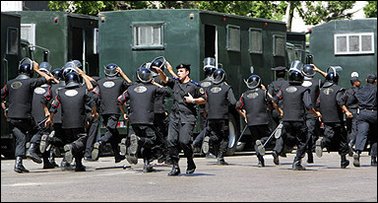
“The streets of downtown looked as if a foreign country had declared war on Egypt,” quipped a judge. Indeed, Thursday 11 May was even more brutal than Thursday, 27 April, as security forces deployed maximum and indiscriminate force to sunder the growing bonds between judges and public.

While the head of state was busy surveying Pharaonic artefacts in Berlin, security forces in Cairo were busy quashing peaceful demonstrators showing their support for judges.


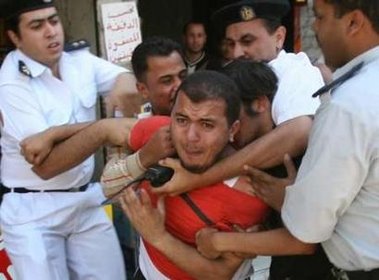
Journalists were not exempt from police brutality; al-Jazeera’s camera and sound crew and Associated Press reporter Nadia Abou El-Magd were roughed up by both uniformed and plainclothes police agents.


And as per usual in the last few years, police officers did not exempt women from their violence. Kifaya has this harrowing account of what happened to al-Destour journalist Abir al-‘Askari, no stranger to police terror. She was one of the many women assaulted on referendum day, 25 May 2005.

Lives were lost yesterday. On its way to reinforce the already overwhelming security presence in downtown Cairo, a truck carrying CSF recruits overturned on 6 October bridge at Abbasiyya, killing 8-10 conscripts (reports vary) and injuring 20.

Unlike 27 April, security forces occupied the inside of the High Court building and obstructed even workaday judges from reaching their courtrooms to adjudicate among ordinary litigants. On the orders of disciplinary tribunal head and Cassation Court president Fathi Khalifa, none but the two accused judges and seven members of their defence team were allowed entry into the courthouse. As Cassation Court justice and head of the defence committee Hossam al-Ghiryani went inside to negotiate with Khalifa, about 400 judges attending with accused judges Mekky and Bastawisi waited outside, rigorously separated from members of the public by elaborate phalanxes of CSF recruits.

Khalifa refused to budge and the judges refused to comply. The hearing was adjourned yet again to 18 May. Judges returned to their Club for further deliberation, which culminated in a resolution to continue the weeks-long sit-in that has so perturbed the Mubarak regime. Two proposals were also floated: boycotting the hearing on 18 May until Fathi Khalifa recuses himself from the disciplinary board, and a more compromise proposal to attend but only under the condition that security forces evacuate from the courthouse.

What is happening in Egypt today has caught the men of the regime off guard. They never anticipated the resolve of judges to follow through on their mission of ensuring clean elections. They never anticipated the persistence and depth of popular support for the judges. And they never imagined that indiscriminate and brute force would only reinforce the resolve of both judges and activist segments of the public. Most of all, they never thought that election-time mobilisation would continue well after elections were over.

Sometimes, it is the simple but fatal mistake of miscalculation that is the undoing of the high and mighty.


*Photos from AP, Reuters, AFP.

Wednesday, May 10, 2006

مدد

Yet another significant day dawns, as judges Mahmoud Mekky and Hisham al-Bastawisy prepare to reappear before the disciplinary board entrusted with reviewing their “competence” to hold their judicial posts. They may very well be dismissed, censured, or the hearing adjourned yet again.

There’s also the slight possibility that the ministerial order referring them to the board will be voided, in exchange for judges disbanding their weeks-long sit-in at the Judges Club. A farrago of government emissaries to the Club and to disciplinary board president Fathi Khalifa have been attempting to broker just such a deal, but it appears that all negotiations have reached an impasse.

Meanwhile, in what may very well be a first, sitting Egyptians judges have penned an opinion piece in a major foreign newspaper. Mekky and Bastawisi wrote this article in the British Guardian outlining their views, thus considerably widening the audience for this remarkable drama. Particularly notable are the two judges’ firm avowals of self-reliance in their battle for autonomy. As is to be expected, powerful third parties are now intensely interested in what used to be the marginal and rarefied affair of Egyptian judicial independence, viz. American and European governments. I read Mekky and Bastawisi’s concluding statement as a clear signal that they will have no truck with attempts to appropriate their struggle by those who have their own agendas: “In Egypt we don’t have any confidence in US policy because it is a contradictory policy that pays lip service to democracy while supporting dictatorships. We have confidence in the Egyptian people. We welcome support from any quarter, but we won’t rely on it. We will depend on ourselves in our campaign for reform and change.”

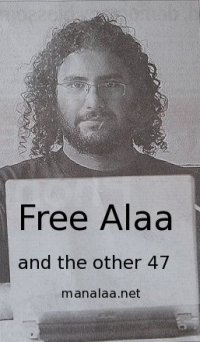
Organised elements of the Egyptian public continue to declare their solidarity with judges. There are now some 100 activists of all political persuasions being detained for their unceasing support of the judges, among them three women activists (Nada al-Qassas, Asma’ Ali, Rasha ‘Azab), feisty bloggers-demonstrators Alaa Abdel Fattah, Malek Mustafa, and Muhammad al-Sharqawi, veteran demonstrator Kamal Khalil, journalists Ibrahim al-Sahari and Saher Gad, and some 50 members of the Muslim Brothers.

A medley of “Egyptian National Forces” have signed a short statement calling for the release of all detainees and reaffirming solidarity with judges. The signatories are Kifaya, the Nasserist Party, the Communist Party, Freedom Now, the Muslim Brothers, the 9 March movement for university’s independence, Writers and Artists for Change, The Street is Ours, Journalists for Change, the Egyptian Socialist Party, the Tagammu’ Party, the Socialist People’s Party, the Labour Party, the Ghad Party, the Karama Party, Youth for Change, the Revolutionary Socialists Organisation, the Pharmacists’ and Physicians Syndicates.

The date and time: 11 May, 10 am

The place: High Court building

The slogan: Yes to judicial independence, no to tyranny and to the state of emergency, long live the Egyptian national movement.

*AP Photo, April 27, 2006.

Monday, May 01, 2006

Mubarak: Fin du Régime?

Forecasts of a fin de siècle fill the air, alternately breathless and reasoned. They point to the swiftly cascading natural and man-made disasters, terrorist bombings, political movement (hirak siyasi), recurring sectarian conflict, and economic malaise, all mingling in a portentous brew. Murmurs abound that Mubarak’s regime is in its final throes, that delaying local elections, swiftly renewing emergency law, and repeatedly cracking down on protest are signs of the beginning of the end. Predictably, current events are compared to the combustible final years of Anwar al-Sadat’s tenure, when the tussle between an increasingly irrational president and an angry, organised society ended so abruptly, violently, and dramatically.

There is an equally compelling though less ambient view that such predictions are facile and rather foolish. How can anyone really predict anything as complex as regime change? And even if change occurs, there’s no way to determine precisely why it happened, leaving the field wide open for every disingenuous two-bit pundit to retrospectively pronounce that he/she guessed it all along. Above all, there’s no inevitable connection between one or a few social crises and a fin du régime. Regimes have imploded in the absence of major crises or societal discontent, and regimes have survived despite multiplying crises and intense discontent. Hosni Mubarak’s regime has been dogged by crises and intensifying street protest since at least 2000, yet it totters on.


Déja Vù

I remember the same feeling of an untenable status quo on the verge of explosion. It was in spring 2003. As the American invasion of Iraq was imminent, the government speedily secured the renewal of emergency law. Massive anti-war protests then shook the country, and biting anti-Mubarak slogans electrified the streets. Security forces viciously beat protestors and threatened the women among them with rape; two opposition parliamentarians were savagely attacked by hired thugs; Hosni Mubarak’s obscenely huge visage was torn off the NDP headquarters, and Gamal Mubarak “led” a hastily organised government anti-war protest in Cairo stadium, flanked by the bankrupt and sycophantic Adel Imam and the erstwhile powerbroker Kamal al-Shazli (those were the good old days, Kimo. How cruel are the times).

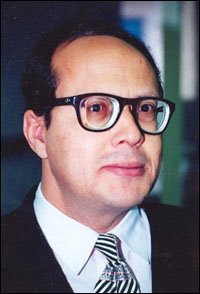
Back then, Abdel Halim Qandil (right) and Abdellah al-Sennawi took turns savaging the regime, and with considerable rhetorical force, too. It was difficult to resist their weekly forecasts of impending doom, of a spent regime devoid of any ounce of legitimacy, stupidly hastening its own ignominious demise. When several presidential emissaries failed to tame the intrepid duo, Qandil was plucked from his Cairo street in the dead of night and stuffed into a speeding car by four massive individuals in suits. They savagely beat him, demanded that he stop writing about “the big people,” stripped him of all his clothes, and left him to die on a deserted highway on that frigid November night. Of course, this only widened his popularity and fortified his resolve, earning him the respect he deserves. As for Sennawi, he continues to tirelessly deliver weekly auguries of regime downfall, apparently untroubled by plenty of evidence to the contrary.


Old but Sturdy?


If Mubarak and his retinue survived the upheavals of 2003, which were arguably the gravest challenge to their rule, then why shouldn’t they be able to muddle through the current difficulties? The regime is still intact, internal fissures exist but are manageable, and there have been no spectacular defections of any key pro-regime figures or blocs. The ministers are all siphoning off our public funds and tying up traffic as usual, governors are slavishly doing their jobs as glorified security personnel, and NDP independents are kept in line and are only really troublesome during elections.

The ballyhooed “reformists” surrounding Gamal Mubarak are busy walking their delicate tightrope of just the right amount of loyalty coupled with a healthy helping of, shall we say….flexibility. The hubbub manufactured by the unctuous Osama Ghazali Harb a few months back was an amusing but essentially harmless little sideshow. Much as he clambered to claw his way into the inner circle, Harb was never more than a pathetic, marginal hanger-on, perpetually pleading and grovelling at the gates, only to be unceremoniously rebuffed every time. So he finally grew tired and embarked on his latest project of reinvention. Mr Harb is apparently contemplating founding a “liberal” political party with other “respectable” social personages.


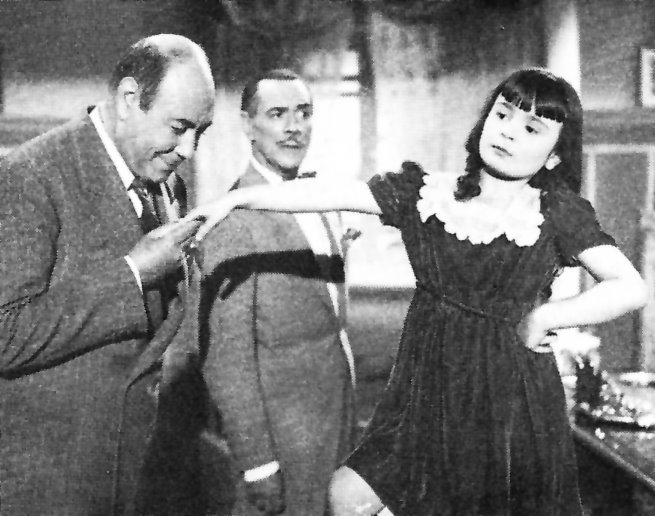
As the truly great Stefan Rosti (centre) used to say, “diabolical!” (gahannami!).

If the commanding heights of repressive rule are holding together, so seem to be the nuts and bolts. The enforcers of repression continue to follow orders and to smash dissidents. Everyone from governors to security directors at the top to police chiefs, officers, and simple recruits at the bottom are doing their bit (if not more) to run the coercion machine. If anything, it seems as if the new Cairo security chief, Ismail al-Shaer, is even more ruthless than his predecessor Nabil al-Ezabi, who’s moved on to greener pastures. For his efforts in policing the numerous contentious episodes of 2005, Ezabi has been rewarded with a big, fat governorship (mabrouk ya siyadat al-liwa).

For the regime to end, state security personnel must splinter and some then join the reform movement, even if secretly à la Ukraine. At the very least, a critical mass must shirk their duties and withhold their cooperation. Everyone was excited by the 1986 CSF mutiny precisely because it seemed as if the agents of repression were turning on their masters, at a time when other social forces (particularly labour) were also rebelling. But the formidable capacities of the Egyptian state effectively contained that brief upsurge, and draconian new control mechanisms were instated to prevent any second acts. If the sinews of state control remain intact and loyal to the regime, it’s difficult to imagine how the latter can be dislodged.

Much has been made of the security forces’ crushing of protestors over the past few days, and at least one person has written that the culture of police brutality and impunity is itself a portent of impending chaos. However, aside from the one incident of the police beating of judge Mahmoud Hamza on 24 April, recent police brutality is nothing new. Has some invisible threshold been crossed?

What of the most inscrutable institution in Egyptian politics? There’s a lot of talk about what the military will and won’t do in X, Y, or Z event, but frankly, I don’t know how anyone can credibly claim to know anything about the potential behaviour of this institution. I don’t care how many “Western diplomats” are anonymously quoted in foreign news accounts pontificating on this matter. Nor how many informal conversations were had with “top-ranking generals” while strolling on the beach at Marina (or is it Ain al-Sukhna?). Or any of the other laughable gossip and tall tales that enliven the cocktail party functions of the foreign and local blathering classes. Some Nasserists seem to think that the valiant military will step in at just the right moment to prevent a handover of power to Gamal or to save Egypt from other nightmarish prospects. I beg to differ. If this logic holds, the military would have stepped in a long long time ago, mesh keda walla eih?

The most intriguing thesis I’ve heard (and wish I could claim credit for) is that the military no longer acts as a coherent, corporate entity. Since the Abu Ghazala affair, Hosni Mubarak has ironically presided over the comprehensive depoliticisation of the Egyptian military. Although he does not explicitly make this argument, the most astute and respected scholar of Egyptian organisations had this suggestive yet still crucial information to share on current military practices, facts that have gone strangely undiscussed. Anyone who claims that the military can still act as the final arbiter and guardian of the republic must contend with both severe lack of information and internal organisational practices that suggest quite the opposite.


The End Draws Nigh?


If there are very good reasons to doubt forecasts of imminent regime demise, there are equally good reasons not to uncritically accept assertions of regime “stability.” After all, no serious observer can dismiss the significant, perhaps seismic shifts over the past few years in how the regime interacts with its domestic and international interlocutors. A regime that was able to effectively quell a militant Islamist insurgency from 1992-1997 now seems unable to manage peaceful voters, peaceful judges, and peaceful street demonstrations.

A regime that convinced the country and the world that it was waging a brutal but necessary campaign to rid Egypt of terrorism now cannot muster a single convincing explanation for any of its increasingly irrational and often hysterical actions. In September 1999, Hosni Mubarak began his fourth term with only the faintest murmurs of elite opposition, confined to closed rooms and abstruse constitutional conversations at that.

In September 2005, Hosni Mubarak was being pilloried and humiliated in public and private just as he was putting himself up for "election" (AP Photo, September 10, 2005).

The signs of decay are numerous and multiplying all around us, but in my opinion, two in particular stand out as indices of a potential cataclysmic upheaval. First is the extent to which Hosni Mubarak and especially his family have become the target of popular hatred, biting ridicule, or mild distaste (depending on who you talk to). There is no disaster, policy decision, or daily inconvenience that is not popularly believed to originate at the doorstep of the presidential residence. Whether it’s the series of tunnels and overpasses near Heliopolis and Madinat Nasr, or the fancy, air-conditioned “capital cabs” complete with digitised meters, or the crackdown on opposition candidates and voters during elections, or the crackdown against alleged homosexuals, or the decision of the Minister of Justice to refer two senior judges to a disciplinary board, it is truly remarkable how swiftly such actions are attributed to Gamal, Alaa, and Suzanne Mubarak, by both patrician and plebeian alike.

It matters little whether these and other decisions are actually the work of the ruling family. What matters is the near-unanimous public perception, the incessant jokes, the rich rumours, and the flourishing samizdat. If Suzanne Mubarak is continuously presented to us as the First Lady of Virtue and Beneficence and her son is foisted upon us as the Visionary Young Moderniser with a Heart of Gold, is it any wonder that Egyptians believe the president’s family runs the country? Add to this additional tangible facts such as the yawning succession vacuum, the marriage between business and power (of which the ruling family is a neat exemplar), and the never-missed opportunities to exploit and insult Egyptians.

I cannot contain my outrage at this last trait. When the ferry sank and the Dahab bombings happened, the state-owned media made sure to highlight that Gamal bey’s “Policies Secretariat” observed a moment of silence for the ferry victims, and Suzanne Mubarak oh-so-graciously cancelled her trip to a “businesswomen’s conference” in Turkey so she could visit the Dahab injured. Does this not reveal an extraordinary level of indifference to the loss of human life and to the grief of family members? (Family members of ferry victims, Cairo, March 13, 2006).

If the ruling family is increasingly viewed as the problem, an unlikely sector is increasingly viewed as the solution. The second sign of regime decay is the Mubarak regime’s unexpectedly drawn-out and now extremely public confrontation with judges. This could have remained a contained and rather marginal intra-state affair, were it not for the highly unusual and intensifying public support of judges as the only trustworthy, inspiring, and capable force in public life. Every major pundit has written about the judges’ saga over the past two weeks. Nearly every major social group has visited the Judges Club to express solidarity for the ongoing sit-in. And as we know, the extremely brave and committed young activists who have staged their parallel sit-in supporting the judges were attacked three times by security forces and finally forcibly removed one day before Bastawisy and Mekky’s hearing.

That day was a turning point of sorts. The outpouring of public support for judges on 27 April took everyone by surprise, most of all the judges themselves. It surpassed the solidarity demonstrations of 13 May, 14 August, and 2 September 2005, and it surpassed the turnout on 17 March 2006. As a judge and member of Bastawisi and Mekky’s defence team reflected, “One amazing thing is that on our way from the Club to the courthouse and back, security failed completely and we were hugged by the masses, they knew us by name, they were singing for us, one of them kissed my hand! It was a huge day in the history of our country, I know that our days will be dearly remembered as part of our great history for years to come, thank God I was part of it no matter how small, and thank God I was on the right side.”

An intriguing proposal was floated on that day, first by Nasserist parliamentarian Hamdeen Sabahy in the library of the Cassation Court, as throngs of judges, journalists, and lawyers waited for the disciplinary board’s verdict (adjournment until 11 May). He said that if the two judges are dismissed, Egypt will have gained two candidates for president. The electrifying suggestion was met with enthusiastic applause and of course percolated to high places. The authorities are reportedly now scrambling to contain the whole matter before 11 May.

The Judges’ Club resolution after its 27 April emergency general assembly is a powerfully worded document. Its last paragraph in particular has a momentous ring to it, at least for me: “Egypt’s judges, and they represent one branch of state power, realise that the nation is the source of all powers, and that achieving security and stability has it source in the prosperity of the nation and the consent to its rulers, and that the rulers’ esteem is in responding to the desires of citizens, not in haughtiness and intransigence. There is no way of achieving security and stability in the country merely through the repression of force and the control of power. Rather, the people’s hope in justice must be preserved, as well as preserving their dignity and honour, and reviving their hope in reform, and establishing a true democratic life through fair elections and real transfer of power, and lifting all exceptional laws including ending the state of emergency, and unleashing freedom of expression, and the freedom to form parties, unions, and associations, without any restrictions, so that Egypt can regain its place among nations.”


Aporia


There are firm grounds for confidence in regime stolidity, and equally robust signs of impending implosion. Comparing current events to the twilight of Sadat’s rule or Hosni Mubarak to Romania’s Ceauşescu is good for dramatic effect, I suppose, but I wonder how those comparisons are made, and to what extent they are simply parroting a currently very trendy idea. I am also confounded by those who think that nothing has changed, who dismiss popular ferment as so much frippery that doesn’t dent the “real” sources of power, who assert that only external pressure matters.

I think only an oracle (if there are such things) can know which “path” will be trod at this “crossroads” that so many people keep announcing. If Egyptian politics have indeed arrived at a crossroads, then I’d like to savour the extraordinary uncertainties and hence possibilities that characterise such points. Unless you’re Teiresias, loud assertions about the likelihood of this or that “scenario” are rather dubious, mesh keda?

*Mahmoud Mokhtar, “Keeper of Secrets” (Katematul Asrar)

Wednesday, April 26, 2006

On the Eve of the Hearing

The incredible Wael Abbas has captured on video security forces' disbanding of the peaceful vigil in support of judges maintained by Kifaya, al-Ghad, Freedom Now, and allied civil society groups. Amid screams, sobs, and cries of "Down with Hosni Mubarak," "Down with Habib al-Adli," riot police cornered protestors as plainclothed agents removed them one by one. In a final, eerie scene, police peeled off the huge Egyptian flag that demonstrators had strung up to frame their vigil.


Among those arrested today are Kamal Khalil, journalists Ibrahim al-Sahari and Saher Gad, and blogger Malek Mostafa. These and more are in addition to the 12 protestors arrested early Monday morning and currently held in police custody for 15 days on the following charges: assembly, assaulting public functionaries, disseminating allegations that disturb public order, amd obstructing a street without permission. These are the actual charges.

Power was abruptly cut off and then eventually restored to Nadi al-Quda today, where judges are energetically planning for today's decisive events. A defense committee comprising 24 judges and headed by justice Hossam al-Ghiryani is preparing its legal arguments for the disciplinary hearing of justices Bastawisy and Mekky, due to begin at 10 in the morning. Afterwards, the Judges Club will convene an extra-ordinary general assembly.

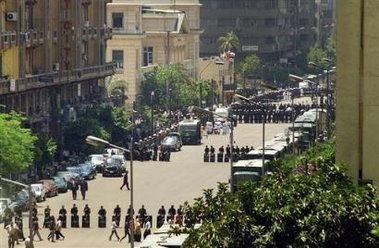
The square of downtown bordered by Abdel Khaleq Tharwat, 26th July, Ramsis, and Champollion streets, home to the Bar Association, Press Syndicate, Judges' Club, and the High Court complex, is now clogged with the trucks and personnel of the Central Security Forces. “Freedom Square,” as it’s fittingly dubbed, looks to be under siege, in an attempt by security forces to obstruct the medley of civil society protests planned for today, and importantly, to dampen turnout at the general assembly. Outrage is at an all-time high after the unprecedented beating of a judge by State Security and police agents on Monday. Judge Mahmoud Abdel Latif Hamza, president of the North Cairo Primary Court, was savagely cursed and beaten while taking photos on his mobile phone of security forces' first disbanding of civil society groups' vigil. The raid made sure to pilfer the huge signs with reformist judges' photos.

The powers-that-be are intensely perturbed by the outpouring of popular support for the judges. For the past week, the Club has welcomed an unceasing flow of supportive delegations from all over the country. Coptic dignitaries, university professors, members of parliament, the press syndicate board, and countless other citizens have walked through the Club's elegant, wrought-iron gates to express their solidarity and admiration. A young judge, overcome by emotion, tells of the endless platters of delicious, home-cooked, and artfully arranged food (and fresh-squeezed juice and desserts!), carefully packed and delivered to the Club, courtesy of dozens of anonymous Egyptian women. “I’ve grown plump,” he chuckles.

Mystery surrounds the outcome of an eleventh-hour negotiation manoeuvre by the regime. Presidential emissary Adli Hussein, a former judge and now governor of Qalyoubiyya, was dispatched to meet with the Club’s board on Sunday evening, reportedly to arrive at a truce of sorts. Yet only innuendo and rumour remain in the wake of his visit. On Monday, Hosni Mubarak was forced to publicly address the crisis with judges. In an interview with al-Gomhoriyya, he said that this was “a dispute among judges, specifically between the Judges Club and the Supreme Judicial Council, neither the government nor the state has anything at all to do with it.”


And so begins another chapter in the tale of the president, the judges, and the public.

*Hosam Gharbeia, "Hearing" (2001)


Thursday, April 20, 2006

Tribulations of Self-Determination

After an emergency meeting Tuesday night, the Judges Club board resolved to immediately begin a continuous sit-in at the Club until 27 April, when two frontline figures in the judicial independence movement will appear before a disciplinary board that will determine their “competence” (salahiyya) to retain their judicial posts. By the wee hours of Wednesday morning, judges were milling about in the beehive that is the Club, starting the sit-in, while the Club’s committed clerical staff organised themselves in shifts to man the phones, serve tea, and otherwise ensure the smooth running of the institution.

This latest, most flagrant harassment of pro-independence judges is only the most dramatic in a bundle of reprisals this week that demonstrate as never before just what is at stake in this gripping politico-judicial saga. We know that judges have long chafed under the arbitrary and corrosive control of the executive, but developments this week reveal just what that means in very concrete terms.


Facts


On Sunday, the Justice Minister summoned the two senior judges to appear before a disciplinary board (magles ta’dib), a very grave procedure that surpasses a warning (tanbih) and leads to one of two possible outcomes: censure or dismissal. The specific charge against the two judges is slandering another judge by falsely accusing him of complicity in rigging elections. Be it noted: this is the first time in Egyptian judicial history that judges of this rank have been disciplined. Even the notorious August 1969 “massacre of the judiciary” steered clear of this procedure, instead retiring or transferring 189 judges to non-judicial posts under the rubric of “judicial reorganisation.”

The two justices in question are high-ranking members of the Cassation Court, and as such count among the crème de la crème of the Egyptian judiciary. Alexandrian Mahmoud Mekky and Cairene Hisham al-Bastawisy have also long been active in the judicial independence movement. They are not elected members of the Judges Club board but serve on the 21-member committee entrusted by the Club to produce an assessment report on the autumn 2005 parliamentary elections. Both are highly effective spokesmen for the cause, with a penchant for precision and clarity of expression and an unwavering commitment to judicial collective action for a new law, and full supervision over elections.

Let’s remember that this very dramatic escalation comes at the end of a long train of harassments that began in 2004 with the warnings issued to Hossam al-Ghiryani and Mahmoud Mekky’s older brother Ahmed, followed by the November 2005 order by the Supreme Judicial Council to refer 10 judges to interrogation for their outspokenness about election abuses, to the February-March 2006 orders of the SJC to strip seven judges of their immunity as a prelude to interrogation by the State Security prosecution.
Bastawisy in particular has been tagged in each and every one of these procedures. It’s pointless to speculate on precise reasons why, given the extraordinary amount of misinformation, rumour, and conflicting reports flying about, but one thing is clear: Bastawisy is a very capable, articulate, and bold judge who made a strategic decision in 2005 to take the judges’ case to the public and link it to the cause of clean elections. For years, he has worked avidly for a regional Arab Judges Union, and schooled scores of young judges in the doctrines of judicial independence and separation of powers before his stint as lecturer at the National Centre for Judicial Studies was terminated. In 2005-06, he has been a model of dogged perseverance, unfazed by truly crushing pressures and the criticisms of some in the profession who believe that his conduct deviates from judicial traditions.

In a distinct but related development, the Supreme Judicial Council has granted its permission for the interrogation of Alexandria Judges Club board member Mahmoud Abou Shousha (b&w photo above). The permission was granted after a complaint filed by one Ezzat Agwa against Abou Shousha for the latter’s allegedly slanderous remarks against Agwa uttered at the December 16, 2005 Judges Club general assembly. Ezzat Agwa of course was the long time incumbent president of the Alexandria Judges Club and close pal of certain government ministers until his ouster in the 2004 Club election and defeat in another election a year later, both of which saw the victory of reformist Mahmoud al-Khodeiry. Agwa’s name is included on the “blacklist” of judges alleged to have colluded in rigging elections, a list put out by the Bar Association board. There’s no word on why Agwa waited four months to file his complaint. All that we know is that at 34, Abou Shousha is one of the youngest members of the judicial independence movement, a natural orator with an engaging, calm demeanour and a razor-sharp mind who inspires other young judges to join the cause.

Finally, distinguished senior Cassation Court justice Hossam al-Ghiryani, no stranger to harassment, has also been fingered. He received a phone call from the technical bureau (al-Maktab al-Fanni) of the Cassation Court summoning him for an interrogation before the president of the Court regarding supposedly dozens of unspecified and anonymous “complaints” against him. Incredible as it may seem, anonymous grievances are currently enough to subject an Egyptian judge to interrogation and potential disciplinary proceedings.


Context


The pattern governing all of the actions this week is clear: the regime is leaning on certain judges to activate seemingly unobjectionable procedural mechanisms to punish prominent reformist judges, who are portrayed as errant deviants undermining the stature and integrity of the judicial profession. Now, there is a real rift between Egyptian judges, particularly visible in the last four years. This rift widened into a yawning chasm after the parliamentary elections, as reports swiftly circulated telling of certain judges colluding to fix results in the critical districts of Damanhour, Madinat Nasr, Quellin, Doqqi, and Kerdasa, to name but a handful. Bastawisi and Mekky rightly assert that they have never accused any of their colleagues; indeed, the Club committee preparing a report on parliamentary elections is still not finished precisely because it is scrupulously compiling reliable data on the vote count at each and every auxiliary polling station in each of the contested districts. However, this investigative work is itself perturbing, and judges whose initials appeared on the Bar Association’s blacklist have had their reputations sullied and wish to silence their colleagues.

It just so happens that the minority of judges who are ruffled by the bold leadership of the Judges Club have strong ties to legal personnel in the executive branch, so they are an exceptionally well-connected minority. Both groups have been colluding to undermine, fracture, demoralise, frighten, and otherwise confuse reformist judges by a variety of mechanisms. The problem is that none of these seem to be denting the resolve or support of the pro-independence coalition. For example, take the manoeuvre to piece together a pro-regime judicial counter-coalition in the form of a presidium of “presidents of appeals courts.” As Zakariyya bey Abdel Aziz said, “I don’t know what that is.”

Indeed, there is no such thing in Egyptian judicial structures, it’s an invented entity designed to mobilise judges against the Club’s leadership as a prelude to eventually unseating them. On 29 March, this entity convened a meeting of about 130 judges; the sole item on the agenda was to “discuss the appearance of several judicial colleagues on satellite television channels.” On 2 April, they issued a statement that rebuked “some judges who wish to impose themselves with loud voices and inappropriate expressions…the judiciary is the judiciary, if you don’t like it, then resign and work in politics as you wish, so that judges don’t become a vehicle for political ends.”

The statement was also keen to lambaste the proposed meeting between the Judges Club board and the American-based organisation Human Rights Watch. As we know, there was an insane panic in the corridors of power about this meeting, leading the government to unleash a pathetic, hopelessly amateurish smear campaign against both the Club and the rights organisation, even as the hapless Ahmed Nazif met with its delegation and received a humiliating dressing-down. Could it be that this mammoth regime armed to the hilt with “New Thought,” “women’s empowerment,” and all those other Western-friendly slogans is mighty scared of some judges? Truly, I feel for Mr Nazif. It must be so difficult waking up every morning knowing what quantities of self-abasement the day holds.

But back to our story. I’ll wager that the manoeuvre to construct a critical mass of judges to discredit the independence movement will fail. Here’s an indication: on 7 April, internal elections of the Mansoura Judges Club returned a victory for the reformist camp. Hussein Qandil won the presidency of the Club, receiving 241 votes, while Mahmoud Siddiq Berham garnered 106. Qandil’s slate also captured three out of the four board seats up for election. Berham heads a circuit of the Cairo Appeals Court and is active in the effort to malign the independence movement and its leaders.


More Facts


There’s no clearer testament to the urgency of a new judiciary law than the summons meted out to Bastawisy and Mekky. Consider: the existing law specifies that the disciplinary board’s verdict be announced in a secret session, and that it cannot be appealed “by any route,” (Article 107). The Judges Club proposed law stipulates that the verdict be announced in an open session, and that it be subject to appeal before a special circuit of the Cassation Court. Judges note the irony that all ordinary litigants are granted the opportunity to appeal court verdicts, while judges are not availed of the same opportunity when it comes to their own affairs.

The existing law says that the disciplinary board is to be composed of seven members: president of the Court of Cassation serving as president, the three most senior presidents of appeals courts, and the three most senior Cassation Court justices (Article 98). First, we know that the actual persons who hold these posts now are simply incapable of ruling fairly on the “competence” of any reformist judge. President of the Cassation Court Fathi Khalifa has been violently and publicly sparring with reformist judges for at least four years, and presidents of appeals courts are now trying to bypass the existing, legitimate judicial representative institution (the Judges Club) by constructing a phony body as a counterweight. The Judges Club draft law proposes a different composition for the disciplinary board that addresses potential conflicts of interest.

But the root cause of the problem remains: Article 111 of the existing judiciary law empowers the Minister of Justice to refer any judge to a disciplinary board. Correcting this glaring violation of separation of powers has not been among judges’ demands, both because this prerogative has not been used before and because there are other, more pressing executive violations of judicial independence that they’ve experienced and seek to fend off. Now, in 2006, the hypothetical has become real. As crises often do, this one is bound to sharpen judges’ demands and add to the list of abuses from which they seek deliverance.


Significance


It’s easy to become entangled in the absorbing details of this never-ending story and forget why it all matters. To me, the real gravity of what we’re witnessing today transcends the battle for a truly independent judiciary, as irrefutably crucial as that is. Independence of the judiciary is not enough to realise democracy, nor is it a synonym for democracy. Democracy hinges on the capacity of citizen groups to form freely and govern themselves, unencumbered by the grasping claws of the state. The Judges Club saga is especially riveting because it concerns a very special group of citizens, those who are at once members of and watchdogs over the state.

But the fundaments of judges’ struggle are the same for other citizen associations currently in the throes of their own projects of autonomy. Witness one unfolding right now before our eyes: Egyptian engineers and their truly epic efforts to take back their union from a decade of enforced hibernation and decay (and surely we all know how superior Egyptian engineers are, don’t we?!). And Egyptian professors acting collectively to wrest their campuses from the stultifying grip of security forces and their vile academic collaborators. And Egyptian journalists finally cognisant of the president’s phony “promise” to abolish imprisonment for press offences. And Egyptian physicians who have been emboldened by judges to hold similar stands outside their union. And let’s not forget Egyptian actors, who in a less publicised but critical election last December threw out their own ossified leaders, including the intolerable presidential sycophant Yusuf Sha’ban, and voted in the honourable Ashraf Zaki as union president and fresh, new members to the board.

I can’t think of a truer observation about this whole drama than one penned years ago by a perceptive scholar, yet ever resonant today: “Egypt’s rulers have harboured an enduring suspicion of organised professionals.”